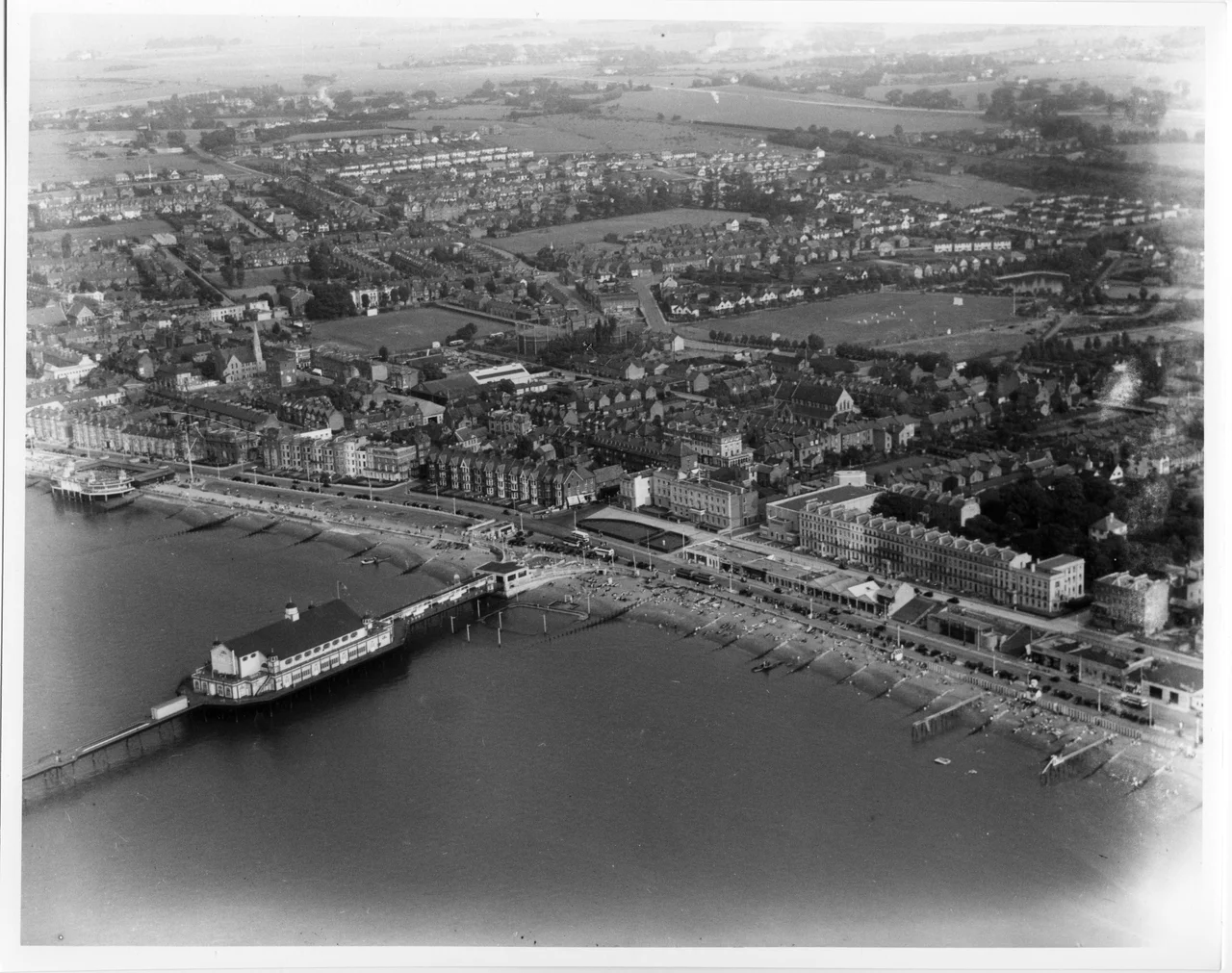

Herne Bay Pier
Look out from Herne Bay's shore at low tide and you see one of the strangest sights on the English coast: an octagonal Victorian pavilion sitting all by itself, half a mile out in the Thames Estuary, with nothing connecting it to land. That isolation is the result of a single violent night - 11 January 1978 - when a North Sea storm surge tore away most of the iron jetty that had once linked pierhead to shore. The army's wartime decision to blow gaps in the structure in 1940, to prevent enemy landings, had weakened the pier in ways that took thirty-eight years to come due. What remained was three things: a pier stub still attached at the landward end, the abandoned pierhead pavilion marooned offshore, and the memory of when this was the third pier built here, and the longest of its kind in the world.
Thomas Telford's Assistant
According to The Illustrated London News, Herne Bay had fewer than a dozen inhabitants at the start of the 19th century. A military encampment changed that. Visitors from passing London-to-Margate steamers began to make shore excursions in small boats called hoys, and decided they wanted a pier and accommodation to extend their stays. A Surrey contractor named George Burge - who had worked for Thomas Telford on St Katharine Docks - led a group of investors. Telford himself was busy building Whitstable harbour a few miles down the coast, but he loaned them his assistant Thomas Rhodes to design the new pier. The first wooden pile was driven on 4 July 1831; the 3,613-foot timber pier was complete by 12 May 1832 at a cost of £50,000 - about £4.6 million today. The steamer Venus was the first to bring passengers in. The pier's length was determined by the one-fathom draught of the paddle steamers and the bewildering shallowness of this part of the estuary: even three-quarters of a mile offshore, the sea is barely two fathoms deep at high tide.
Shipworm and Iron
The wooden piles were never copper-sheathed, which meant shipworm went to work on them almost immediately. By 1850 many had been replaced with iron or treated by Mr Payne's anti-shipworm process. The railway reached Herne Bay in 1861 and the holiday traffic boomed. A new iron pier built alongside the wooden one - the third on the site - opened to the public, and a 1908 upper deck brought a bandstand and shops. Later that same year, on 23 November, a Thames Conservancy ship broke its moorings and smashed through the pier, leaving a hole and £650 of damage. In 1924 the pier got a new electric tramcar, built locally by Strode Engineering Works at Herne. In 1932 the pier approach was rebuilt after a fire had taken Mazzoleni's cafe and the theatre at the entrance. The 1899 octagonal restaurant at the pierhead - wooden, domed, with a promenade deck on its roof - survived all of it. That is the building still standing alone in the water today.
Bailey Bridges and Frozen Sea
During the Second World War the army wrapped the pier in barbed wire. Local women manufactured camouflage netting in the pavilion. In June 1940, fearing German landings, the army blew up two sections between the pavilion and pierhead; Bailey bridges spanned the gaps from the mid-1940s onwards. Paddle steamers were returning to call by 1947. In 1953 the stone balustrade from old London Bridge - set at the pier entrance back in 1833 - was taken down and replaced with railings. The whereabouts of that London Bridge balustrade is now unknown. In January 1963 the sea around the pier froze for weeks, the tide going in and out under a white crust, the curved shapes of frozen sea spray reaching a mile offshore. Rapid thaw stressed the piles. Decades of neglect and the Bailey-bridge sections did the rest. When the storm surge hit on 11 January 1978, the structure could not hold. The jetty went; the pierhead remained, suddenly an island.
Ken Russell's Backdrop
Cultural footprints survive even where the pier itself does not. The director Ken Russell shot the opening sequence of his first feature film, French Dressing (1963), on Herne Bay Pier; the Bailey bridge is visible at the 43-second mark. Russell returned in 2008 to mourn the missing pier. The pier also features in Hugues Burin des Roziers's 1976 film Blue Jeans - Du beurre aux Allemands. The cricketer Godfrey Evans used to box at £2 a bout on the pier until his county side Kent, fearing for his eyesight, ordered him to stop. Pierrot performers gave open-air shows at the end of the pier until 1914. Punch and Judy still play on the beach beside the stub during the annual Herne Bay Festival. The Herne Bay Pier Trust, established in 2008 and described by the National Piers Society as one of the most active in the country, runs retail kiosks along the promenade and dreams of rebuilding the long pier - estimated at £12.5 million back in 2008, more now. In the meantime, the lonely pavilion sits in the sea, propped in 2019 by what fearful surveyors described as a piece of plywood, waiting either for funding or for the next storm.
From the Air
Located at 51.372°N, 1.121°E in central Herne Bay on the north Kent coast. From the air, the most striking feature is the visual gap: a short stub of pier extending from shore, then open water, then the isolated octagonal pavilion roughly half a mile out in the estuary. London Manston Airport (EGMH) is approximately 8 nm east-south-east. The Reculver twin towers stand about 3 nm east, providing a recognisable coastal landmark. Approaches into London City (EGLC) cross the estuary just to the north.
Nearby Stories
- Battle of Maldon 4 km away
- Dover Priory 6 km away
- HMS Hermes (1898) 7.7 km away
- Sissinghurst Castle Garden 9.4 km away
- Priestfield Stadium 11 km away
- Clacton Pier 13 km away
- 1382 Dover Straits Earthquake 19 km away
- Four Days' Battle 46 km away