
Battle of Maldon
We will pay you with spear tips and sword blades. The line is from an Old English poem written within living memory of the events it describes. It is the answer the Essex ealdorman Byrhtnoth gave to a Viking herald who offered, across a tidal causeway on a summer morning in 991, to sail away if he was paid in gold. Byrhtnoth refused. Then, in a decision that has been argued about for a thousand years, he allowed the Viking army to cross the causeway and fight him on level ground. He lost. He died. His body was found afterwards with its head missing, his gold-hilted sword still beside him. The poem about that day, 325 lines long, survives because a clerk transcribed it in 1724, seven years before the manuscript burned in a London library fire.
The Causeway at Northey Island
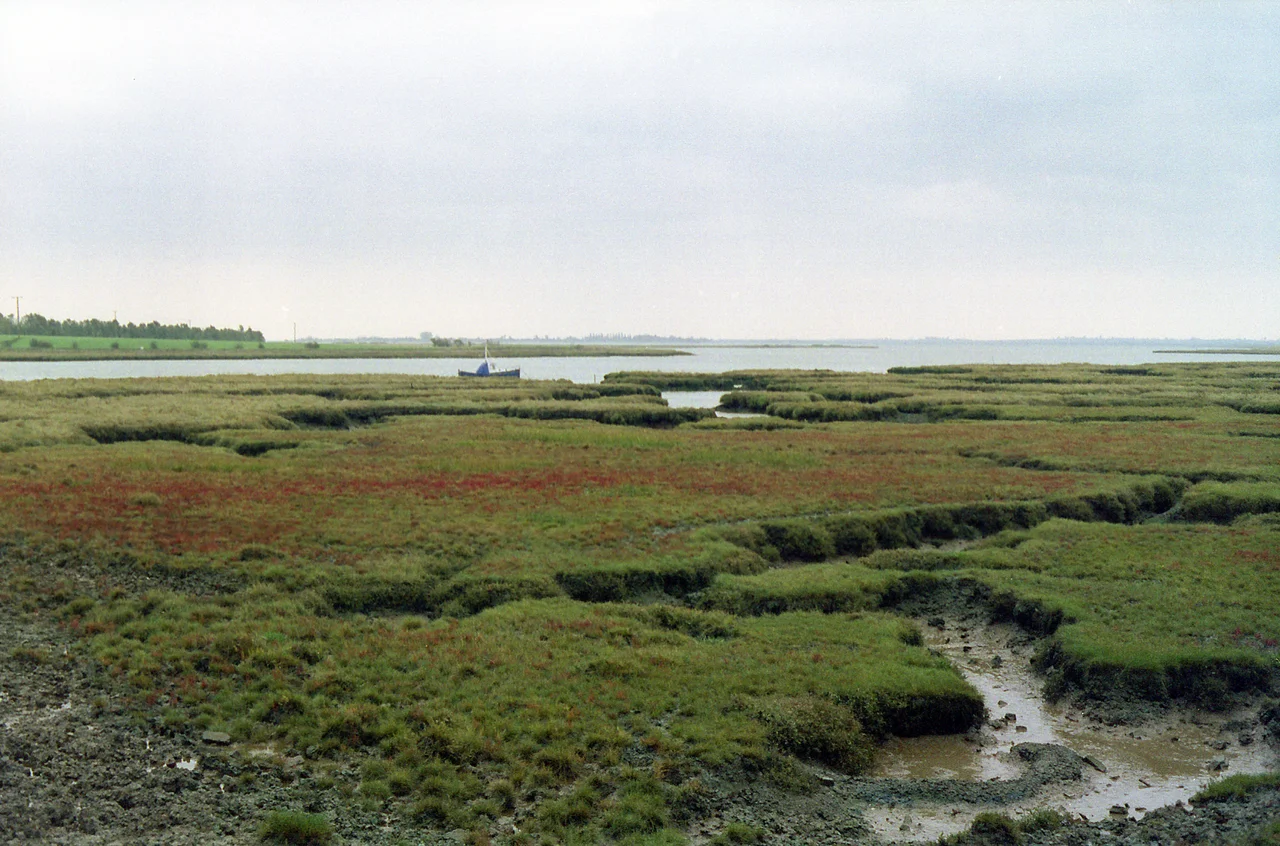
The Vikings sailed up the River Blackwater - then called the Panta - in August 991. They landed on Northey Island, a small tidal island connected to the Essex shore by a causeway that floods at high water and is exposed only at low tide. About two miles southeast of the town of Maldon, an Anglo-Saxon ealdorman named Byrhtnoth was waiting for them with the Essex fyrd - the local militia of farmers and villagers, with his personal household troops at the core. The fyrd had come on horseback but Byrhtnoth ordered them to send their steeds away and stride forward. They fought on foot. Across the water the two sides could shout at each other. The Viking herald called: pay us, and we will go. Byrhtnoth's reply has come down through a millennium: we will pay you with spear tips and sword blades, with the old sword from the morning of the world.
The Bridge and the Three Defenders
When the tide began to ebb, the Vikings tried to cross. Three Anglo-Saxons held the narrow causeway - Wulfstan, Aelfhere and Maccus, named in the poem as the men who blocked the bridge. They held. Any Viking who pressed forward was cut down. The poem describes them in language that echoes the heroic codes of the older Germanic world - men who would die before they let the enemy past. And then Byrhtnoth made the decision that has divided commentators ever since. He let the Vikings cross. The Old English word the poet uses is ofermod - literally 'over-heart,' related to the Danish overmod and German Ubermut, words that mean both 'pride' and 'recklessness.' He allowed the enemy onto the mainland for a formal battle. Why? Some scholars argue it was generosity, the chivalric instinct that the matter must be settled by combat on fair ground. Others - including J. R. R. Tolkien - believed the poem was an elegy that explicitly criticised this as a sinful pride, noting that ofermod is, in every other surviving Old English use, the word for Satan's pride.
The Battle and the Betrayal
Battle was joined on the field beside the causeway. The fighting was savage and the English took heavy casualties before Byrhtnoth himself was struck down. Then came the moment that turned defeat into rout. An Englishman called Godric, who had been given horses many times by Byrhtnoth as gifts, fled the field on his lord's own horse. His brothers Godwine and Godwig followed him. Other English saw the horse, thought their lord must be retreating, and broke and ran. The household troops who remained - the ones who had sworn the old comitatus oath, that they would not leave the battlefield alive if their lord lay dead - fought on, naming themselves in the poem one by one as they prepared to die. They did die. The Vikings cut down what remained of the English line. Byrhtnoth's body was found after the battle. The head had been taken as a trophy. The sword had not.
The Lost Manuscript
The poem we have is not the whole poem. The single medieval manuscript that survived was attached - by lucky binding - to Asser's Life of King Alfred, in the Cotton Library held at Ashburnham House in London. On the night of 23 October 1731, the library caught fire. About a quarter of the Cotton manuscripts were damaged or destroyed. The Maldon manuscript was among the casualties. But seven years earlier, in 1724, the keeper of the collection John Elphinstone (or his assistant David Casley) had copied out the 325 surviving lines of the poem. That transcription, now in the Bodleian Library as MS Rawlinson B. 203, is the only text we have. The original manuscript had been incomplete even when transcribed - an earlier catalogue described it as fragmentum capite et calce mutilatum, 'mutilated at head and heel.' Perhaps fifty lines are missing at each end. We do not know how the poem began. We do not know how it ended.
What Maldon Means
The battle did not stop the Viking raids. If anything, it accelerated them - the English king Aethelred the Unready paid the first organised Danegeld the following year, a precedent that would beggar the kingdom over the next two decades and contribute to the eventual Danish conquest under Cnut. But the poem became something more than a historical document. It became a meditation on courage and pride, on the loyalty that binds men to their lord, on whether honour requires a doomed stand or merely a sensible one. Tolkien wrote his own short verse drama, The Homecoming of Beorhtnoth Beorhthelm's Son, in 1953 as a response to it. A modern statue of Byrhtnoth by John Doubleday stands in Maldon today, his sword raised. The causeway to Northey Island still floods twice a day. The tide does what the Vikings depended on it to do. And across the water you can almost hear, in the right light, three Saxons telling each other not to step back.
From the Air
The site of the Battle of Maldon is at 51.7153 degrees North, 0.7008 East, on the mainland shore opposite Northey Island in the Blackwater Estuary, about two miles southeast of the town of Maldon in central Essex. Best viewed at 1,500 to 2,500 feet. From the air the topography is striking - Northey Island is a small triangular tidal island linked to the shore by a thin causeway visible at low water, with broad mudflats and saltmarsh on either side. London Southend (EGMC) lies about 13 nautical miles south-southwest; Earls Colne (EGSR) sits 12 nm north. The Blackwater Estuary itself is a wide, sinuous tidal feature that dominates this corner of Essex.
Nearby Stories
- 1996 Docklands Bombing 1.3 km away
- St Osyth's Priory 3.8 km away
- Cooling Castle 5.4 km away
- Clare Priory 6.1 km away
- Ipswich Museum 7.3 km away
- Waltham Abbey Royal Gunpowder Mills 8.3 km away
- Herne Bay Pier 15 km away
- Bourn Windmill 20 km away