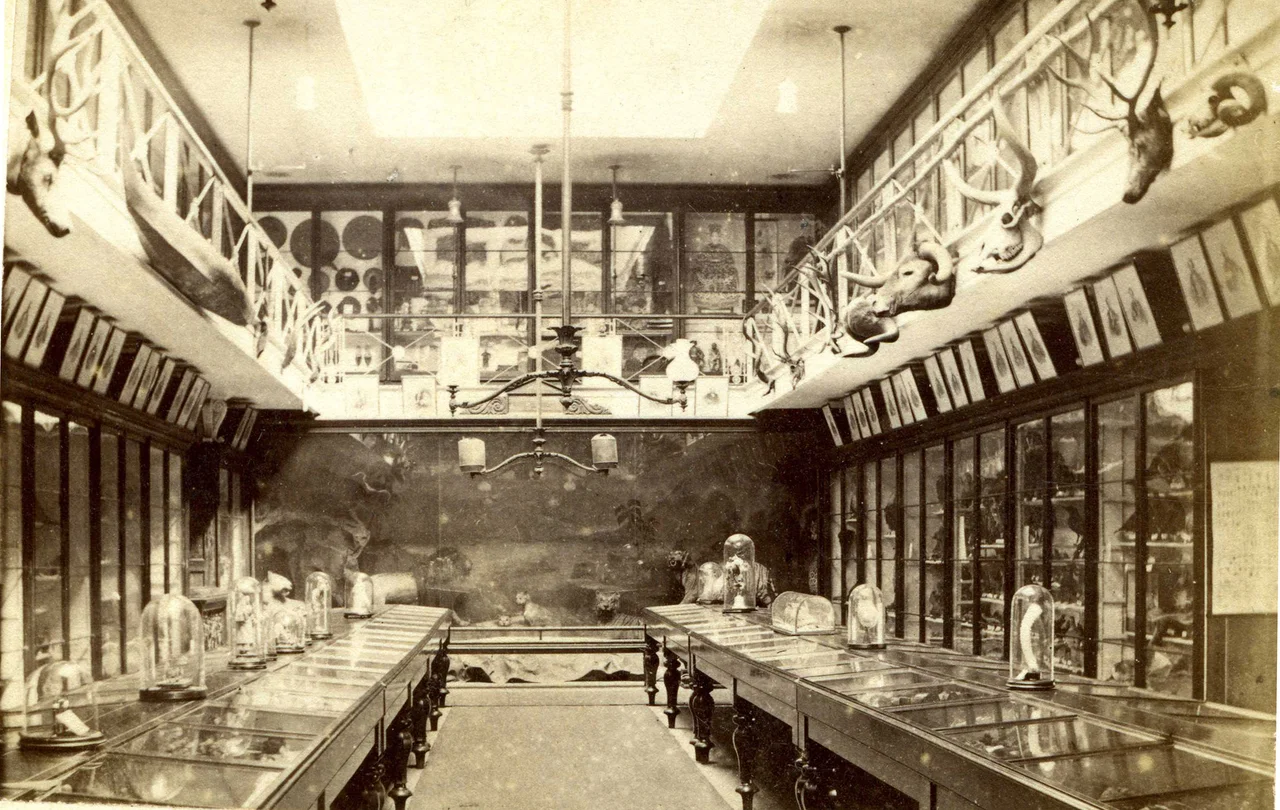

Ipswich Museum
Charles Darwin's mentor came to Ipswich to run a museum. Then Prince Albert dropped in. Then the man who would eventually unearth the Sutton Hoo ship was hired as a field archaeologist. Ipswich Museum, which opened in a newly laid street in December 1847, has a habit of being at the center of things much larger than itself — and doing so while explicitly dedicated to educating the working classes in natural history. That was its founding purpose. That radical intent, in the mid-Victorian age, shaped everything that followed.
A Museum Built for Everyone
The original impetus came from George Ransome of the Quaker engineering family, whose firm had helped build Ipswich's industrial prosperity. He gathered a coalition that crossed every political line — over sixty leading scientists became honorary members or vice-presidents. From the start, the museum was not for the wealthy alone. Open evenings welcomed the general public. The first president was the entomologist William Kirby, an original Fellow of the Linnean Society. But it was the second president, the Reverend Professor John Stevens Henslow, who gave the museum national standing. Henslow had been Darwin's mentor at Cambridge, and the natural history displays he oversaw — set up in the years just before the publication of The Origin of Species — were meant to show the natural kingdom as it was understood on the eve of revolution. Many of the honorary members who attended Ipswich functions were the very people at the center of that revolution: William Jackson Hooker, William Yarrell, John Gould. In 1851, Prince Albert himself visited and became the museum's official Patron. The working-class natural history museum of Ipswich had, somehow, become one of the most intellectually connected institutions in Britain.
Rescued by a Vote
Financial collapse nearly ended it all in 1852. Rather than let the museum die, the town held a referendum — and voted overwhelmingly to support it through a public rate, under the provisions of the Public Libraries Act 1850. The collections transferred to the Corporation. Henslow stayed on as president until his death in 1861, just after presiding over the great Oxford confrontation between Bishop Samuel Wilberforce and Thomas Huxley on evolution. His successor, curator Dr. John Ellor Taylor, proved equally remarkable: a botanist, geologist, and editor of the national science journal Hardwicke's Science Gossip Magazine, he gave free lectures to audiences of up to 500 working people, twenty lectures each season for two decades. Taylor also built what one expert considered the finest representative collection of local geology in the country. The museum outgrew itself, and by 1881 a new building on High Street opened — its principal sponsor was Sir Richard Wallace of Sudbourne Hall, whose own art collection filled Hertford House in London. The original 1847 building became a dance hall. It is now a brasserie.
The Man Who Found the Ship
The museum's most consequential chapter came quietly, through an employment arrangement. After 1934, the museum sent its field archaeologist, Basil Brown, to investigate Roman sites across Suffolk. Brown was self-taught — not the sort of man the academic establishment typically celebrated. In 1938, the landowner Edith Pretty asked through the museum for Brown's help excavating burial mounds on her estate at Sutton Hoo. He worked with her gardener, gamekeeper, and one other estate hand. In May 1939, three days into digging Mound 1, he found an iron rivet. Then another. Within hours the scale of it became clear: a ship, buried intact in the earth. When Cambridge archaeologist Charles Phillips arrived and saw what Brown had found, the national institutions moved in rapidly. The Ipswich Museum — which had released Brown for the job and guided the early excavations — was later squeezed out of the story as national interests took over. But Brown was the museum's man, and the discovery was his. The 2021 Netflix film The Dig, which follows that story, made it known to a new generation.
Closed, Refurbishing, Returning
The Grade II* listed Victorian building on High Street closed in October 2022 for what was initially projected as a three-year refurbishment. The budget has grown from an original £8.7 million to £12.3 million, with a reopening now planned for early 2027. The Victorian Society raised concerns early on about proposed interior changes, and the museum has since reassured conservationists that the Natural History Gallery's Victorian ambiance will be preserved. Meanwhile, the companion institution at Christchurch Mansion — the Tudor house given to the town by Felix Cobbold in 1895 — continues to display fine and decorative arts. Both sites are now managed under Colchester + Ipswich Museums, a joint service formed in 2007. The building and its collections remain Ipswich's own. The museum has belonged to the town since a public vote in 1853, and that has not changed.
From the Air
Located at 52.06°N, 1.15°E in the center of Ipswich, Suffolk. From the air, look for the River Orwell to the south and the distinctive grid of the town center. Norwich Airport (EGSH) is approximately 40 miles north-northeast; London Stansted (EGSS) is around 55 miles southwest. At altitude, Ipswich appears as a compact port town set at the head of the Orwell estuary, with the docks visible to the south and the Victorian museum building on the High Street below.
Nearby Stories
- Walton-on-the-Naze 2.7 km away
- Clare, Suffolk 9.5 km away
- RAF Lakenheath 10 km away
- RAF Hardwick 11 km away
- Beeleigh Abbey 13 km away
- Four Days' Battle 45 km away
- Southern Bight 75 km away
- Battle of Lowestoft 79 km away