
RAF Hardwick
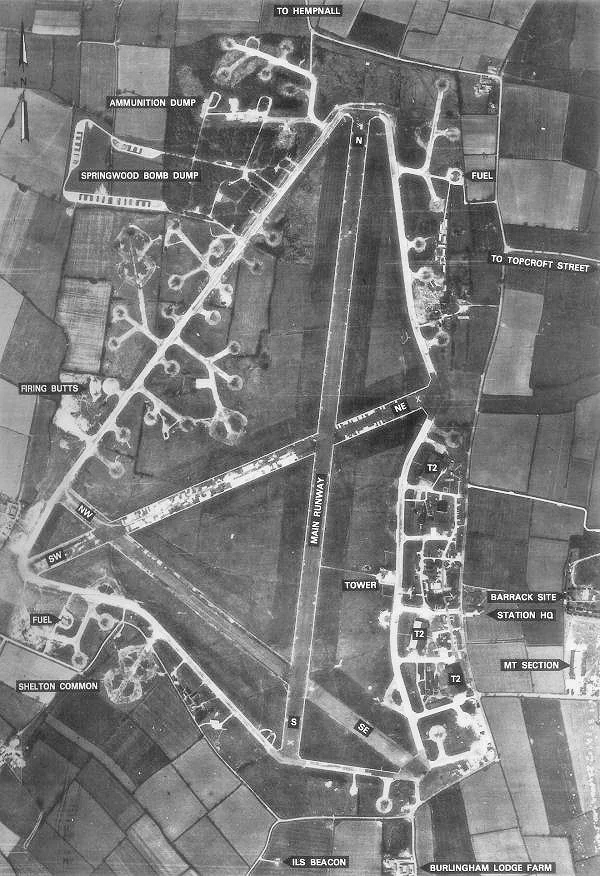
Four million seven hundred and fifty thousand bricks. That is what John Laing and Son Limited needed to build RAF Hardwick. Add 4 miles of surface drains, 13 miles of underground drains, 13 miles of internal roadways, 5 miles of sewers, and 7 miles of water mains. Then, on top of all of that, set down three concrete runways, three T-2 hangars on the eastern side, fifty hardstands rather than the thirty originally planned, and a sprawling camp scattered through the surrounding woodland in temporary Nissen huts. RAF Hardwick became Station 104 of the United States Army Air Forces in 1942, and from 7 November 1943 through 12 June 1945 it was the headquarters of the 20th Combat Bombardment Wing of the 2nd Bomb Division. Two of its airmen received Medals of Honor for the same mission. Most of the bricks are gone now.
First Tenants, Brief Stay
The airfield opened in September 1942 and the first Americans to use it were the 310th Bombardment Group (Medium), arriving from Greenville Army Air Base in South Carolina. They flew the North American B-25 Mitchell, the twin-engine medium bomber, and Hardwick was for them only a transit point. They were the first 12th Air Force group to leave the United States for Europe, but their final destination was Telergma, Algeria, where they would fight in the North African campaign rather than from England. The last 310th elements departed for North Africa in November 1942, leaving the brand-new airfield empty for its second, larger tenant.
Circle B Liberators
The VIII Bomber Command 93rd Bombardment Group (Heavy) flew its Consolidated B-24 Liberators in from RAF Alconbury in December 1942 and stayed for the rest of the war. Their tail code was a Circle B; their squadrons were the 328th, 329th, 330th, and 409th Bombardment Squadrons. The 93rd had entered combat on 9 October 1942, attacking steel works at Lille, France. From late 1942 they operated primarily against German submarine pens in the Bay of Biscay. By any standard, they became one of the most-traveled groups in the Eighth Air Force: detachments rotated repeatedly to North Africa, the Mediterranean, and back, helping with Operation Torch logistics, the invasion of Sicily, the Italian campaign, and the daylight strategic bombing of Germany.
Ploesti and Two Medals of Honor
On 1 August 1943, the 93rd was part of Operation Tidal Wave, the low-level attack on the Romanian oil refineries at Ploesti. The mission was famous and disastrous. Lieutenant Colonel Addison E. Baker, the group commander, and Major John L. Jerstad, a former 93rd man who had volunteered to come along for this raid, flew as pilot and co-pilot of the lead plane. Their B-24 was hit hard before it reached the target. They could have crash-landed and possibly saved themselves. Instead they led the group through the bomb run, putting their bombs on the oil installations before their burning aircraft crashed in the target area. Both men were posthumously awarded the Medal of Honor. The group received a Distinguished Unit Citation for the Ploesti raid, having followed another formation along the wrong course and accidentally hit targets assigned to other groups.
Salerno, Cherbourg, the Bulge
The 93rd's combat record reads like a tour of the war's geography. After Ploesti, detachments returned to the Mediterranean to support the Fifth Army at Salerno during the invasion of Italy in September 1943. The group rejoined for strategic bombing of German marshalling yards, aircraft factories, oil refineries, chemical plants, and cities. On D-Day, 6 June 1944, they bombed gun emplacements and bridges near Cherbourg. They supported the Saint-Lo breakthrough, dropped supplies during Operation Market Garden in September 1944, hit transportation networks during the Battle of the Bulge, and on 24 March 1945 flew two missions during the airborne crossing of the Rhine, dropping supplies near Wesel and bombing a night-fighter base at Stormede. Combat operations ceased in April 1945. The group returned to Sioux Falls Army Airfield during May and June.
Joint STARS Descendant
The 93rd had an unusual postwar career. Redesignated very heavy in July 1945, converted to B-29 Superfortresses, and assigned to Pratt Army Airfield in Kansas for the planned invasion of Japan, the group instead went to Clovis Army Airfield in New Mexico after V-J Day and was assigned to Strategic Air Command. As the 93rd Bomb Wing it was a front-line SAC unit through the Cold War until deactivation on 30 September 1995. Today the lineage continues as the 116th Air Control Wing at Robins Air Force Base, Georgia, the first United States Air Force wing blended from active duty and Air National Guard airmen, flying Northrop Grumman E-8 Joint STARS battlefield surveillance aircraft. Hardwick itself was closed in 1962. Most of the runways went for aggregate. A small private museum on Airfield Farm now contains memorabilia, 93rd Bomb Group artifacts, and items recovered by the East Anglian Aircraft Research Group.
From the Air
RAF Hardwick sits at 52.4706 degrees north, 1.31139 degrees east, between the Norfolk villages of Topcroft and Hardwick, about 5 miles west of Bungay in Suffolk. Nearby aviation: the Norfolk and Suffolk Aviation Museum at Flixton is 7 nautical miles east; Norwich Airport (EGSH) is 13 nautical miles north; Beccles Airfield (EGSM) lies 11 nautical miles east. Recommended viewing altitude is 2,500 to 4,000 feet AGL to identify the surviving runway segment, the Nissen huts on the dispersed sites east of the airfield, and the Airfield Farm museum location.
Nearby Stories
- Weeting Castle 5.9 km away
- RAF Debach 8 km away
- RAF Coltishall 8.8 km away
- Houghton Hall 11 km away
- Clare, Suffolk 16 km away
- Four Days' Battle 65 km away
- Battle of Lowestoft 79 km away
- SM U-97 121 km away