
RAF Debach
On 6 June 1944, while the first waves of Allied troops were wading ashore on the Normandy beaches, the men of the 493rd Bombardment Group flew their first combat mission from a Suffolk airfield that had only become operational the day before. RAF Debach was the last of the great Eighth Air Force heavy bomber stations to open - the last in a building programme that had paved East Anglia with concrete since 1942. The 820th Engineer Battalion of the US Army had been pouring runways here through 1943 and into 1944, racing to finish in time for the invasion. They made it. What they did not make were runways that would survive the winter.
Built In Time, Built Too Fast
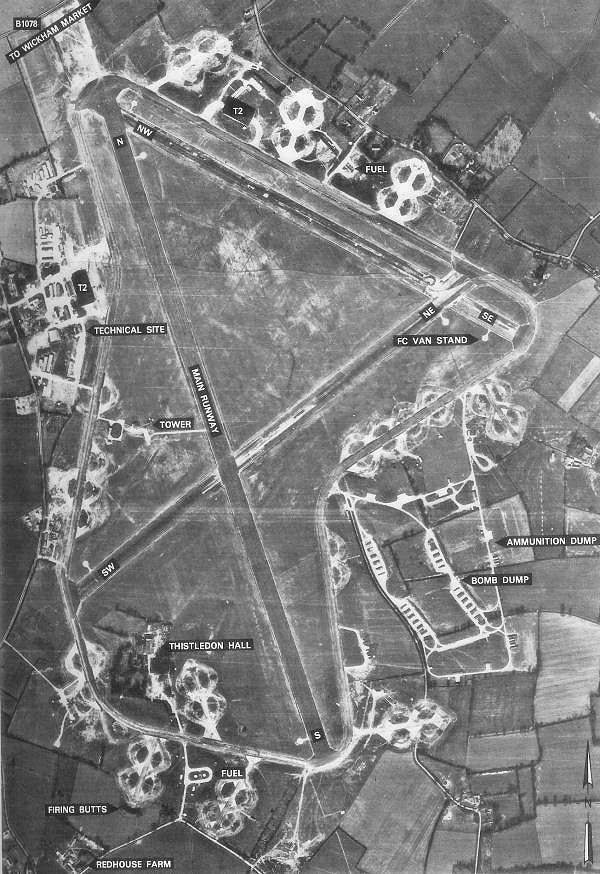
Debach sits three miles north-west of Woodbridge, on flat Suffolk farmland chosen for its proximity to the Channel and its lack of natural obstacles. The 820th Engineers laid out a standard Class A bomber field - three intersecting runways, fifty hardstandings, two T2 hangars, an enormous bomb dump cut into the woods. Their priority was speed. By April 1944 the station was officially open, designated USAAF Station 152, and the 493rd Bombardment Group was on its way from Elveden Hall. The group flew Consolidated B-24 Liberators initially, marked with a Square-X tail code, and operated as part of the 93rd Combat Bombardment Wing. Four squadrons made up the group: the 860th, 861st, 862nd and 863rd Bombardment Squadrons. By the end of 1944, the runways the 820th had poured in such a hurry were breaking apart under the weight of fully loaded B-24s and B-17s. The concrete simply could not take it. The whole group had to relocate temporarily to RAF Little Walden while the runways were dug up and rebuilt. They came back in March 1945.
The Targets, Named
The 493rd's mission list reads like an atlas of the final year of war in Europe. An ordnance depot at Magdeburg. Marshalling yards at Cologne. Synthetic oil plants at Merseburg - one of the most heavily defended targets in the German air defence zone, where Luftwaffe fighters and 88mm batteries took terrible tolls. A railroad tunnel at Ahrweiler. The factories of Frankfurt. Bridges at Irlich. On 25 September 1944, the group bombed Strasbourg, with damage extending into the historic city centre - the kind of mission that won the war and that nobody who flew it talked about easily afterwards. In September 1944, the group converted from B-24 Liberators to B-17 Flying Fortresses, simplifying maintenance and accepting the slower bomber's better high-altitude defensive characteristics. They supported the Normandy breakout in July, the airborne attack on the Netherlands in September, the Battle of the Bulge in December and January, and the Rhine crossing in March 1945. Their final combat mission was a strike against marshalling yards at Nauen on 20 April 1945 - eighteen days before the German surrender.
After the Last Mission
When the war ended, the airfield's purpose ended with it. The 493rd flew home to Sioux Falls Army Air Field in South Dakota and was inactivated on 28 August 1945. Debach itself was used briefly as a prisoner-of-war camp for German PoWs, and then for displaced persons - the millions of Europeans uprooted by the war and waiting for somewhere to go - before being abandoned around 1948. The land was sold in 1963 and 1964, with the main north-south runway forming the boundary between two adjoining farms. The northern end was sold in 1969 for a mushroom farm. Much of the concrete was ground up for aggregate and used to surface other roads. One of the T2 hangars became a grain store. The other was dismantled - and during that work, in a quiet accident on a quiet farm, one man was killed.
What Remains Above the Stubble
The western side of the airfield kept its character. The control tower still stands, and has been completely restored. Around it, a cluster of surviving wartime buildings now serves as the 493rd Bomb Group Museum, run by volunteers who collect and display the photographs, log books, uniforms and crew artefacts left behind by the men who flew from here. The aim is simple: that the names of the 493rd's dead remain attached to specific aircraft, specific missions, specific Suffolk hardstandings, rather than dissolving into the larger statistics of the Eighth Air Force's terrible losses. Power-line pylons now stride across the southern edge of the field, carrying current to East Anglian villages. The runways beneath them are still legible from the air - long ghost-strips of pale concrete crossing the green farmland, marking out where eighteen-year-old waist gunners once climbed into B-17s for missions they did not expect to survive.
From the Air
RAF Debach lies at 52.14 degrees north, 1.27 degrees east, three miles north-west of Woodbridge in central Suffolk. The wartime runway pattern - a triangular layout typical of Class A bomber fields - is still partly legible from the air against the surrounding agricultural fields. The control tower and museum sit on the western edge. Recommended viewing altitude is 1,500-2,500 feet. The River Deben curves south through Woodbridge and provides the main natural reference. The nearest active airfield is RAF Wattisham (EGUW) to the west. RAF Bentwaters and RAF Woodbridge to the east - both Cold War USAF bases, both now closed - share the same flat coastal geography. North Sea weather brings rapid visibility changes; mornings are clearer than afternoons.
Nearby Stories
- Walton-on-the-Naze 2.7 km away
- Clare, Suffolk 9.5 km away
- RAF Lakenheath 10 km away
- RAF Hardwick 11 km away
- Beeleigh Abbey 13 km away
- Four Days' Battle 45 km away
- Southern Bight 75 km away
- Battle of Lowestoft 79 km away