
Walton-on-the-Naze
There is a Latin inscription on a Canon's stall in St Paul's Cathedral that reads Consumpta per Mare - consumed by the sea. It commemorates a parish church that fell into the North Sea on the night of 22 July 1798. A Sunday service had been held there earlier that day. The medieval village of Walton-on-the-Naze, which once stood miles inland, is now entirely underwater. The North Sea here advances at roughly two metres per year. The pillboxes that defended the cliffs in 1940 now sit on the beach below them, like teeth that have fallen out of a giant's mouth.
Naze, Tower, Erosion
The name Naze comes from Old English naess, meaning a headland or ness. The Hanoverian-era Naze Tower at the cliff edge was built as a sea mark to help ships navigate this otherwise featureless coast. During the Second World War the headland became a radar station, with some aerials mounted on the tower itself. Today the tower is privately owned, open to visitors, and threatened. The cliff is receding so quickly that within fifty years the structure may follow the medieval church into the sea. The Naze Protection Society fights for sea walls, riprap, groynes, and millions of tons of imported sand. The cliff edge moves anyway.
Two Million Years on the Beach
The cliffs are a Site of Special Scientific Interest. The base is London Clay, 54 million years old. The top is sandy Red Crag, 2 million years old. The London Clay yields pyritized fossil wood and, unusually, fossil bird bones - in 1998 David Attenborough estimated over 600 bird specimens had been found here. The Red Crag offers bivalves, gastropod shells, sharks' teeth, and whale bones. Children with plastic buckets routinely pocket fossils older than the human species. Then the tide comes in, the cliff slumps another foot, and tomorrow the beach has new specimens.
Two Piers, Both Lost
The first Walton pier was built in 1830, one of the earliest in Britain, a 150-foot wooden landing stage for goods and passengers from steamers. It was lengthened to 330 feet in 1848. A storm in January 1880 destroyed it. The second pier opened in 1880 and also failed to last. The current pier dates from the early 20th century, was bought in 1937 by Charles Goss who formed the New Walton Pier Company, and underwent a major revamp in 2022. The Walton and Frinton lifeboat has been moored off the pier since 1900. Bird-watchers, not bathers, are now the steadiest visitors - the marshes of Hamford Water behind the town host wintering ducks and Brent geese, and the Naze itself is a key stop on the migration flyway.
Fiction, Pop, Top Gear
Walton has accumulated a strangely wide cultural footprint for a town of under 7,000 people. Arthur Ransome set Secret Water, his Swallows and Amazons novel, in the maze of creeks around Hamford Water. Blackadder Goes Forth has Captain Blackadder mock Lieutenant George's family with the line about a Walton uncle constantly trying to swallow a ballcock. Blur's Tracy Jacks takes the first train to Walton and stands on the seafront. The first Stig, killed off when his Jaguar drove off an aircraft carrier in 2003, was revealed in 2009 to have actually washed ashore on Walton's central beach and run off down the pier. Assassin's Creed Valhalla puts Port Walton in Saxon Essex, and Eivor raids it. Elizabeth George renamed it Balford-le-Nez for her novel Deception on His Mind. The town shows up in EastEnders and Call the Midwife. The seafront has a way of sticking in writers' minds.
The View from the Sky
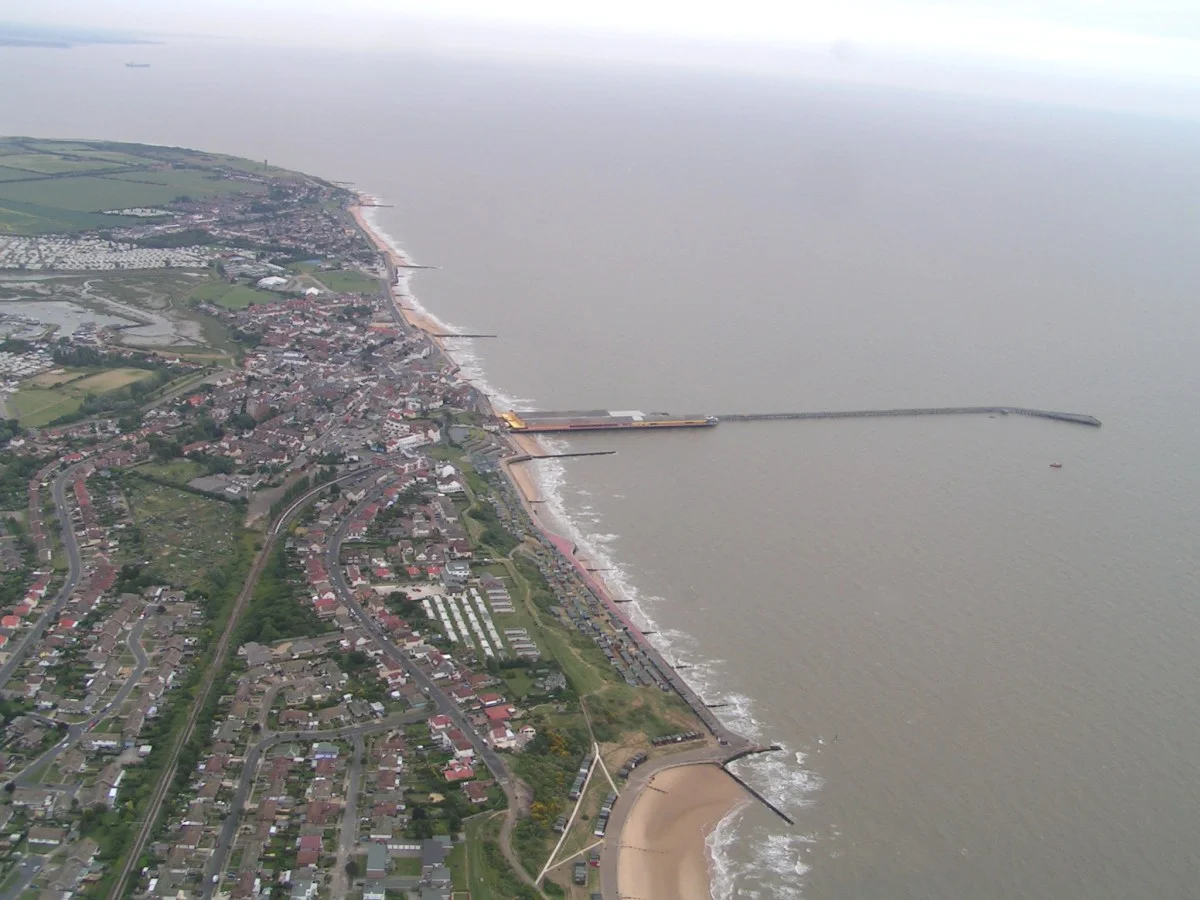
From altitude, Walton-on-the-Naze is the distinctive squared-off headland between Hamford Water and the open sea, the last hard land before Suffolk. The pier extends prominently south. The Naze Tower is a small white needle on the cliff edge. Below the cliffs, geometric groynes reach out into the water trying to slow the sea's advance. The salt marshes behind the town are an intricate filigree of channels that fill and empty twice a day. Frinton-on-Sea, with its famous reluctance to permit pubs, lies immediately south. Harwich and the container ships of Felixstowe are visible across the water to the north. The whole coast is the same story - sea and clay in a slow, lopsided fight.
From the Air
Walton-on-the-Naze sits at 51.85 N, 1.27 E on the Essex North Sea coast, with The Naze headland forming a distinctive squared promontory between Hamford Water (south) and the Stour estuary (north). From altitude, look for the white Naze Tower on the cliff edge and the long pier extending south. Nearest airports: Stansted (EGSS) 50 miles west, Cambridge (EGSC) 65 miles west, Southend (EGMC) 35 miles south. The Walton-on-the-Naze railway terminus and pier are both visible. Watch coastal erosion progress year to year.
Nearby Stories
- Ipswich Transport Museum 2.5 km away
- Beeleigh Abbey 4.3 km away
- Clare Priory 9.7 km away
- Cooling Castle 14 km away
- Margate Surfboat 15 km away
- 1382 Dover Straits Earthquake 25 km away
- Four Days' Battle 44 km away
- Southern Bight 75 km away