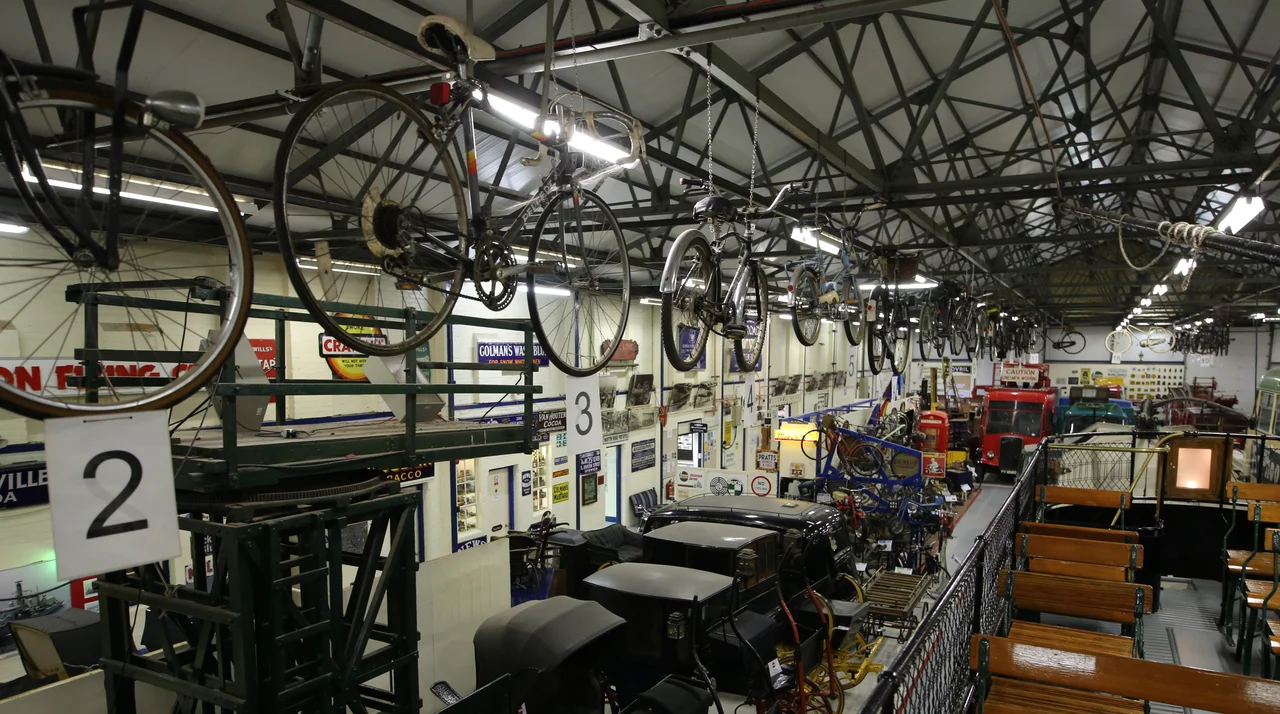

Ipswich Transport Museum
It started with one bus. In 1965, a group called the Ipswich Transport Preservation Group rescued a single Eastern Counties Dennis Ace and decided it was worth saving. Sixty years later, their collection has grown to more than a hundred large objects — trams, trolleybuses, double-deckers, fire engines, horse-drawn vans, electric milk floats, and a funeral hearse — housed in the old Priory Heath trolleybus depot on Cobham Road, which the museum has occupied since 1988. It has been open to the public since 1995. What began as a rescue operation became one of the most comprehensive transport collections in England.
Machines with Second Lives
The collection's most striking quality is not its size but its provenance. These are not pristine showroom pieces. They are vehicles with histories — often strange ones. The 1923 railless trolleybus, Ipswich Corporation No. 2, was withdrawn from service in 1934 and spent its subsequent years as a caravan at Flatford. The museum acquired it in 1977. A 1926 Ransomes, Sims & Jefferies trolleybus, Ipswich Corporation No. 9, was rebuilt in the 1930s, withdrawn in October 1949, and then incorporated into a house at Theberton until the museum claimed it in 1972. The 1933 Ransomes double-decker served as a caravan at Needham Market after its 1951 withdrawal. Each of these vehicles lived a second life — domestic, provincial, improbable — before ending up under the museum's care, where volunteers have spent years and considerable sums restoring them to operational status.
The Horse Tram That Traveled England
Among the highlights of the collection is a horse tram built in 1880 for the Bath Tramways — a gauge that would not last. The patent cable corporation took over in 1884, then sold again; the tram was converted and passed to Bradford and Shelf Tramways, where steam locomotives hauled it until that system closed in 1903. At some point it migrated to Cambridge Street Tramways, probably in 1894, became car No. 7, and was sold at auction when that system closed in 1914. It became a shed. In 1988 it was found in Ely, its lower deck serving as a cobbler's workshop. The museum obtained it before it could be demolished. A seven-year restoration project began in 2012, assisted by a £49,000 grant from the Heritage Lottery Fund. Removing the toplight windows revealed handwriting inside confirming the original Bath manufacture. The upper deck — added at Bradford in the 1880s — had to be largely recreated. The tram is now restored in the livery of Cambridge Street Tramways No. 7.
Ransomes and the Engineering Heritage
Ipswich was a manufacturing town, and the museum reflects that identity. Ransomes, Sims & Jefferies — the engineering firm that helped define Ipswich's industrial character — is represented throughout the collection. Their trolleybuses, a crawler tractor, an electric dustcart originally hired by Birmingham City Council in 1915, and various agricultural machines all appear. The museum also houses the Ipswich Engineering Collection, with items from Ransomes & Rapier, Cranes, Reavell, and Cocksedge. Cranes, fork lift trucks, and lawnmowers share space with the buses and trams. This is not incidental. The Ransome family funded Ipswich's first natural history museum. Their machinery shaped how the town worked. Having that machinery preserved a short distance from the museum they helped to found gives the collection a layered coherence that goes beyond transportation.
Where the Vehicles Go After
The museum is a registered charity, open Sundays from April to November and on weekday afternoons during school holidays. Each year in early May, it organizes the Ipswich to Felixstowe Run, sending vintage vehicles from Christchurch Park to the promenade at Felixstowe — a public demonstration of the collection in motion. The restoration work continues year-round in the workshop, staffed almost entirely by volunteers. A Co-op horse-drawn bread van was completed around 2018. A 1939 Dennis Ace bus and a 1965 Scammell Scarab mechanical horse were in progress at the same time. In 2018, a £7,000 grant from the Association of Industrial Archaeology enabled work to begin on a Co-op battery-electric coal truck, with new batteries and refurbished motor equipment. The work is slow, meticulous, and sustained by genuine enthusiasm for the machines themselves and for what they meant to the people of Ipswich.
From the Air
Located at 52.04°N, 1.20°E in the Priory Heath area of south Ipswich, in the Cobham Road industrial district. From the air, the former trolleybus depot is visible southeast of the town center. The River Orwell docks are approximately 1.5 miles to the south. Norwich Airport (EGSH) lies around 40 miles to the north-northeast. The museum is not visible from altitude but the surrounding industrial estate provides a useful landmark.
Nearby Stories
- Walton-on-the-Naze 2.7 km away
- Clare, Suffolk 9.5 km away
- RAF Lakenheath 10 km away
- RAF Hardwick 11 km away
- Beeleigh Abbey 13 km away
- Four Days' Battle 45 km away
- Southern Bight 75 km away
- Battle of Lowestoft 79 km away