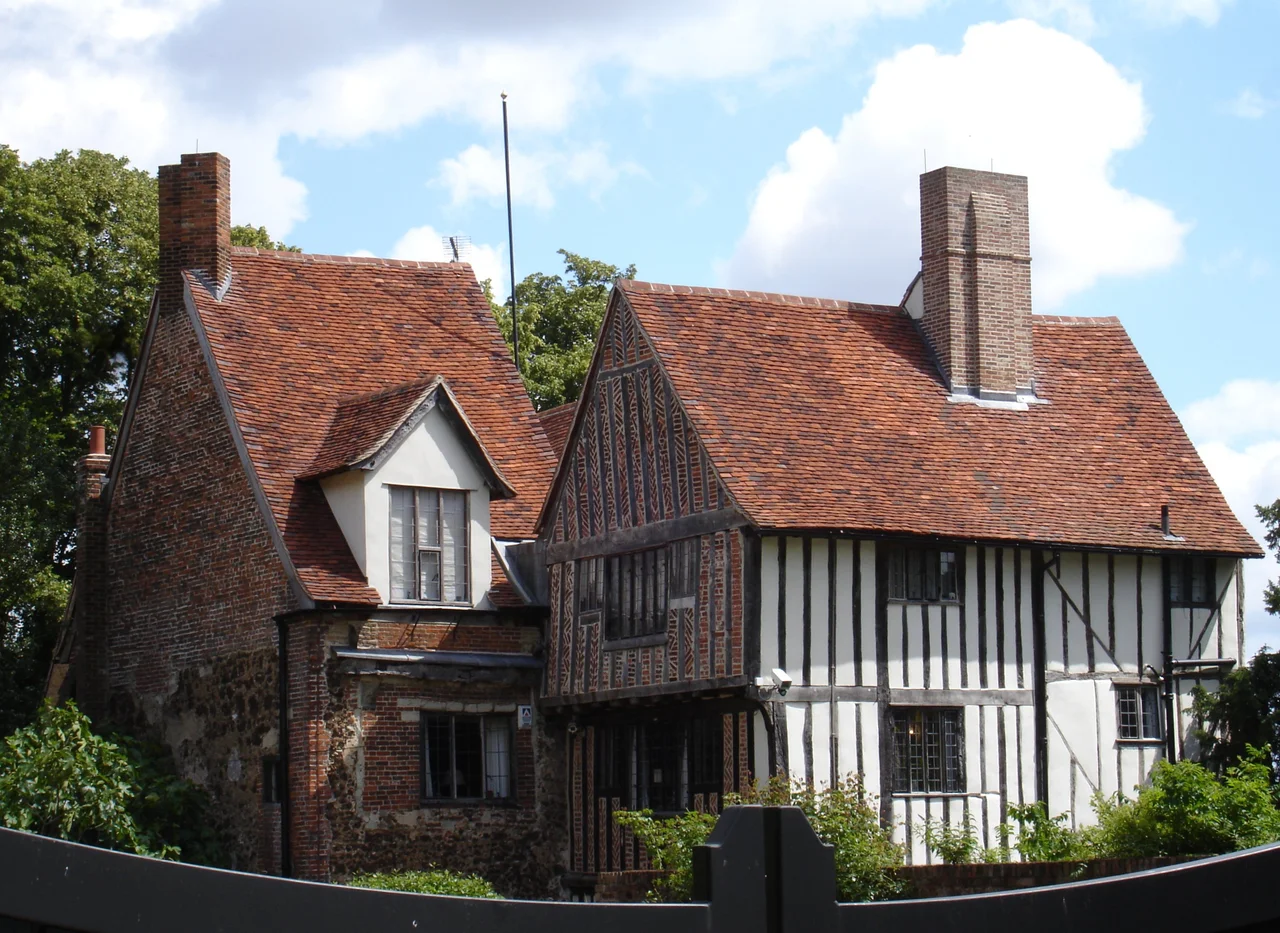

Beeleigh Abbey
In 1289, King Edward I and Queen Eleanor of Castile knelt beside the River Chelmer to venerate a heart. It belonged to Roger Niger, a former Bishop of London who had died half a century earlier, and the monks of Beeleigh Abbey had enshrined the relic in their church. Royalty came on pilgrimage. So did ordinary people seeking miracles. Today the abbey is a private home owned by the family that built the famous Foyles bookshop on London's Charing Cross Road, and most visitors only glimpse the medieval roofs from a footpath that follows the river through the Essex marshes.
White Canons on the Chelmer
The Premonstratensians arrived at Beeleigh in 1180, sent from Newsham Abbey in Lincolnshire at the request of Robert de Mantell, the local lord. They were the new model of monastic life - canons rather than monks, walking the line between cloistered prayer and active ministry, wearing white habits that earned them the nickname White Canons. Richard the Lionheart granted them a royal charter in 1189, two years before he left to fight in the Third Crusade. The abbey settled into the rhythms of the Chelmer valley, draining the marshes, growing what the soil allowed, and praying the canonical hours within stone walls raised from local rubble and flint. For three and a half centuries, this was their world.
The Bishop's Heart
Roger Niger had been Bishop of London from 1229 until his death in 1241. In the medieval imagination, a saintly heart was a portable piece of heaven - and when Roger's heart was buried at Beeleigh, the abbey acquired something more valuable than land or charters. Pilgrims came. They left offerings. The shrine grew, until in 1289 it drew the king and queen of England themselves. Eleanor of Castile would die the next year on a journey north, prompting her grieving husband to mark her funeral route with the famous Eleanor Crosses. For one summer day, though, she stood here at the river's edge with Edward, doing what countless humbler pilgrims also did - asking a dead bishop to intercede with God.
What Henry's Men Took Down
The Dissolution arrived in 1536. Beeleigh was suppressed; its canons scattered; its lead and bells carted off as crown property. In 1540 Henry VIII granted the lands to Sir John Gate, Chancellor of the Duchy of Lancaster, and over the next century most of the great church and cloister came down for building stone. What survived was the southeast corner - the chapter house, the dormitory range, the warming room - retained as the core of a working farmhouse. Stones that had heard plainchant now sheltered cattle and grain. By the late 18th century the building was operating as a public house. By the 1890s it was nearly derelict, slumping into the Essex earth that had cradled it for seven hundred years.
The Bookseller's Restoration
In 1943, with London being bombed and the future of England uncertain, William Foyle - founder of the famous bookshop on Charing Cross Road - bought Beeleigh Abbey. He filled it with rare books. His daughter Christina inherited it on his death and lived there until 1999. The following August, William's grandson Christopher Foyle and his wife Catherine bought the abbey and its 400-acre estate from Christina's executors and began a four-year restoration. In 2008 the Royal Institution of Chartered Surveyors named the project Britain's best restored historical building. The same year, the Premonstratensians returned to Essex after a 472-year absence, establishing a house at St Philip's Priory in nearby Chelmsford. In 2011 Father Hugh Allan was made the first Titular Abbot of Beeleigh since 1536.
What the Footpath Sees
Among those buried within the abbey are Isabel of Cambridge, Countess of Essex, and Henry Bourchier, the 1st Earl of Essex - York supporters whose tombs survived even as the walls around them came down. An archaeological investigation from 2000 to 2006 found pottery shards from the 12th to the 16th centuries, jetons used for medieval accounting, and a seal matrix bearing the abbey's own mark. Nothing dated to the original 1180 construction was recovered. The abbey remains a private home, opened occasionally for garden visitors in summer. From the footpath that descends Market Hill in Maldon and follows the Chelmer west, you can see the medieval roofs above the trees - tile and timber where the great church once stood, the smallest fragment of what Edward and Eleanor came to see.
From the Air
Beeleigh Abbey sits at 51.74°N, 0.66°E on the north bank of the River Chelmer just west of Maldon, Essex. Recommended viewing altitude is 2,000-3,000 feet, low enough to pick out the medieval roofs amid the riverside trees. Look for the broad tidal Blackwater estuary opening east toward the North Sea, with Maldon's church spire as the local landmark. Nearest airports: London Stansted (EGSS) about 25 nm northwest, London Southend (EGMC) 14 nm south. The Essex coast is busy with general aviation; expect controlled airspace overhead.
Nearby Stories
- 1996 Docklands Bombing 1.3 km away
- St Osyth's Priory 3.8 km away
- Cooling Castle 5.4 km away
- Clare Priory 6.1 km away
- Ipswich Museum 7.3 km away
- Waltham Abbey Royal Gunpowder Mills 8.3 km away
- Herne Bay Pier 15 km away
- Bourn Windmill 20 km away