
St Osyth's Priory
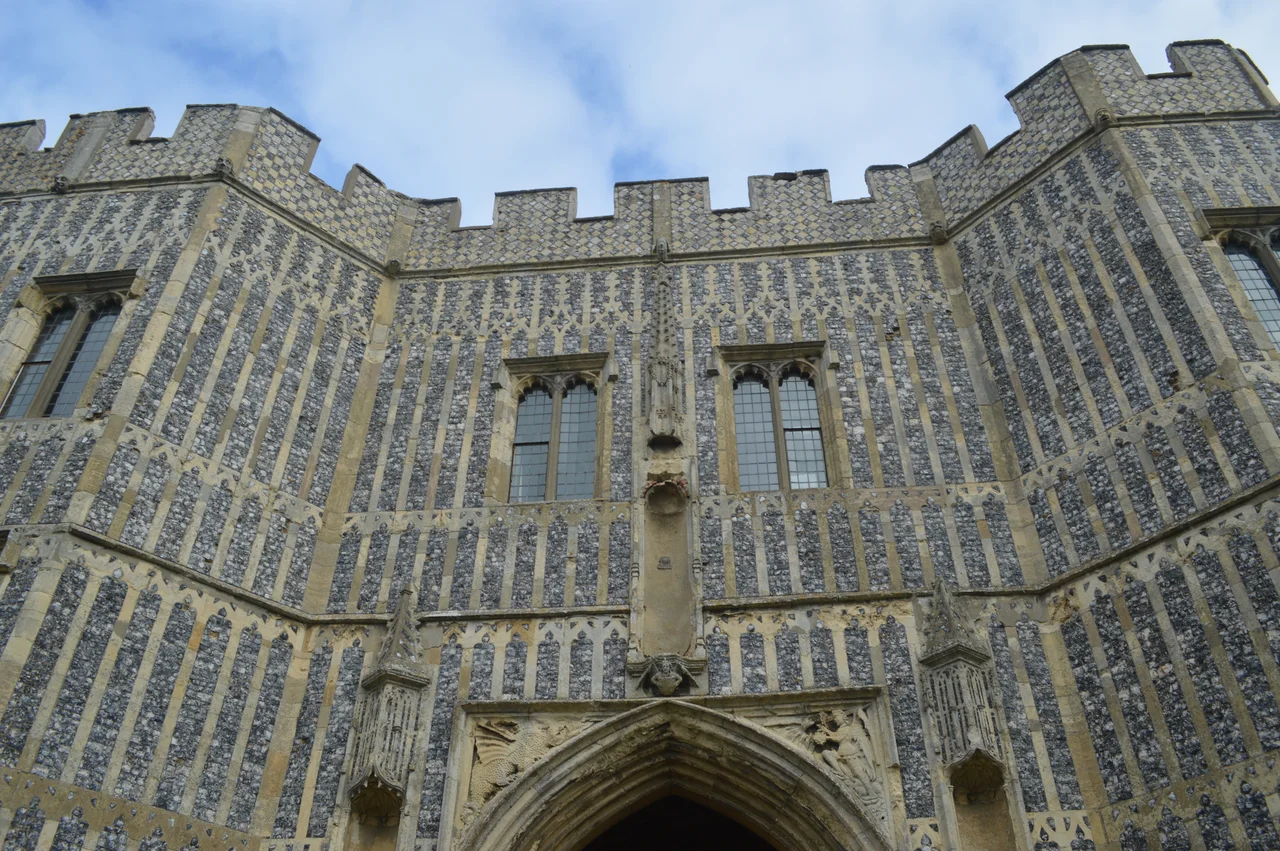
Down a quiet lane in the village of St Osyth, a few miles inland from Clacton, a battlemented gatehouse rises out of the Essex flatness like a Tudor stage set. Its facade is one of the most beautiful in England: alternating squares of black flint and pale Caen limestone laid in a chequer pattern so precise it looks pixelated, late-medieval flushwork carried out by craftsmen who knew exactly how their stone would catch the light. Beyond the gatehouse stretches an estate of cloisters, towers, lawns and ruins - the Priory, the Abbot's Tower, the Clock Tower, the eighteenth-century house, the formal gardens. It began as a place to keep the arm bone of an East Saxon princess.
A Saint and Her Arm
Osyth - sometimes spelled Osgyth or Osith - was, according to tradition, a Mercian princess and the wife of an East Saxon king in the late seventh century. She founded a religious community at Chich, was killed by Danish raiders, and was venerated as a virgin martyr. Her cult took hold; her relics moved between churches; by the early twelfth century her arm bone was kept at Aylesbury. In the 1120s Richard de Belmeis, Bishop of London, decided to found an Augustinian house in the Essex parish that bore her name. He obtained the saint's arm bone from Aylesbury for the new monastic church, granted the canons the parish church of St Osyth, and the village - until then called Chich - quietly began to be called St Osyth as well. The priory was dedicated to Saints Peter and Paul, and to Osyth. By the mid-twelfth century it had been promoted from priory to abbey, though local usage stubbornly kept the older name. People in Essex still call it St Osyth's Priory.
Canons, Corrodians and a Theft
The first canons came from Holy Trinity Priory at Aldgate, in the City of London. William of Malmesbury, writing the Gesta Pontificum Anglorum in the early twelfth century, praised the piety and scholarship of the St Osyth's community. One of the second generation of canons was William de Vere, who would become Bishop of Hereford and who wrote a Latin Life of St Osyth - it mentions that his own mother Adeliza, daughter of Gilbert fitz Richard of Clare, lived at the abbey as a corrodian (a kind of pensioner) for twenty years of her widowhood. Henry II's charter confirmed the canons' right to elect their own abbot and to hold a Sunday market at Chich. Then there was the curious 1434 affair: John Depyng, prior of St Botolph's at Colchester, was promoted to abbot of St Osyth's - and apparently took with him a quantity of valuable goods belonging to his old house. He never sent them back. After his death, St Botolph's brought a Chancery lawsuit against St Osyth's to recover them. They did not succeed.
Dissolution and a Cromwell
When Henry VIII's commissioners arrived in 1539 the community consisted of a prior and sixteen canons. They surrendered, were pensioned off, and the abbey was granted to the king's chief minister, Thomas Cromwell. Cromwell did not enjoy it for long; he fell from royal favour in 1540 and was executed, and St Osyth's reverted to the Crown. In 1553, in the reign of the boy-king Edward VI, the estate was sold for just under £400 to Thomas Darcy. Darcy - later the first Lord Darcy of Chich - was a typical Tudor buyer of monastic property: prosperous, well-connected, with an eye on building a country house from the bones of a religious one. He took the cloister ranges, the gatehouse, the abbot's lodging, and folded them into a new domestic complex. His chequer-work masonry, alternating flint and limestone, is what gives the Abbot's Tower, the Clock Tower and the northern and western ranges their distinctive appearance. What looks medieval in much of the surviving fabric is in fact Tudor - though laid in a medieval idiom, with medieval materials, by Tudor masons working over Norman foundations.
Civil War and Plunder
The Darcy line passed eventually to the Rivers family, and in October 1642 - in the opening months of the First English Civil War - the Rivers house at St Osyth was the target of a violent crowd action. Elizabeth Savage, Countess Rivers, was a prominent Catholic and supporter of the king. A Parliamentarian mob, drawing on years of religious tension and on rumours that the countess was hoarding arms for the Royalists, stormed the estate and plundered it. The house was stripped, furnishings smashed, much of the building left uninhabitable. The damage took decades to repair. By 1671, however, the Hearth Tax returns recorded 76 hearths at St Osyth's - making it the fourth-largest house in Essex, restored to a scale that suggested wealth as much as recovery.
Earls, Gardens and Survival
In the eighteenth century the estate passed by marriage to the Nassau de Zuylestein family, the Earls of Rochford - Dutch nobles who had come to England with William III. They added an oval carriage sweep, formal gardens laid out on the site of the medieval monastic cemetery, and remodelled the gatehouse and its western range. Lucy Young, wife of the 4th Earl of Rochford, is buried at the priory. In the modern era the estate has changed hands several times, with parts of its grounds opening to the public for limited periods. The buildings together hold one of the densest concentrations of historic fabric in Essex - it is a scheduled monument that contains numerous separately listed structures within its precinct. The arm bone of the saint is long gone. The flint-and-limestone chequer pattern remains, three or four centuries weathered but still catching the slanting Essex light exactly the way the masons intended.
From the Air
St Osyth's Priory sits at approximately 51.80 N, 1.08 E, in the village of St Osyth, about four miles west of Clacton-on-Sea. Recommended viewing altitude is 1,500-2,500 ft AGL; the priory is identifiable as a complex of grey and pale buildings around interior courtyards, with formal gardens to the south-west and salt marsh and creek visible toward the coast. London Stansted (EGSS) is 39 nm west; Southend (EGMC) 22 nm south-west. Class G airspace below the Stansted TMA.
Nearby Stories
- Ipswich Transport Museum 2.5 km away
- Beeleigh Abbey 4.3 km away
- Clare Priory 9.7 km away
- Cooling Castle 14 km away
- Margate Surfboat 15 km away
- 1382 Dover Straits Earthquake 25 km away
- Four Days' Battle 44 km away
- Southern Bight 75 km away