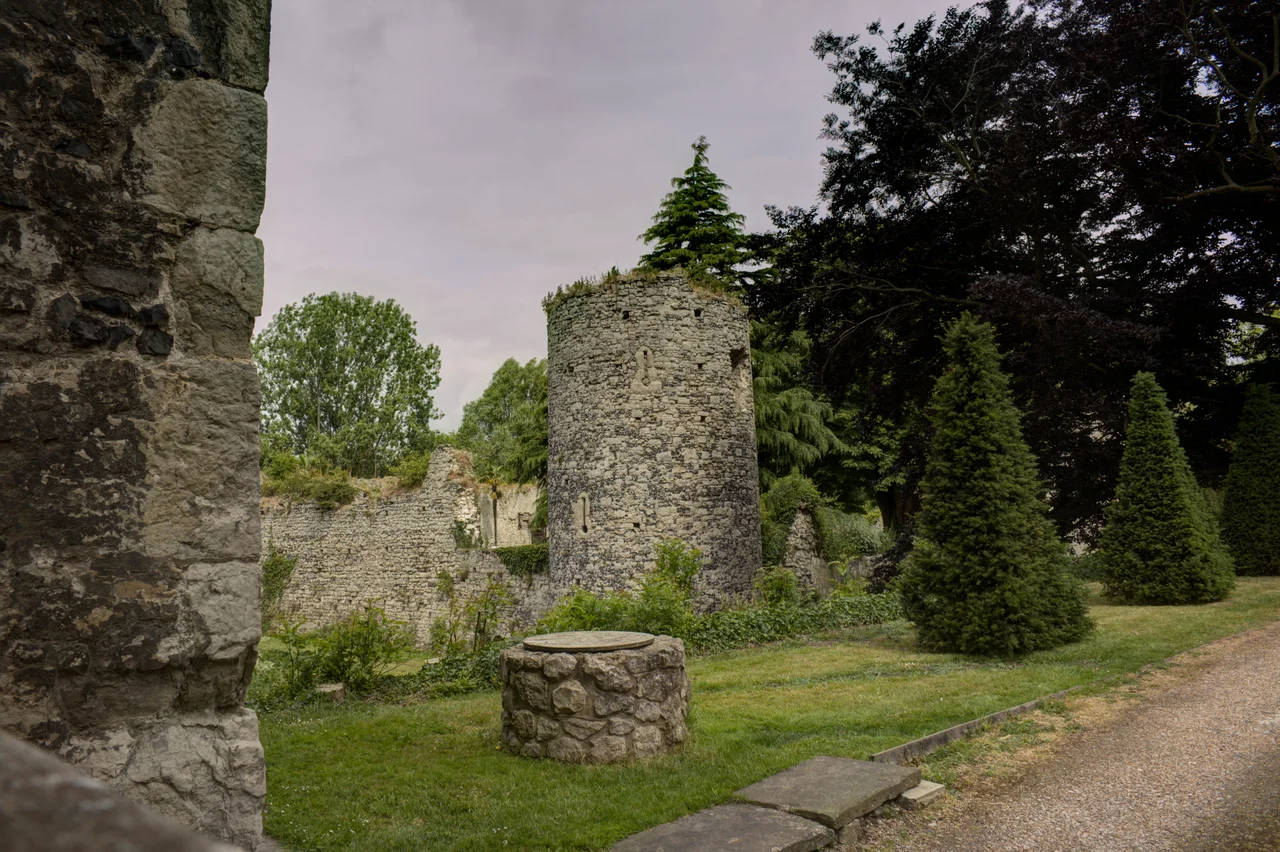

Cooling Castle
Lord Cobham's instructions to his masons in 1380 survive in the records, in the dense legal French of the era: "x arket holes de iii peez longour et tout saunz croys". Ten holes for arquebuses, three feet long, without cross-slits. They were the first such loops cut into the walls of an English castle - keyholes for the new gunpowder weapons that were just beginning to reshape European warfare. Cooling Castle was therefore the earliest English castle designed for the use of gunpowder by its defenders. Less than two centuries later, in January 1554, it was captured in eight hours by an army using gunpowder against it. There is a lesson in this somewhere, though nobody on the receiving end would have appreciated it at the time.
Why a Castle at Cooling
The Hoo Peninsula in north Kent juts into the Thames Estuary like a forefinger pointing at Essex. In the 14th century, the river ran much closer to the village of Cooling than it does today - the modern shoreline is about two miles north, separated from the castle by reclaimed marshland that did not yet exist. In 1379, during the second phase of the Hundred Years' War, French raiders devastated towns and villages along the estuary. John de Cobham, 3rd Baron Cobham, lord of the manor at nearby Cobham Hall, petitioned the Crown for licence to fortify his estate. Permission came in February 1380. Work was completed by 1385. The result was a quadrangular castle - two walled wards of unequal size lying side by side, surrounded by moats and ditches - designed by master masons working under the supervision of Henry Yevele, the king's master mason, the same Yevele who designed Westminster Hall and parts of Canterbury Cathedral.
Holes for the New Weapons
The gunloops were a deliberate innovation. By the 1380s, hand-held firearms - arquebuses, primitive matchlocks - were beginning to appear in European warfare. The technology was clumsy and unreliable, but accelerating. Cobham's masons cut wall openings designed specifically for these weapons rather than the cross-slits that had served archers for centuries. The masons named in surviving accounts include Thomas Crompe, William Sharnall and Thomas Wrek. The prominent gatehouse, with its twin drum towers, was the showpiece. The outer ward measured roughly 134 by 88 metres - the size of a large sports field - with horseshoe-shaped towers at three corners, all projecting about five metres in front of the curtain wall, and still standing to 12 metres high today. Behind that, the smaller inner ward held the keep and domestic quarters. The whole was wrapped in water-filled ditches that the marshy ground readily supplied.
The Family Falls
John de Cobham fell out of royal favour shortly after the castle was completed - exiled for a time, eventually allowed to return, finally dying at Cooling in 1408. His granddaughter Joan inherited the estates and married four times. Her last husband was Sir John Oldcastle, a Lollard - one of the followers of the religious reformer John Wycliffe whose challenges to Catholic doctrine would eventually feed into the Reformation. Oldcastle led a doomed Lollard rising in 1414, was eventually captured, and was executed in 1417 in a particularly brutal manner - hanged in chains over a fire. Shakespeare based the character of Falstaff partly on him before the Cobham family complained and the name was changed. The Cobham title remained intact through the female line, but the castle began passing between families. By the mid-16th century it was held by George Brooke, 9th Baron Cobham.
Wyatt's Rebellion
Cooling Castle saw real military action exactly once. In January 1554 Sir Thomas Wyatt the Younger - a Kentish landowner whose father was the poet who had introduced the sonnet form into English - raised a rebellion against Queen Mary's planned marriage to King Philip II of Spain. His goal was to depose Mary and place her Protestant half-sister Elizabeth on the throne instead. Wyatt assembled around 4,000 men and captured two cannons from the army of the Duke of Norfolk at Strood, a few miles south of Cooling. He then turned aside from his march on London to attack Cooling Castle. Why he did this is unclear - the detour gave Mary precious time to prepare her defences in the capital. The castle's occupant, George Brooke, 9th Baron Cobham, was Wyatt's uncle; there may have been a personal score to settle. The defenders had eight men, four or five handguns, four pikes, and "some blakbylls" - a kind of cudgel. Against cannons. They surrendered on 30 January 1554 after eight hours of siege and bombardment that badly damaged the castle. Wyatt continued towards London, was defeated at Ludgate, and was executed in April. Mary's marriage to Philip went ahead. The castle never recovered.
Ruins and Roots
Cooling Castle was abandoned after the siege. A century later a farmhouse and outbuildings rose among the ruins, repurposing whatever stone and brick could be salvaged. The Cobham family retained ownership until the 18th century. The castle was designated a Scheduled Monument in 1946 - one of the earliest such protections under the postwar heritage legislation. Today it is on the Heritage at Risk register due to the poor condition of its fabric, particularly the great gatehouse whose drum towers have been progressively shedding stone for centuries. The castle sits on private land and is not open to the public, but can be viewed clearly from the road. The 17th-century farmhouse that grew up inside the outer ward is now the home of the musician and pianist Jools Holland - of Squeeze, of Later... with Jools Holland on BBC Two, of the Hootenanny that has marked New Year's Eve on British television since 1992. The adjacent barn is now a wedding venue. Cooling Castle has been many things: a defence against the French, a Lollard household, a stage for Wyatt's rebellion, a ruin, a farm, a wedding venue. The drum towers still rise above the marsh. The first English gunports still wait, in the masonry, for muskets that have not been fired in over four hundred years.
From the Air
Cooling Castle stands at 51.46°N, 0.52°E in the village of Cooling on the Hoo Peninsula in north Kent, about 6 miles north of Rochester. The castle is highly visible from the air: the twin drum towers of the gatehouse rise above the surrounding farmland, with the curtain walls and corner towers tracing the outer ward, and the 17th-century farmhouse standing inside. The Thames Estuary lies 2 miles to the north, with the marshes between. Rochester Airport (EGTO) is 5 miles south; London Southend (EGMC) is 11 miles east. Best viewed from 1,500-3,000 feet over the Hoo Peninsula.
Nearby Stories
- Waltham Abbey Royal Gunpowder Mills 1.6 km away
- Bethlem Royal Hospital 4.4 km away
- Sissinghurst Castle Garden 5.6 km away
- Chelmsford 6.5 km away
- Herne Bay Pier 6.7 km away
- Operation Stack 7.1 km away
- St Osyth's Priory 13 km away
- Plymouth Brethren 24 km away