
Plymouth Brethren
Four young men met in a Dublin drawing room in 1825 with no liturgy, no order of service, and no minister. A dentist studying theology. A medical student. A curate from County Wicklow. A lawyer who brought them all together. They wanted to take Communion and read the Bible, and they wanted to do it without the Church of England telling them how. They could not have known that this small Eucharist would name a worldwide movement, fracture into bitter rival sects, and still be making news two centuries later from a chapel in West Sussex.
Dublin Origins
The dentist was Anthony Norris Groves. The medical student was Edward Cronin, who would later pioneer homeopathy. The curate was John Nelson Darby, an Anglican clergyman with strong views about the corruption of the established church. The lawyer was John Gifford Bellett. None of them set out to start a denomination. They simply wanted what they called nuda scriptura, scripture and nothing else, with all believers equal at the table. The first meeting was held in 1825. Within a few years, prophecy conferences at Powerscourt House in County Wicklow were drawing in figures who would carry the idea to England: Benjamin Wills Newton, George Müller, the future founder of Bristol's famous orphanages. Darby, the most forceful of them, was already preaching a pre-tribulational rapture in 1831 that would later anchor American dispensationalist theology.
The Plymouth Name
In December 1831, the first meeting on the British mainland was held in Plymouth, Devon. Newton, Darby, and George Wigram organised it. The Plymouth assembly grew faster than anyone expected. By 1845, more than a thousand people were in fellowship there, and outsiders began calling the movement after the city: the brethren from Plymouth, then simply Plymouth Brethren. Many members refused the name. They insisted they were only Christians, gathered around Christ and nothing else. The label stuck anyway. It always does.
The 1848 Schism
The trouble started with a book about the tribulation. Darby disagreed with details in something Newton had published. He also disliked Newton's authority as an elder at Plymouth. Attempts at reconciliation in front of other brethren failed. Tracts flew back and forth. Newton retracted some statements, then left for London. In 1848, Darby turned his fire on the Bethesda assembly in Bristol, where George Müller was prominent, because Bethesda had received a member from Newton's old chapel. On 26 August 1848, Darby issued a circular cutting off Bethesda and every assembly that received anyone from it. The schism this defined would last forever. Two movements emerged. The Exclusive Brethren followed Darby, with rigid boundaries about who could break bread with whom. The Open Brethren followed Müller, treating each assembly as an independent local church. Both kept growing, in Britain, in America, in India and Latin America and central Africa. Both kept splitting further.
Chapels and Gospel Halls
The terminology can confuse outsiders and insiders alike. Open Brethren meet in Chapels. The Closed Brethren, who are not Exclusive Brethren but a conservative subset of the Open, meet in Gospel Halls. Gospel Halls generally avoid musical instruments. Women cover their heads. Reception to the assembly is treated with weight; the Lord's Supper, the Brethren say, is for believers, not for anyone who happens to walk in. Chapels are looser. Some practise an open table, welcoming anyone who professes faith. There are no ordained clergy in any of these assemblies. Elders are recognised by other elders. Preachers receive commendations rather than ordinations. The doctrine of the priesthood of all believers is taken to its furthest extent: every Christian is a minister, and no human being mediates between worshipper and God except Christ himself.
Notable Names
The list of people shaped by Brethren upbringing is long and unexpected. Luke Howard, the chemist who in 1803 gave the world the cloud names cirrus and cumulus and stratus, was Brethren. So was his son John Eliot Howard, who studied the cinchona tree and the chemistry of quinine. Edmund Gosse wrote Father and Son, the searing 1907 memoir about his life under his naturalist father Philip Henry Gosse's strict Brethren faith. Garrison Keillor was raised in the assemblies before leaving. The novelist Ken Follett grew up in a Welsh Brethren chapel. Orde Wingate, the eccentric British commando who led the Chindits in Burma, was Brethren. The hymn How Great Thou Art carries Brethren fingerprints through its English translator Stuart Hine. The Foreign Secretary Anthony Crosland was Raven Exclusive Brethren by descent. Costa Prize winner Rebecca Stott wrote In the Days of Rain about her own father's life inside, and her family's escape from, the most hardline branch.
The Hardline Branch
That hardline branch now calls itself the Plymouth Brethren Christian Church. The media still calls it Exclusive Brethren. It is the Taylor-Hales group, currently led by Bruce Hales of Australia, the Elect Vessel. The PBCC claims fifty thousand members worldwide. Its separation rules extend far past Communion: members do not dine with outsiders, do not enter business partnerships with outsiders, do not join clubs with outsiders, do not marry outsiders. Children attend the group's own schools. Television is forbidden. Many Open Brethren in Australia and New Zealand have stopped using the Plymouth name altogether to avoid being confused with them. The split that began with one Dublin meeting in 1825 has, through almost two centuries of further dividing, produced a constellation of communities ranging from ordinary evangelical chapels to a tightly controlled separatist church, all still arguing about exactly what scripture demands.
From the Air
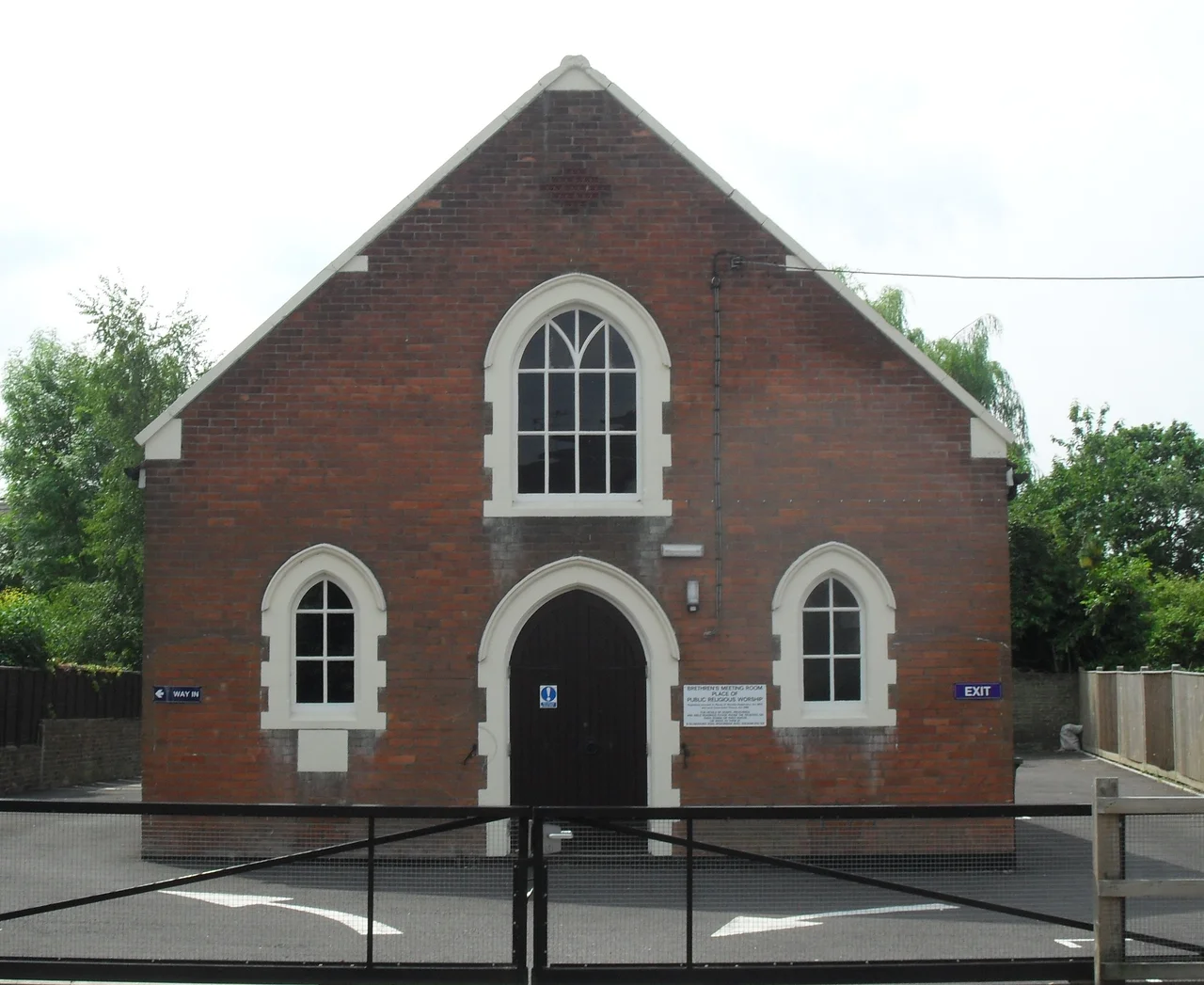
The geohash gcpc places this article in West Sussex, England, near the Broadbridge Heath chapel pictured in the source. Coordinates 50.96°N, 0.14°W. Cruise altitude over southern England 3,000 to 5,000 feet for visual reference. Nearby airfields include EGKA Shoreham 18 nautical miles south and EGKB Biggin Hill 35 nautical miles east. The South Downs ridge runs east-west to the south; Gatwick airspace lies immediately north.
Nearby Stories
- Waverley Abbey 6.6 km away
- Battle of Mercredesburne 7 km away
- Fishbourne Roman Palace 9.5 km away
- The Carrington Event: The Solar Storm That Could Happen Again 9.8 km away
- Mereworth Castle 12 km away
- Swanage Lifeboat Station 88 km away
- Wellington Clock Tower 125 km away
- Cléon 154 km away