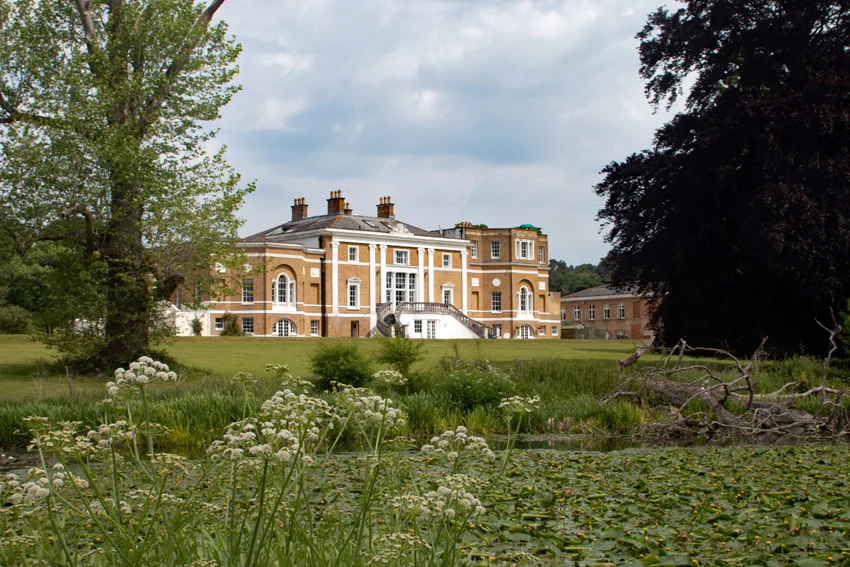

Waverley Abbey
Twelve monks and an abbot arrived from Normandy in November 1128, bringing with them a Cistercian rule that demanded silence, simplicity, and rough manual work on land deliberately chosen to be poor. Their patron William Giffard, Bishop of Winchester, gave them a wedge of floodplain southeast of Farnham, ringed by the channels of the River Wey. The land was so prone to flooding the church had to be rebuilt in the thirteenth century. Famine struck the monks more than once. They stayed for four hundred years, and the yew tree they planted, or one of its descendants, is still here.
First of the White Monks
Cistercian houses began in 1098 at Citeaux in Burgundy as a reform of Benedictine life - stripped back, contemplative, set in wild places. Waverley was the first the order founded in England, the seed from which other English Cistercian abbeys would grow. The mother house at L'Aumone in Normandy sent the first twelve monks and an abbot on 24 November 1128. Giffard's endowment gave them every acre within the parish of Waverley, two acres of meadow at Elstead, and the right to cut wood at Farnham. His successor Henry of Blois - younger brother of King Stephen - added thirty acres at Wandford and permission to dig turf, heath, stone, and sand. Stephen himself granted land at Neatham and excused the abbey from military levies and from the Danegeld. In 1147 Pope Eugenius III freed the house from tithes by papal bull. On paper, Waverley should have been prosperous.
Poverty and Floods
In practice, it was "slenderly endowed," and the monks more than once begged food from sister houses. The site itself was the problem: flat ground beside a temperamental river. The church was begun in 1203, but King John fell out with the Pope in 1208, confiscated all ecclesiastical property in England, then spent the last days of Holy Week at Waverley itself - apparently as repentance - and restored its possessions for the rebuilding. Two years later, when the Cistercians refused his demands for money, John pulled their privileges again. Many monks fled. The abbot, the chronicle records, "fled away by night." Construction stuttered on through the political weather and the literal weather. Five altars were consecrated by an Irish bishop, Ailbe of Ferns, in July 1214. The new church was not finished until 1278 - seventy-four years after the work began. At its consecration, a feast supposedly fed 7,066 people including six abbots and a forest of knights and ladies.
Visited by Kings
King John came back in penitence; King Henry III came in piety, taking communion at Waverley on 16 December 1225. The abbey lasted four more centuries before Henry VIII's dissolution caught up with it in 1536. Most of the buildings were pulled down; their stone went into the houses of Farnham and the surrounding villages. Waverley Abbey House, built in 1723 in the northern half of the old precinct, almost certainly contains masonry from the abbey it replaced. The historian Walter Scott chose the name for the hero of his first novel - and although Scott himself never said why, Leslie Stephen wrote in the 1897 Dictionary of National Biography that the name was "probably suggested by Waverley Abbey, near Farnham, which was within a ride of Ellis's house where he had been recently staying." Conan Doyle wove the abbey into Sir Nigel as the setting for his hero's youth.
A House That Kept Working
Waverley Abbey House had a second life as a battlefield asset. During the First World War it became the first country house in England converted into a military hospital, treating over five thousand soldiers. In the Second World War, the abbey precinct was wired into the GHQ Line, the defensive belt drawn around London in 1940. The grounds today still hide anti-tank pimples and cylinders, pillboxes, hidden bases for the secret Auxiliary Units who would have fought the Germans behind their own lines, anti-tank ditches and roadblocks. The ruins themselves became a film set: 28 Days Later filmed there in 2002, Hot Fuzz in 2007, Elizabeth: The Golden Age in the same year, Charles Darwin's biopic Creation in 2009, Into the Woods in 2014, the BBC's Howards End in 2017.
The Tree of the Year
On the southeast corner of the old church wall grows a yew tree, Taxus baccata, nearly five hundred years old. It took root after the dissolution, perhaps just decades after the monks left, and has stood through every storm and flood since. In November 2022 the Woodland Trust gave it the title of UK Tree of the Year, recognising both its age and the way it has fused itself with the masonry, root and stone holding each other together. Flooding remains a real threat - an English Heritage report in 2014 called the risk to the south half of the estate extensive - and the ruins, the meadow, and the tree are watched closely. English Heritage manages the site now, and visitors come freely along a path that follows the line of a vanished cloister, past the lay brothers' undercroft, to where the high altar once stood, and the yew.
From the Air
Waverley Abbey is about two miles southeast of Farnham at 51.200°N, 0.758°W, on the floodplain of the River Wey near the village of Tilford. Visible from low altitude on approach to Farnborough (EGLF), about 7 nautical miles north. Frensham Great Pond - a recognisable circular lake - is the most obvious landmark to the south; the open commons of Hankley and Thursley extend further south.
Nearby Stories
- Ealing Abbey 3.4 km away
- SeaCity Museum 7.6 km away
- The Carrington Event: The Solar Storm That Could Happen Again 13 km away
- Mansion House, Hurstpierpoint 13 km away
- Fishbourne Roman Palace 16 km away
- Hellfire Caves 17 km away
- Hungerford Massacre 21 km away
- Museum of the Great Western Railway 28 km away