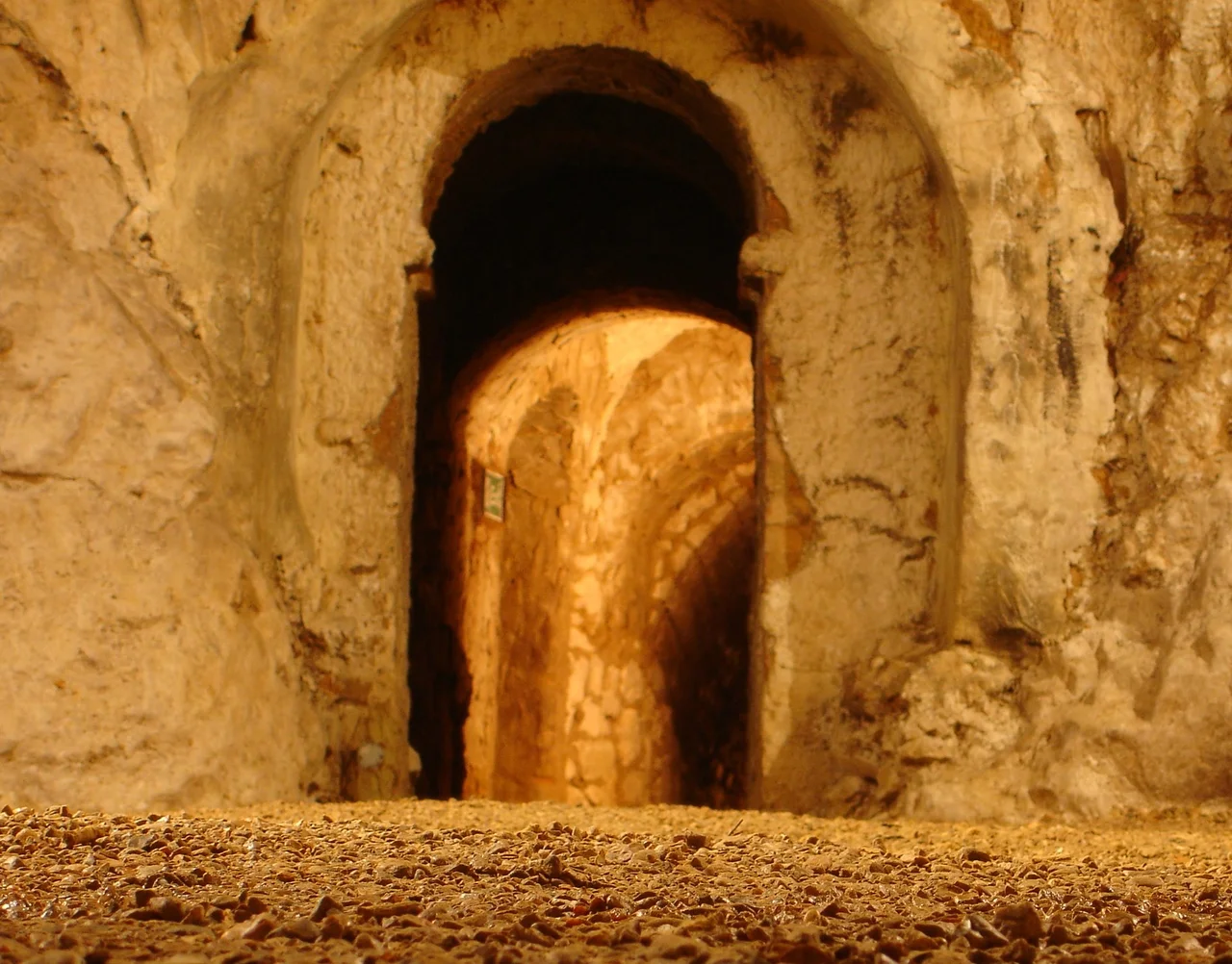

Hellfire Caves
Three hundred feet directly above the deepest chamber of the Hellfire Caves sits St Lawrence's Church, a hilltop building Sir Francis Dashwood crowned with a golden ball big enough to seat ten men. Directly below it, at the far end of a quarter-mile of chalk tunnels, lies a chamber called the Inner Temple. To reach it visitors must cross an underground stream Dashwood named the Styx, after the river that separates the living from the dead in Greek myth. Above, the church. Below, the temple. Heaven and Hell, as Dashwood imagined them, joined by a chalk hill in Buckinghamshire.
The Grand Tour Returns
Francis Dashwood inherited his baronetcy at sixteen and his fortune somewhat later, and he spent most of his early adult life travelling - Italy, Greece, Turkey, Syria, the territories of the Ottoman Empire. The educated young man's Grand Tour had become for him a habit of mind. He came home with a head full of antique imagery, founded the Society of Dilettanti to import classical taste into England, and looked at the hill above his ancestral estate of West Wycombe and decided to dig. Excavation ran from 1748 to 1752. He framed it publicly as a poor-relief scheme: the chalk was needed for a new straight road three miles long between West Wycombe and High Wycombe, then the busy London-Oxford route. Local farm workers, broken by repeated droughts and failed harvests, were the labour force. Several seasons' wages came out of Dashwood's pocket and several thousand tons of chalk came out of the hill.
An Architecture of Mischief
What he made down there was not a quarry. It was a procession. From the Entrance Hall, the passage leads through the Steward's Chamber and Whitehead's Cave to Lord Sandwich's Circle - named for John Montagu, fourth Earl of Sandwich and inventor of the sandwich - then Franklin's Cave, for Benjamin Franklin, who visited Dashwood at West Wycombe more than once. Beyond is the Banqueting Hall, said to be the largest man-made chalk cavern in the world. Past the Triangle and the Miner's Cave the visitor crosses the Styx and emerges in the Inner Temple. The Styx is an actual subterranean stream, dressed with theatrical purpose. The Inner Temple lies, by Dashwood's careful surveying, directly under St Lawrence's Church on top of the hill. Above ground, his church served the parish. Below ground, in a chamber three hundred feet beneath the altar, his club met. The geometry was the joke and the message both.
The Club That Wasn't Called Hellfire
The members never used the name Hellfire Club while the club was active. They called themselves the Brotherhood of St Francis of Wycombe, the Order of Knights of West Wycombe, the Friars of St Francis. The name Hellfire was applied later, by hostile journalism, and stuck. The membership was a roster of eighteenth-century power: the painter William Hogarth, the radical politician John Wilkes, the politician George Bubb Dodington, later Baron Melcombe, Lord Sandwich, Thomas Potter. Benjamin Franklin, never formally a member, was a close friend of Dashwood and a visitor to the caves. Their motto came from the French satirist Rabelais: Fais ce que tu voudras - do what thou wilt. Horace Walpole, who was not invited, wrote acidly that "their practice was rigorously pagan: Bacchus and Venus were the deities to whom they almost publicly sacrificed; and the nymphs and the hogsheads that were laid in against the festivals of this new church, sufficiently informed the neighbourhood of the complexion of those hermits." Whatever the truth - costumed mock-religious rituals, heavy drinking, paid female company, perhaps political networking dressed up as transgression - the club was no longer active by the early 1760s.
Sukie and Other Ghosts
Local legend holds that the caves are haunted by Sukie, a young maid said to have been killed accidentally by villagers playing a cruel practical joke. Others claim to have seen the ghost of Paul Whitehead, who served the club as its steward and was its trusted keeper of secrets. Whitehead's heart was famously interred at Dashwood's mausoleum on the hill above, and his cave inside the system bears his name. Ghost stories aside, the caves emptied of purpose after the club dissolved. They sat idle for nearly two centuries. During the Second World War plans were drafted to convert them into a vast air-raid shelter for High Wycombe and the towns of the Chilterns, but Buckinghamshire's quiet rural geography meant the area was never seriously bombed, and the plans were shelved.
A Quarter-Mile of Curiosity
It was the eleventh baronet, also called Sir Francis Dashwood, who renovated the caves and opened them as a tourist attraction in 1951. Since then more than 2.5 million people have walked the quarter-mile of chalk passages, past Lord Sandwich's Circle and Franklin's Cave, into the Banqueting Hall, across the underground Styx, and into the Inner Temple. Above their heads, on the crown of the hill, St Lawrence's Church still stands with its hexagonal nave and its absurd golden ball - the ball Wilkes once climbed inside to play cards with friends. Much of what the caves earn now goes to the National Trust, which holds West Wycombe Park across the valley. The drama series Most Haunted came here for an overnight vigil. Little Dorrit used the caves as a prison set. Whatever the eighteenth-century Friars of St Francis actually did down here - and the truthful answer is, less satanically interesting and more drunkenly conventional than the legend suggests - they left behind a piece of theatre cut into the chalk of a single Buckinghamshire hill, and a question that is still its own joke. Above your head, the church. Beneath your feet, the temple. Which is which?
From the Air
The Hellfire Caves lie under West Wycombe Hill at 51.646°N, 0.803°W, on the southern edge of the Chiltern Hills near High Wycombe in Buckinghamshire. Visible from low altitude on approach to RAF Benson (EGUB) or Booker (EGTB), about 8 nautical miles southeast. The conspicuous landmark is St Lawrence's Church, perched on top of the hill with its golden ball; West Wycombe Park and the village stretch in the valley below to the south. The M40 passes a few miles to the south.
Nearby Stories
- Harrow and Wealdstone: Britain's Worst Peacetime Rail Disaster 1.2 km away
- 1952 Farnborough Airshow Crash 9.2 km away
- Stevenage 12 km away
- Great Train Robbery (1963) 14 km away
- The Carrington Event: The Solar Storm That Could Happen Again 16 km away
- Littlecote Roman Villa 21 km away
- Woodhenge 31 km away
- Battle of Edgehill 32 km away