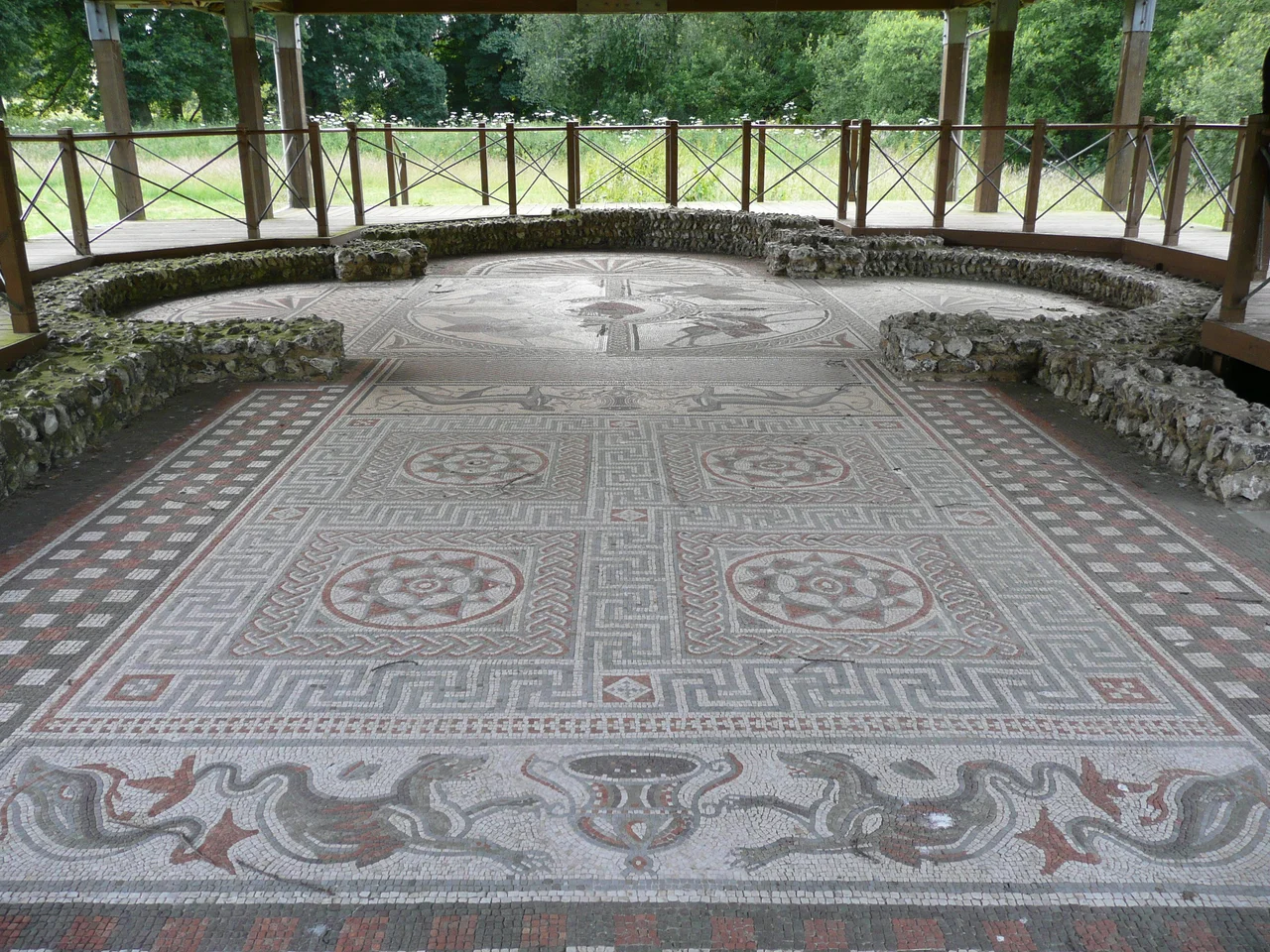

Littlecote Roman Villa
In 1727, a farmer named William George was digging post-holes on a Berkshire estate when his spade caught on something hard and brightly colored. What he had found, just over a mile west of Hungerford, was the Orpheus mosaic of Littlecote, immediately hailed as the finest pavement the sun ever shone upon in England. Antiquarians drew it carefully, marvelled at it, and then, baffled about what to do with such a thing, reburied it. The villa beneath promptly slipped out of memory. For almost 250 years, Wiltshire farmers ploughed straight over one of the largest and strangest Roman complexes ever built in Britain, with no idea what lay six feet below.
The Pavement That Was Lost
When the mosaic resurfaced in 1976, excavators discovered they had not simply rediscovered a wealthy Romano-British farmhouse. The Orpheus pavement, set on the floor of a building shaped like a three-lobed clover called a triconch, depicts the mythical singer charming a procession of beasts. It is woven through with imagery of Bacchus and Apollo. Buildings shaped like this exist in only a handful of places elsewhere in the Roman world, mostly in North Africa, and most of them date to the sixth century, two centuries later. Littlecote built one around 360 AD, on a quiet bend of the River Kennet. Archaeologists Bryn Walters and his team spent the next fifteen years working out what they had stumbled into. The answer, slowly, became this: a pagan cult centre, hiding in plain sight.
Sixty Rooms and Five Towers
At its peak in the fourth century, Littlecote was vast. Sixty rooms organized around a courtyard. Two separate thermal bath suites. Five tall towers and a gatehouse so grand it had three arched vaults supporting upper-floor rooms, possibly for storing grain. Many of the buildings rose two storeys high. There were workshops, barns, and stables; the south range alone had a converted residential wing with its own baths. The complex enclosed an area among the largest of any villa in Britain. Some of the buildings may have been converted into accommodation for visiting pilgrims, because by the late fourth century Littlecote had stopped being a farm. The numismatic evidence, the coins dropped and forgotten across the floors, tells a quiet story: agriculture ceased. Something else took its place.
Orpheus, Bacchus, and an Emperor Who Brought Back the Old Gods
The timing matters. In 361 AD, the emperor Julian, later called Julian the Apostate, briefly restored paganism to the official life of the empire, in defiance of decades of Christian ascendancy. His reign lasted only two years. But it gave cover, however fleeting, to wealthy provincials who had never warmed to the new religion. The triconch hall at Littlecote, with its Orpheus floor and its echoes of Bacchic mystery cults, was probably built in this window. Visitors crossed the courtyard, slipped off their cloaks in the apodyterium, passed through the cold and warm rooms of the small bath suite, and emerged into the cult hall to gaze down at Orpheus among the beasts. Whether they sang, drank, danced, or simply contemplated, we cannot know. Around 400 AD, after Theodosian laws had finally outlawed paganism and as Roman power in Britain began to crumble, the place was abandoned. The roof fell in. The mud rose.
What You See Today
The mosaic was protected by a permanent roof in 2000, and since 2018 a new team has been carefully restoring what years of mixed care had eroded. Walking the grounds at Littlecote Park now, you can read the villa's whole history laid out across the river meadow: the line of the first-century fortlet that guarded the river crossing, the corridor villa that replaced the round huts in 170 AD, the bath suites added and rebuilt as fashions changed, and finally the triconch with its strange North African geometry, sheltering its impossible floor. Just a few miles upstream, at the site of the Roman town of Cunetio, a hoard of nearly 55,000 Roman coins was unearthed in 1978. The Kennet valley was wealthy in its day, and Littlecote was where some of that wealth chose to display itself, in tesserae and towers and a god who could charm anything that lived.
From the Air
The villa sits in the wooded grounds of Littlecote Park, on the broad meadow above the River Kennet's north bank. The cover building over the Orpheus mosaic is the most visible structure from the air; surrounding it, the footprint of the courtyard villa is picked out in low walls and gravel paths. The chalk downs of the Marlborough Downs rise to the south and west, and Hungerford's church tower marks the eastern horizon.
From the Air
Located at 51.4329 N, 1.56841 W, just over a mile west of Hungerford, Berkshire, on the north bank of the River Kennet. View from 2,000 to 4,000 feet AGL for the best appreciation of the villa's courtyard layout and the river meadow setting. Nearest airfields: Membury (EGLM area) to the north and RAF Welford to the north-east. The Marlborough Downs and the M4 corridor are visible to the south.
Nearby Stories
- Lacock Abbey 0.6 km away
- Berkshire 3.8 km away
- Mottisfont Abbey 13 km away
- Stourhead 15 km away
- Prinknash Abbey 17 km away
- Waddesdon Manor 20 km away
- Cotswolds 23 km away
- Fishbourne Roman Palace 39 km away