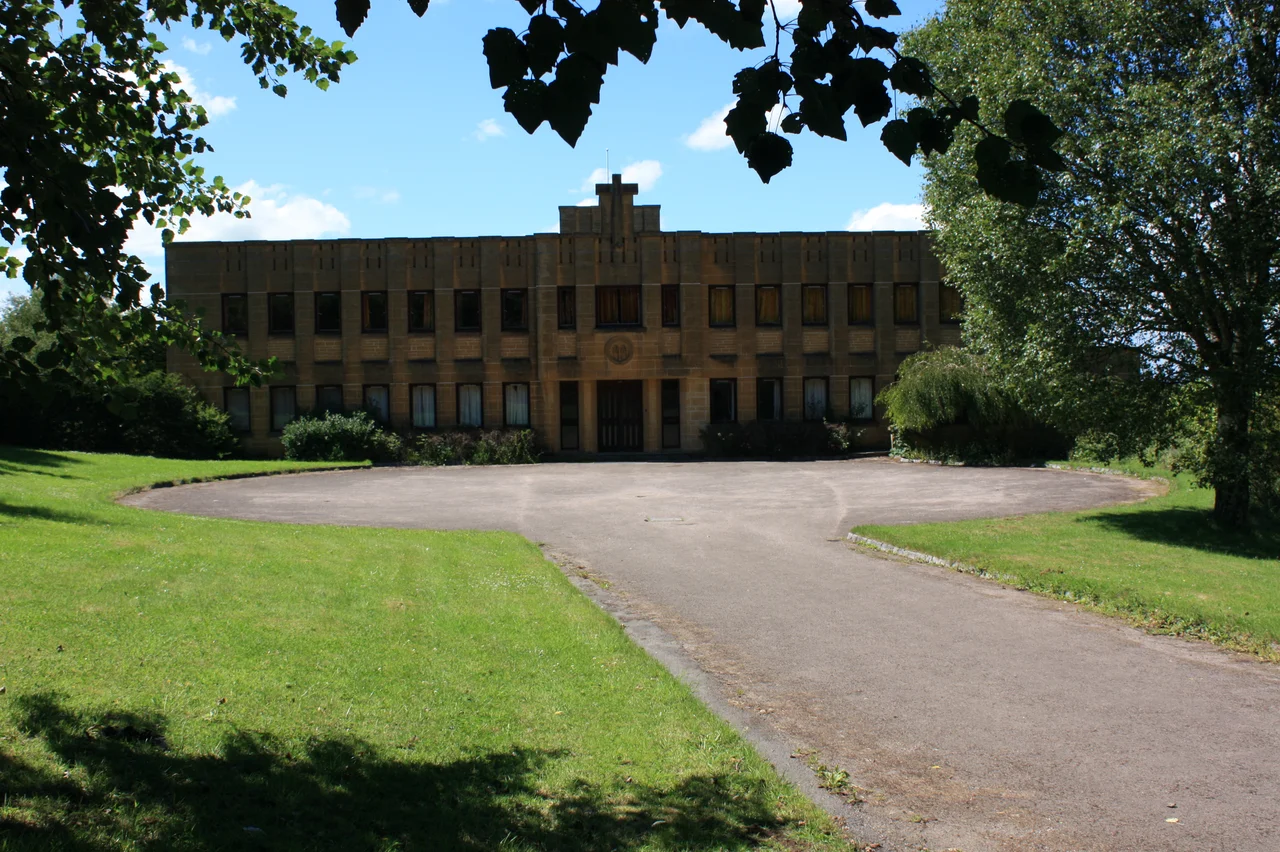

Prinknash Abbey
Locals can't agree on how to say the name. Some pronounce it Prinidge, others Prinnish, neither matching the spelling on the road sign. The locals know what the rest of us have to learn: the land has been associated with Benedictine monks since 1096, when the Giffard family, fresh from arriving in England with William the Conqueror, gave it to Serlo, Abbot of Gloucester. Nearly nine centuries later, the monks are still here, still keeping the canonical hours, still mixing incense by hand in a workshop that perfumes the surrounding fields with frankincense and rose.
A Hunting Lodge for Henry
Around 1520, William Parker, the last Abbot of Gloucester before the Reformation swept it all away, built much of the present house as a hunting lodge. Twenty years later he was dead and the monasteries were being dissolved. Sir Anthony Kingston rented Prinknash from the Crown on one peculiar condition: he had to deliver forty live deer each year to Henry VIII, who used the lodge to hunt the surrounding woods. For four hundred years the property passed through generations of Gloucestershire gentry, each one altering the building, none of them religious. The monks were a memory, then a footnote, then nothing at all. The land simply waited.
Return of the Monks
The waiting ended in 1928. The previous owner had left Prinknash to the Catholic Church with a request that it be given to a community of Benedictines living on Caldey Island off the Welsh coast. These monks had converted en masse from Anglicanism to Catholicism in 1913, a small ecclesiastical sensation, and they needed a new home. On 26 October 1928, six of them arrived at Prinknash to begin again. They were poor, they were uncertain, and they were back where Benedictines had first prayed eight hundred years earlier. By 1937 they had elected their first abbot. By 1947 they had enough confidence to refound St Michael's Abbey at Farnborough. The community Henry's commissioners had scattered was reassembling itself, one prayer at a time.
The New Abbey and the Return Home
In 1939 Cardinal Hinsley laid a foundation stone for a grand new abbey. Then came the war. Plans were redrawn, modesty replaced ambition, and architect Frank Broadbent eventually produced the long, low building the monks finally moved into in 1972. The old house, renamed St Peter's Grange, became a retreat centre. But the community kept shrinking, and the new abbey began to feel too big. So in 2008, on the Feast of Saints Peter and Paul, they walked back across the lawn into the building Henry's huntsman had once used. The Grade I listed Grange was home again. The new abbey, barely a generation old, was abandoned.
Clay from the Foundations
Sometime in the early 1940s, Dom Asaph Harris noticed something interesting in the soil being dug for the future abbey's footings. Red clay, the kind that fires well. He started experimenting. Brother Thomas Morey took up the work in earnest, and by the end of the decade Prinknash Pottery had become a commercial concern, with kilns and wheels and a small army of monastic potters turning out distinctive iridescent ware. The pottery thrived for half a century before closing in 2003. The pots still surface on the Antiques Roadshow, their glaze the colour of a Cotswold sunset, made from the dirt the monks had to remove to build a home they would later leave behind.
The Daily Round
What remains is the rhythm. The monks pray the canonical hours: matins, lauds, terce, sext, none, vespers, compline. Mass is celebrated at 8:30 every morning, including Sunday. Brother Patrick once designed sacred screens for Clifton Cathedral in Bristol. Dom Sylvester Houedard, who died in 1992, was a concrete poet and theologian whose archive sits at the John Rylands Library in Manchester. Dom Stephen Horton paints watercolours and serves as the community's Prior Administrator. And every day, in a small workshop on the grounds, the monks grind frankincense and balsam together to produce the incense for which Prinknash is now better known than for any of its older glories. The smoke rises, the bells ring, and the Vale of Gloucester carries on outside.
From the Air
Located at 51.825 degrees north, 2.176 degrees west on the western edge of the Cotswold escarpment, six miles east-southeast of Gloucester. Best viewed from 3,000 to 5,000 feet. Look for the long, flat-roofed 1972 abbey building near the older St Peter's Grange in wooded parkland above the village of Cranham. Nearest airfields are Gloucestershire Airport (EGBJ) seven miles northwest and Kemble (EGBP) fifteen miles southeast.
Nearby Stories
- Raglan Castle 2.6 km away
- British Camp 5.4 km away
- Clevedon Pier 7.6 km away
- Marlborough Castle 9.8 km away
- Central Government War Headquarters 10 km away
- Church of the Holy Trinity, Stratford-upon-Avon 18 km away
- Hay Castle 22 km away
- Blenheim Palace 29 km away