
Church of the Holy Trinity, Stratford-upon-Avon
Two entries in the same parish register, fifty-two years apart, draw most of the 200,000 annual visitors who walk down the lime-tree avenue to Holy Trinity Church. The first, dated 26 April 1564, records the baptism of Gulielmus filius Johannes Shakspere - William, son of John Shakespeare. The second, dated 25 April 1616, records the burial of Will Shakspere, Gent. The original Elizabethan register, in the same ink and the same hand for both entries, still exists; the Shakespeare Birthplace Trust keeps it for safety, away from candles and tourists. The church on the bank of the Avon keeps everything else: the font, the chancel, the grave slab, the curse.
Older Than the Town
Holy Trinity is Stratford-upon-Avon's oldest building. There has been a church on this riverside site since Saxon times - the present fabric dates from around 1210, raised over the foundations of an earlier monastic settlement. In the 14th century John de Stratford founded a chantry which was substantially rebuilt between 1465 and 1497 by Dean Thomas Balshall, whose tomb still lies in the chancel he built. The original wooden spire was replaced in 1763 by William Hiorne; the present stone spire reads from the river path as a single sharp note above the lime canopy. The church became collegiate, then parish, served by an obelisk-marked roll of organists going back to the 1840s. It remains an active parish church, serving about 17,000 people. The Royal Shakespeare Company has performed inside it - most notably Henry VIII in 2006 - but for most of the week it is the village church it has always been.
A Lay Rector's Privilege
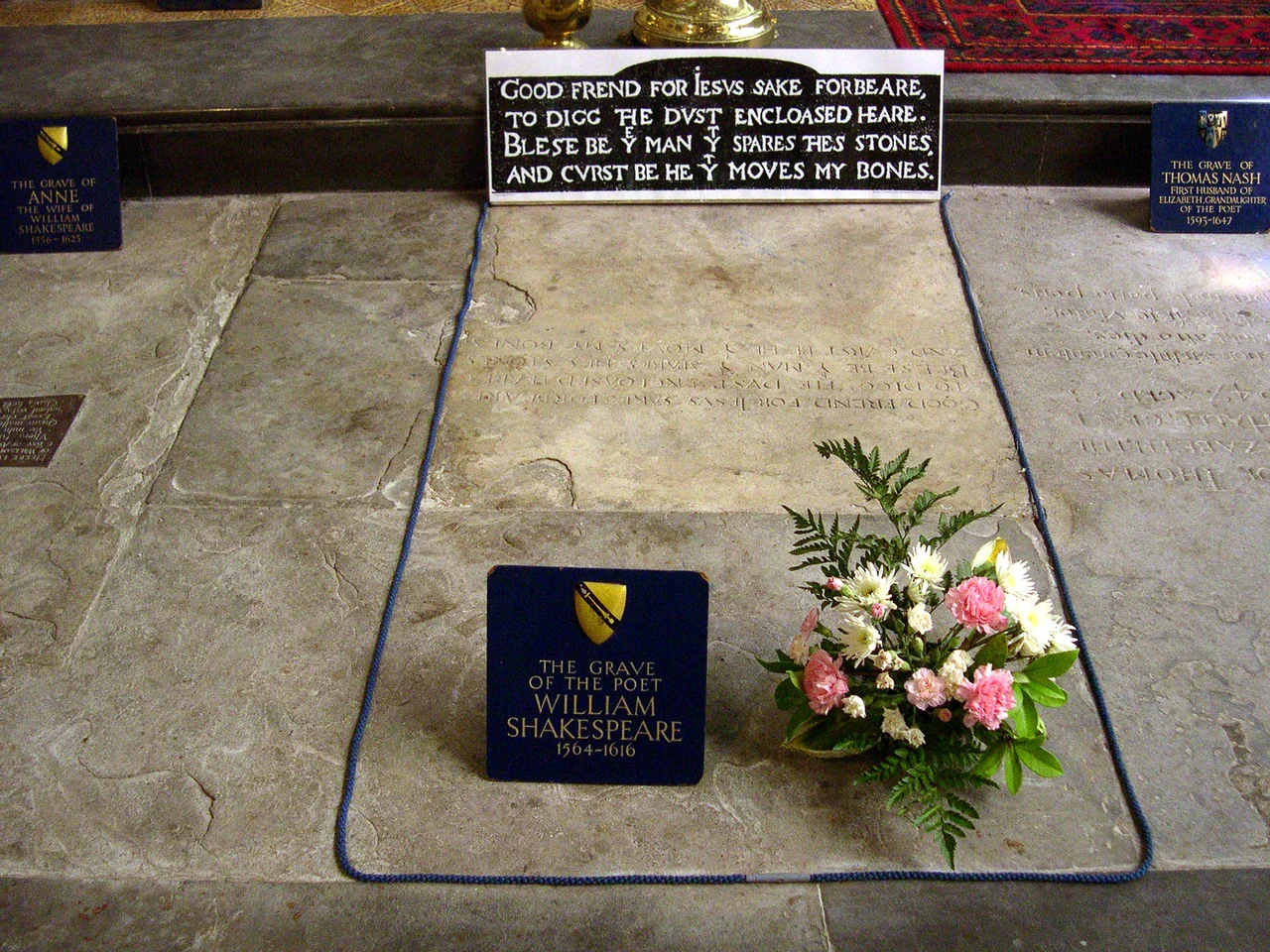
Shakespeare was eligible to be buried inside the chancel - the most sacred section of any Anglican church - because he had bought, in 1605, a share of the parish tithes. This made him, in the language of the time, a lay rector. The arrangement was an investment as much as a status; the tithes paid him an income. It also gave him a burial right inside the chancel where ordinary parishioners could not go. He lies just inside the altar rail, in front of the high altar, in the floor itself. Anne Hathaway, his wife, is buried next to him. Their eldest daughter Susanna lies beside her mother. The placement is unusually intimate: four generations of immediate family, all within touching distance of each other in stone.
The Curse
Across the slab over Shakespeare's grave is carved an inscription that, oddly, never mentions him by name. It reads: 'Good friend for Jesus sake forbeare, To dig the dust enclosed here. Bleste be the man that spares these stones, And curst be he that moves my bones.' Tradition holds that Shakespeare wrote it himself. The lines are bad doggerel and uncertainly attributed, but their effect has been remarkable. The 17th and 18th centuries were enthusiastic about exhuming famous Britons and re-interring them in Westminster Abbey, where they could be conveniently visited and properly commemorated. Several requests were made for Shakespeare. None succeeded. Even in 2008, when church restoration work disturbed neighbouring graves, the slab was left untouched. A 2016 ground-penetrating radar survey, conducted very respectfully, suggested that his skull may have been removed at some point, but his bones have otherwise lain undisturbed for 410 years. The curse, on the evidence, has worked.
The Funerary Monument on the Wall
Above the grave, set into the north wall of the chancel, is the painted limestone bust that constitutes one of only two contemporary likenesses of Shakespeare - the other being the engraving in the 1623 First Folio. The monument was carved before 1623, probably by the Anglo-Flemish sculptor Gheerart Janssen, whose workshop was near the Globe in Southwark and who may have known the man. Shakespeare is shown holding a quill in his right hand and a piece of paper in his left, his cheeks pink, his head bald above a high forehead, his moustache neat. The bust has been repainted several times. The first recorded renovation, in 1746, was funded by the proceeds of a production of Othello - the earliest documented Shakespeare performance in Stratford-upon-Avon. The audience that paid for that paint job were watching one of his plays in order to save his face.
The Last Will and the Bad Spring
Shakespeare signed his Last Will and Testament on 25 March 1616 in what witnesses described as a 'shaky hand'. The day after he signed it, his son-in-law Thomas Quiney was hauled before the church court and convicted of fathering an illegitimate child by a woman called Margaret Wheler, whose own infant had recently died in childbirth along with its mother. It was a domestic disaster, publicly aired, in the family of a man who was visibly unwell. Within a month William Shakespeare was dead. His funeral and burial took place at Holy Trinity on 25 April 1616. Anne survived him by seven years. The Latin inscription on her grave, possibly written by their son-in-law John Hall, asks Christ to come quickly, so that her body 'though shut within this tomb may rise again and reach the stars'. It is, in its way, a more affecting epitaph than the one on her husband's stone.
From the Air
Holy Trinity Church lies at 52.186 degrees N, 1.707 degrees W, on the west bank of the River Avon at the southern edge of central Stratford-upon-Avon. Best viewed from 2,000-2,500 feet. The slender stone spire is the tallest object in the town centre and the unmistakable reference point; the lime-tree avenue from the road to the south door reads as a straight green line approaching the church. Coventry Airport (EGBE) is 15 nautical miles north-east; Birmingham Airport (EGBB) is 19 nautical miles north-north-west. The M40 motorway lies 5 nautical miles south-east. The Avon meanders broadly past the church on its way to Evesham and Tewkesbury.
Nearby Stories
- RAF Defford 3.6 km away
- Great Witcombe Roman Villa 4.1 km away
- Coventry War Memorial 4.5 km away
- Hagley Hall 4.6 km away
- Battle of Naseby 5.4 km away
- Silverstone Circuit 5.9 km away
- Waddesdon Manor 8.8 km away
- Woodstock Palace 15 km away