
Coventry War Memorial
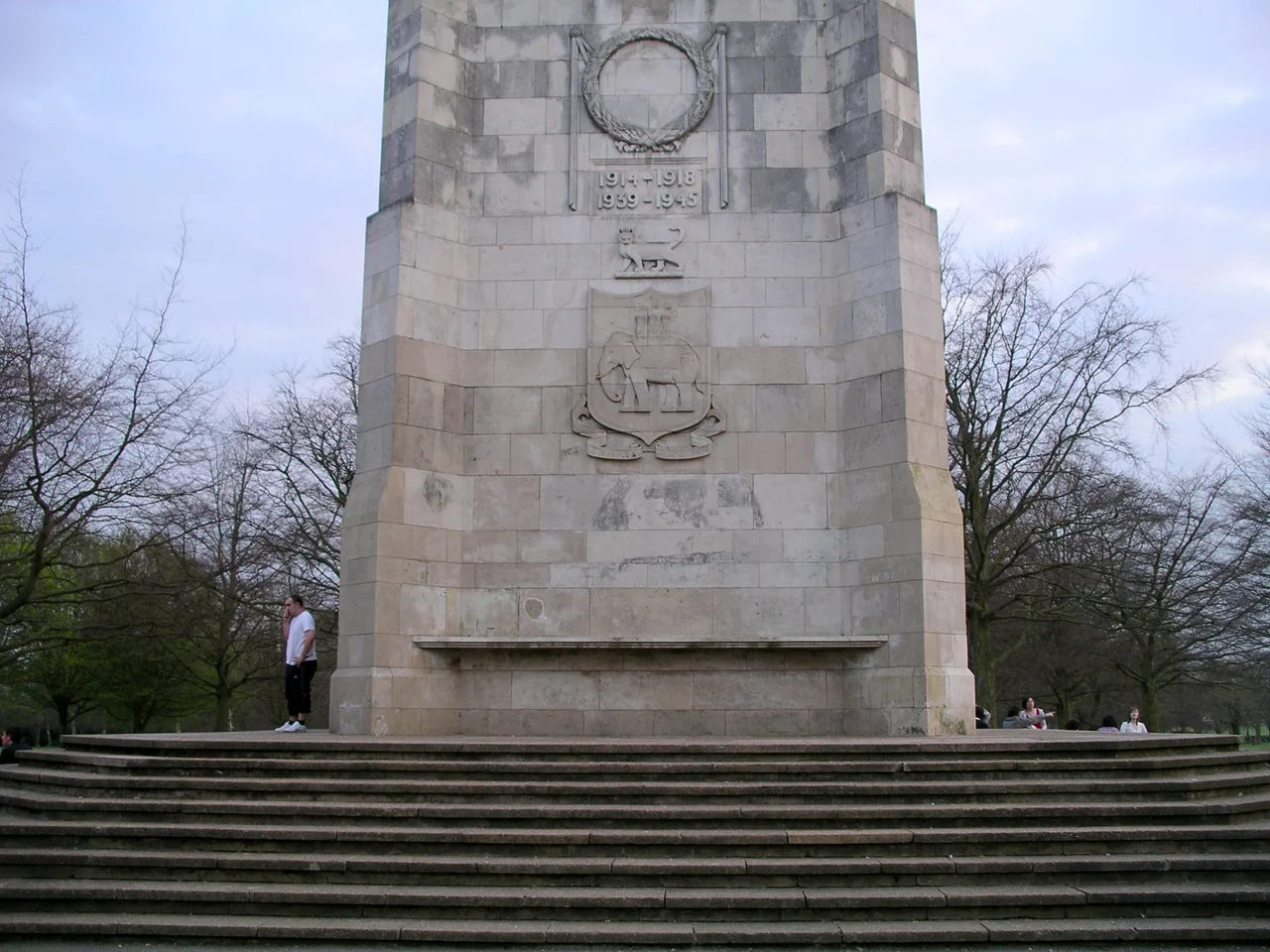
Mrs E. Bench was in the official party that watched Field Marshal Douglas Haig dedicate the Coventry War Memorial on 8 October 1927. Her name is unfamiliar today, but her qualifications for being there were unbearable: she had lost four sons in the First World War. Beside her stood Corporal Arthur Hutt, who had won a Victoria Cross at Poelcappelle in 1917 and survived. The names of 2,587 Coventrians killed in the Great War would be sealed inside the tower they were now unveiling, an 87-foot Art Deco pylon of reinforced concrete clad in Portland stone, raised on the high ground between the River Sherbourne and the River Sowe in the new 120-acre park that the city had bought as their living memorial.
The Park Came First
Coventry City Council formed its war memorial committee in 1919, in the immediate shock of the war's end, and the question of what to build occupied them for years. They settled on a park rather than a single sculpture. £31,000 was raised to acquire 120 acres at Stivichall on the high ground south of the city, sold by the Hon. Alexander Frederick Gregory, son of the 3rd Viscount Hood. The park opened in 1921 with a formal northeastern half and informal playing fields to the southwest, both arranged around a central rise where a monument would eventually stand. In 1925 copper beech trees were planted as memorials along the avenues that radiated out from the high ground. Over 200 trees went in, many with bronze plaques on stone plinths bearing the names of individual fallen soldiers. At least one Verdun oak, grown from acorns brought back from the French battlefield, was planted among them.
A Tower Designed Twice
The committee struggled for funds, and Coventry became one of the last major British cities to complete its First World War memorial; the Liverpool Cenotaph followed only in 1930, Bristol's in 1932. Designs were sought from architects in 1923, and the commission went to local architect Thomas Francis Tickner, who died the next year, before construction began. Another local architect, Thomas Reginald John Meakin, took over and saw it built. A public appeal raised the £5,000 needed for materials. Construction began in 1925 with a builder named John Gray, the same builder who lived at Coombe Abbey, having bought it from the Cravens two years earlier, and who also built the Courtaulds works at Foleshill. By the end of 1927 the tower stood: square in section, with corners stepped back in ten tiers of buttresses ending in blunt pinnacles, an eternal light at the summit, and a deep cross sculpted in relief on the north and south elevations.
Inside the Chamber
Bronze doors added in 1928 open into a Chamber of Silence within the base of the tower. The doors carry the dates 1914 to 1918, and later 1939 to 1945, raised in relief alongside the cross. Inside is a roll of honour. The original list of 2,587 First World War names was joined after the Second World War by the names of those killed in the new war: 817 in the armed forces, 115 in civilian defence, and 1,085 civilians, the bulk of those last killed in the Coventry Blitz of November 1940 and the raids that followed. Bronze discs on the platform around the tower carry the names of Coventry's Victoria Cross holders: Charles Parker for the Boer War, then Arthur Hutt, Henry Tandy, William Beesley, and Alfred Edward Sephton for the First World War. A separate plaque carries Laurence Binyon's words from 'For the Fallen': they shall grow not old. The chamber is opened to the public once a year, on Remembrance Sunday.
Rededicated and Rededicated Again
Field Marshal Bernard Montgomery rededicated the memorial after the Second World War, his presence binding the new losses to the original tower. In 2011 the Heritage Lottery Fund and the Big Lottery Fund paid for restoration. The original stepped octagonal stone platform was replaced with a circular granite one of eight steps with handrails and a ramp, opening the monument to visitors who could not have approached it before. The Bishop of Coventry, Christopher Cocksworth, rededicated the tower in October of that year. Two years later it was Grade II* listed, the park itself Grade II, and the entrance gates separately Grade II. On 17 July 2014 Prince William, Duke of Cambridge, came to designate the park the first of 500 Fields in Trust Centenary Fields, a national programme protecting British green spaces as permanent memorials to the war. The names inside the chamber have stopped being added to only when no name fits the criterion, which is not as often as one might hope.
From the Air
Located at 52.3938°N, 1.5187°W, on the high ground south of Coventry city centre between the Rivers Sherbourne and Sowe. Best viewed from 1,000 to 2,000 feet above ground level. The 87-foot tapering tower stands at the geometric centre of the radial 120-acre War Memorial Park, with tree-lined avenues converging on it from all directions. Coventry Airport (EGBE) lies 3 miles to the south-east; Birmingham Airport (EGBB) sits 13 miles to the west-north-west. The University of Warwick campus is half a mile to the south.
Nearby Stories
- Round Oak Steelworks 1.7 km away
- RAF Gaydon 6.6 km away
- Ashby-de-la-Zouch 7.3 km away
- Battle of Naseby 7.3 km away
- Stafford Castle 7.5 km away
- Siege of Worcester (1646) 7.8 km away
- Asfordby Colliery 9.7 km away
- Silverstone Circuit 15 km away