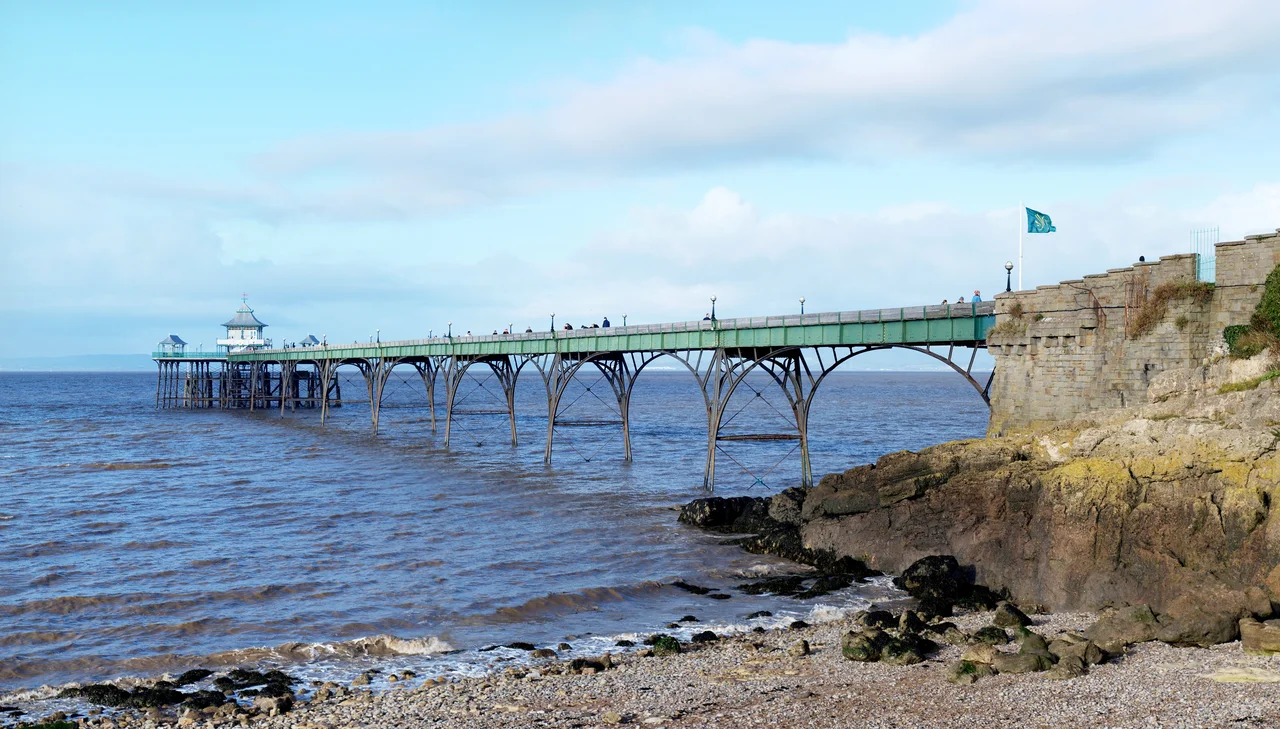

Clevedon Pier
On 16 October 1970, eighteen polyethylene tanks sat on Clevedon Pier, each one filled with ten inches of water to simulate the weight of a Victorian crowd. The first six spans took the strain. Then span seven gave way, span eight followed it, and a structure that had carried paddle steamer passengers for over a century was suddenly broken in half. Demolition was proposed. What happened next - the dismantling, the restoration, the patient reassembly over nearly two decades - is why you can still walk all 312 metres out into the Bristol Channel today.
Built From Brunel's Cast-Offs
When the Clevedon Pier Company set its engineers loose in 1867, they faced a problem and a bargain in the same breath. The Severn Estuary's tidal range, one of the largest in the world at 48 feet, demanded a structure that could withstand water rising and falling like a slow breath. The bargain was a stockpile of Barlow rails, recently pulled from Isambard Kingdom Brunel's South Wales Railway and looking for a second life. John William Grover and Richard Ward riveted them together into eight slender spans of one hundred feet each, and architect Hans Price designed the pier's iron-and-timber face. The whole thing rose on cast iron pillars two feet thick at the seabed. Around 370 tons of wrought iron, much of it once carrying steam trains across the very estuary the pier now reached into.
The Steamers and the Tunnel
The pier opened on 29 March 1869 with a cannon volley from the First Somerset Artillery and a parade through the seaside town. The original idea had been ambitious: ferry passengers from London-bound trains across the estuary to South Wales, cutting the long detour through Gloucester. The Severn Tunnel undercut that dream when it opened in 1886, dragging the rail trade under the riverbed. But Clevedon had already become something else. The paddle steamer Waverley called for the first time that same year, and the White Funnel Fleet - Ravenswood, Westward Ho, Cambria, Britannia - made the pier their regular stop. For almost a century, day-trippers crossed its boards to ride the Bristol Channel.
The Collapse and the Resurrection
The 1970 collapse should have been the end. Insurance companies had insisted on the stress tests since the 1950s, and the failed result was unambiguous: spans 7 and 8 lay broken, the pavilion stranded at the end of the pier like an island. Local funds rallied. Heritage grants followed. Engineers eventually decided that the only honest path was to dismantle every span, restore each piece, and put it back. Partial reopening came in 1989. Full reopening waited until 1998, nearly three decades after the collapse. The next year, the National Piers Society named it Pier of the Year. In 2001, it became one of only two seaside piers in England with Grade I listing - the highest possible designation - sharing that distinction at the time with Brighton's West Pier, which fire and storms would soon destroy.
Pop Culture and Pilgrimage
In 2009, Keira Knightley filmed scenes here for Never Let Me Go, and the pier ended up on the promotional posters. A few years later, the boy band One Direction shot the music video for You and I along its boards. A plaque went up to mark it. None of this seemed particularly weighty until October 2024, when Liam Payne died and fans began arriving at the pier with flowers. The plaque became a vigil site. In January 2025, a memorial plaque to Payne was installed alongside it. A Victorian engineering relic and a 21st-century pop landmark, holding the same patch of estuary.
What the Tide Reveals
At high tide, the legs of the pier vanish almost entirely. At low tide, the whole skeleton emerges - cast iron pillars two feet thick, rusted to a deep orange-brown, standing in the pebbled mud of Clevedon Shore. That shore itself is a geological Site of Special Scientific Interest, its rocks shot through with baryte and copper sulphides, the visible side of a mineralised fault running east-west under the estuary. The water above runs brown with sediment churned by the tide. Stand at the pier head as the Waverley or her sister Balmoral noses in for the summer season, and the same scene plays out that has played out since 1886, paused only briefly by a collapse that should have ended the story.
From the Air
Clevedon Pier sits at 51.4432°N, 2.8632°W on the east shore of the Severn Estuary, roughly 12 miles southwest of Bristol. Visible from cruising altitude on clear days as a slender 312-metre line projecting from the Somerset coast. Nearest airport is Bristol (EGGD) about 10 miles to the east; Cardiff (EGFF) lies across the estuary 20 miles to the west. Best viewed at lower altitudes during clear weather when the tide is out and the iron legs are exposed. The Severn's huge tidal range and notoriously brown, turbid water make for distinctive photography from the air.
Nearby Stories
- Berkeley Castle 1 km away
- Tower Colliery 5.9 km away
- Battle of Sedgemoor 5.9 km away
- Royal Victoria Park 7.1 km away
- Ewenny Priory 8.9 km away
- Crumlin Viaduct 10 km away
- Stourhead 11 km away
- Exmoor 16 km away