_exhibition_-_geograph.org.uk_-_6282936.jpg)
Battle of Sedgemoor
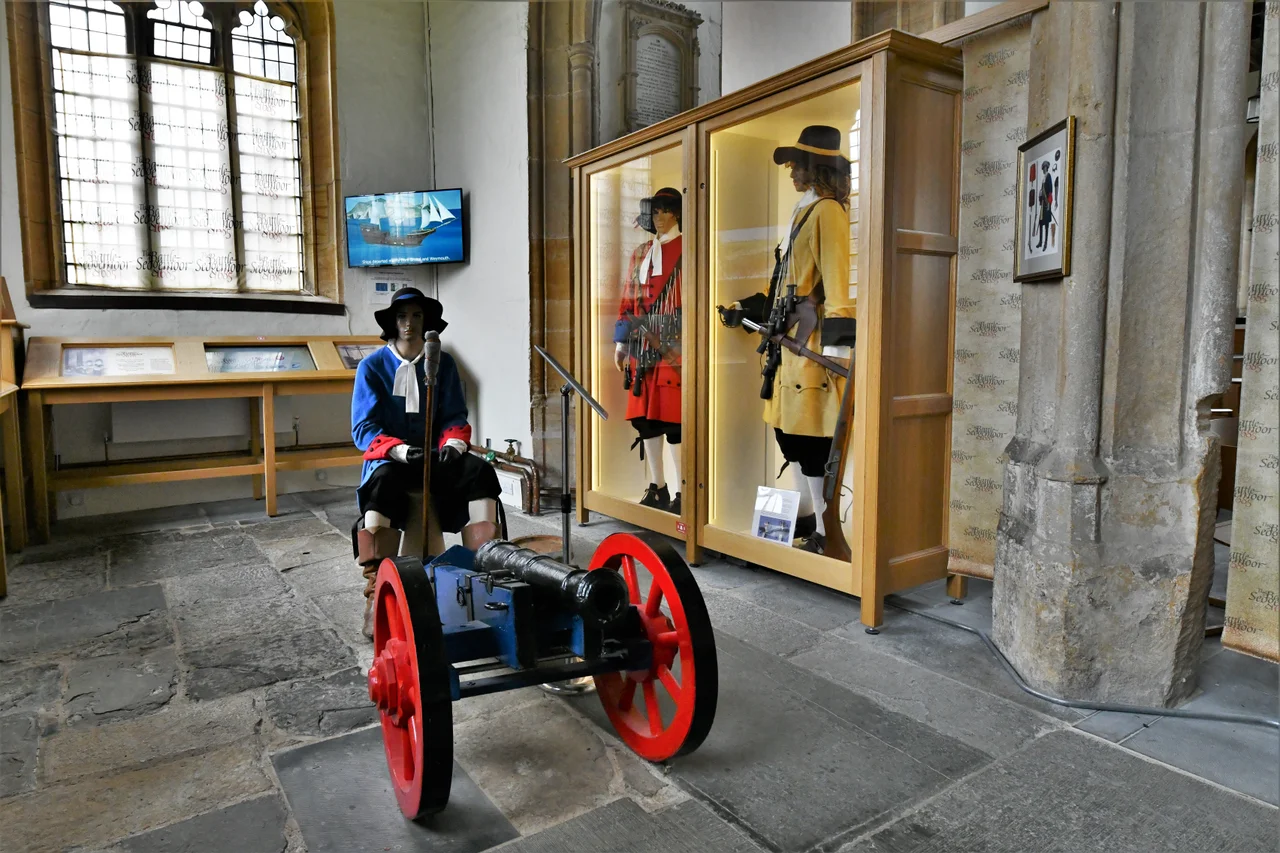
By the night of 5 July 1685 the Duke of Monmouth had run out of options. His army of West Country Protestants, around 3,500 strong, was hemmed in at Bridgwater. Most of them were nonconformist artisans and farm workers carrying scythes and pitchforks. Six hundred royal troops camped a few miles east at Westonzoyland, supported by fifteen hundred militia and a train of artillery. Monmouth could see them from the tower of Bridgwater's parish church. He made a decision that would echo for centuries: a night attack, across open moor cut by deep drainage ditches, guided by a farmer's servant who knew the lanes. They marched out at ten in the evening. By dawn, it was over, and the battlefield held the last pitched battle that would ever be fought on English soil.
An Illegitimate Claim
James Scott, Duke of Monmouth, was Charles II's eldest illegitimate son - handsome, Protestant, and beloved by the West Country crowds who had welcomed him on a goodwill tour in 1680. When Charles died on 2 February 1685, the throne passed to his Catholic brother James, and the dread of a popish king reignited the political crisis that had divided England for years. Monmouth, exiled in the Netherlands after the 1683 Rye House Plot, decided to act. He landed at Lyme Regis on 11 June 1685 with eighty-two men, four light field guns, and 1,500 muskets. Within days he had thousands. Most were the sort of men the gentry never noticed: weavers from Taunton, farm labourers from the Levels, Dissenting tradesmen who saw a Protestant cause worth dying for. They were not soldiers. The pitchforks they carried gave the rebellion its other name - the Pitchfork Rebellion - and the dignity that history has often denied them was real even when their equipment was not.
The Royal Forces Assemble
Against this hastily armed crowd, King James assembled the professionals. The Royal Regiment of Horse rode under Aubrey de Vere, 20th Earl of Oxford. The Queen's Regiment of Horse came under Sir John Lanier. The King's Own Royal Regiment of Dragoons was led by John Churchill, the future Duke of Marlborough whose name would later become legendary at Blenheim. The First Regiment of Foot Guards marched under Henry FitzRoy, Duke of Grafton - Monmouth's own half-brother, another of Charles II's illegitimate sons, now serving the uncle Monmouth had come to depose. Louis de Duras, Earl of Feversham, held overall command. By early July they had cornered the rebel army on the Somerset Levels.
The Long March in the Dark
At about ten on the night of 5 July, Monmouth led his troops out of Bridgwater. Their guide was Richard Godfrey, a local farmer's servant who knew the field lanes. They took the old Bristol road toward Bawdrip, then turned south along Bradney Lane and Marsh Lane onto the open moor. Across that flat country ran the rhynes - deep, water-filled drainage ditches that nobody could see in the dark. The cavalry crossed the first rhyne with difficulty. The first men over startled a royalist patrol; a shot was fired; a horseman galloped off to warn Feversham. Surprise was lost before the rebel infantry had even arrived on the field. Lord Grey of Warke led the rebel cavalry forward into the dark, and the King's Regiment of Horse met them. Cannon began to speak. The royal infantry, alerted, formed up at speed.
Outflanked at Dawn
The professionals did what professionals do. The royal cavalry outflanked the rebel line. The royal artillery, well-positioned, opened on Monmouth's untrained troops. The pitchforks and scythes were no answer to musket volleys delivered by men who had drilled for years. Hundreds of rebels were cut down where they stood. Estimates of the rebel dead range from 727 to as many as 2,700, the wide gap itself a measure of how little anyone counted the bodies of farm workers. Royal losses were twenty-seven men, buried in the churchyard of St Mary the Virgin at Westonzoyland. About five hundred rebels were taken prisoner and locked into the same church - the building Monmouth had used as his lookout tower hours before. Many of them were already wounded. Monmouth himself fled the field and was found two days later, hiding in a ditch in Dorset. He begged James II for mercy. He was beheaded at Tower Hill on 15 July 1685, by Jack Ketch. It took multiple blows of the axe to sever his head; the official Tower of London record says five, other accounts say seven or eight.
The Bloody Assizes
What followed was, for the West Country, worse than the battle. Judge George Jeffreys arrived in Taunton in September 1685 to try Monmouth's supporters. The trials became known as the Bloody Assizes. Around 320 people were condemned to death. About 800 more were sentenced to penal transportation to the West Indies for ten years of hard labour. Those condemned to death were not simply hanged. Many were drawn and quartered - hanged until barely alive, then disembowelled, beheaded, and cut into pieces, the parts displayed on gibbets across the West Country as a warning. The Hewling brothers, Benjamin and William, were both sentenced. Benjamin's sister managed to pay £1,000 for him to be hanged rather than quartered. William died on the scaffold. Daniel Defoe, who had fought as one of Monmouth's rebels, escaped with a heavy fine and the loss of much of his land - he would later write Robinson Crusoe in part to recover his fortunes. The villages of the West Country lost sons by the dozen; gibbets remained at crossroads for years; the smell of tar-preserved bodies would have hung over particular places for months. The land remembered.
Three Years Later
James II spent his political capital harshly. He pushed Catholics into senior positions, tried to repeal the Test Act, raised the standing army. In 1688, when a Catholic heir was born to him, the Protestant establishment turned to William of Orange. The Glorious Revolution put James to flight without a battle of his nephew's scale. Sedgemoor proved to be the last pitched battle on English soil, though the definition itself is contested - the Battle of Preston in 1715 and the Clifton Moor Skirmish in 1745 are sometimes named as later. Culloden in 1746 was the last on British soil. A mural depicting Sedgemoor hangs at the M5 motorway services that bear its name, viewed by travellers who rarely know what happened on the moor below. The Church of St Mary the Virgin still stands at Westonzoyland; the rhynes still drain the flat fields; the wind still moves across grass that once held the bodies of farm workers who marched out with pitchforks because they believed they could not live under a Catholic king.
From the Air
Located at 51.12°N, 2.93°W on the Somerset Levels, three miles east of Bridgwater. The battlefield lies on the flat moorland between the villages of Westonzoyland and Chedzoy. Recommended viewing altitude is 1,500-3,000 feet for clear sight of the rhynes (drainage ditches) and the road pattern that determined the rebel approach. Look for the tower of St Mary's, Westonzoyland - where prisoners were imprisoned after the battle - and the King's Sedgemoor Drain cutting north-east across the levels. Nearest airfields: Bristol (EGGD) to the north, Dunkeswell (EGTU) to the south, Exeter (EGTE) further southwest. The Polden Hills rise gently to the north, the Quantocks more dramatically to the west.
Nearby Stories
- Grand Pier, Weston-super-Mare 2.2 km away
- Royal Albert Memorial Museum 8.5 km away
- Royal Victoria Park 9 km away
- Siege of Lyme Regis 9.1 km away
- Dorset Museum 9.6 km away
- Stourhead 11 km away
- Porlock 17 km away
- Ewenny Priory 18 km away