
Dorset Museum
Thomas Hardy helped found it. That alone gives the Dorset Museum a particular weight: the novelist who turned his county into the fictional Wessex was personally involved in the institution that now keeps over seven thousand artefacts of his life and work, including the 1874 first edition of Far From the Madding Crowd and the handwritten manuscript of The Woodlanders. The museum has been on High West Street in Dorchester since 1881, and behind its crenellated parapet and Portland stone Gothic frontage sits a collection that runs from the dinosaur footprints of the Jurassic Coast to the early-Christian Hinton St Mary Mosaic.
Founded in 1846
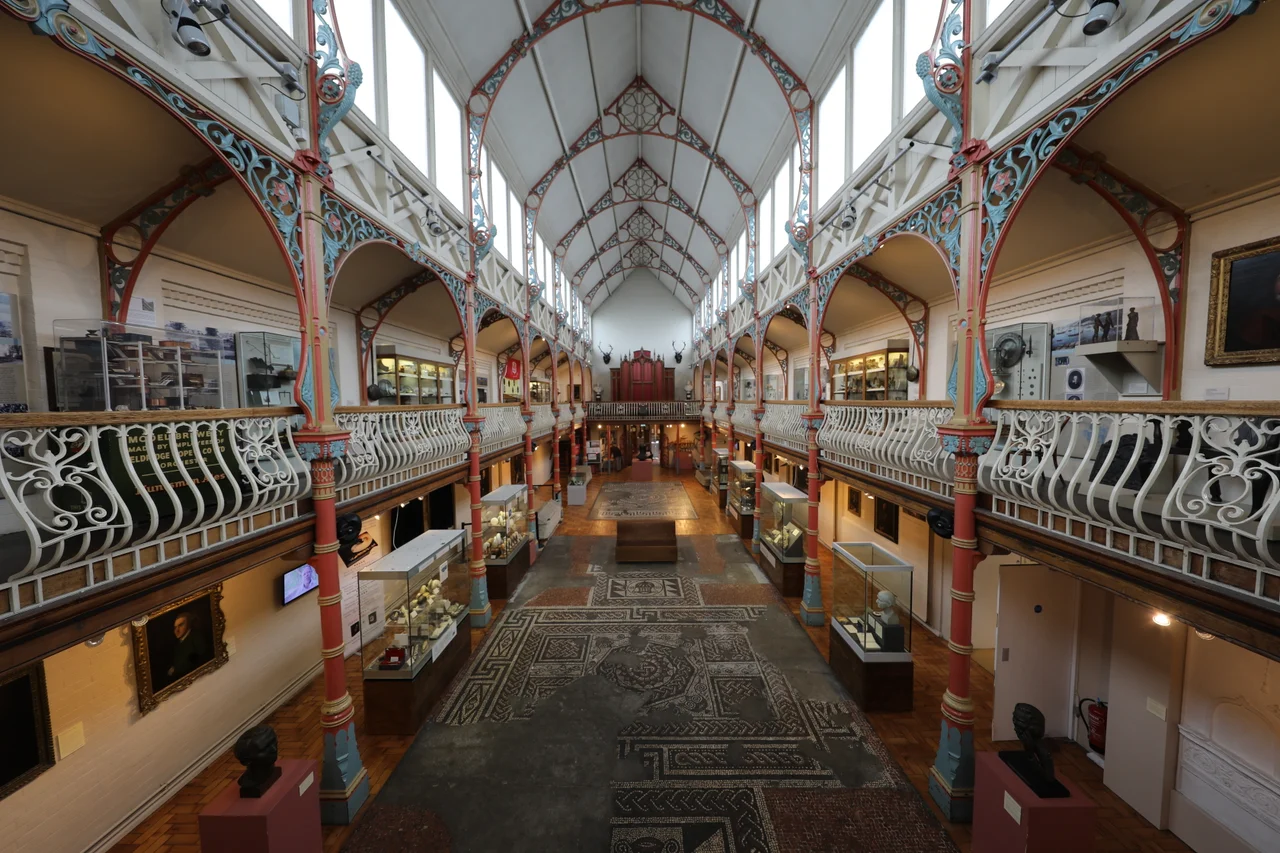
The Dorset Natural History and Archaeological Society founded the museum in 1846, and the society still owns it. For its first thirty-five years it occupied various premises in Dorchester before moving in 1881 to a building specifically designed to house the collection. The architects G. R. Crickmay and Son of Weymouth produced a two-storey neo-Gothic structure in local Portland stone, with hood mouldings over the windows, a crenellated parapet, and a striking two-storey bay with seven transom windows on the High West Street frontage. At the top of the bay a trefoil-headed panel displays the Dorchester coat of arms. The cast-iron columns and metalwork inside the aisled Victorian Hall were cast in Frome by Edward Cockey and Sons. The building was given Grade II listed status on 8 May 1975, as part of a group with the nearby Shire Hall, Holy Trinity Church and St. Peter's Church. To the rear stands John White's rectory, where the colonist priest lived while obtaining the charters that founded Massachusetts.
Hardy's Manuscripts
The Hardy archive is the museum's most famous collection. Over seven thousand artefacts trace his life and writing, from a first edition of Far From the Madding Crowd to the handwritten manuscript of The Woodlanders. Hardy's sister's dress, which is thought to have inspired the dress worn by the title character in Tess of the d'Urbervilles, is preserved here. A reconstruction of Hardy's study has been built from his original furniture and books. For readers of Hardy's Wessex novels, the museum is the place where the fiction grounds itself in real objects: the inkstand, the spectacles, the desk where Tess and Jude and the Mayor of Casterbridge first took shape on the page. Dorchester is the model for Hardy's Casterbridge, and the museum is its archive of memory.
The Jurassic Coast Indoors
Dorset's coast is one of the most important geological landscapes on Earth, a stretch of cliffs that records 185 million years of the Mesozoic. The Dorset Museum holds the inland complement: a fossil collection that runs to many thousands of specimens, including fossilised dinosaur footprints lifted from the local stone. Roman Dorset is represented through mosaics and bronzes, and the Ancient Dorset Gallery, opened by the archaeologist Julian Richards in November 2015, displays Viking artefacts from a nearby burial site alongside prehistoric flint hand axes, an Iron Age bronze mirror, and three Neolithic jadeite axes and mace heads loaned from the British Museum. Between February and May 2018 the museum hosted Dippy, the famous plaster-cast Diplodocus that had spent decades in the entrance hall of the Natural History Museum in London. The total collection now extends to approximately four million items.
The Mosaic at the Centre of an Argument
The Hinton St Mary Mosaic, a fourth-century Roman pavement found in a Dorset village in 1963, contains what may be the only known representation of Christ on an ancient pavement, set into the central roundel as a beardless youth flanked by pomegranates. It has been in the British Museum's collection since shortly after its discovery. For decades, locals have asked for it to come home. In August 2019 the British Museum told villagers of Hinton St Mary and the Chair of the Dorset Unitary Authority that the mosaic would be partially returned to the Dorset County Museum. The head of Christ, however, would not. The original would be loaned to museums worldwide. A replica would go to Dorchester. The Association for the Study and Preservation of Roman Mosaics objected that the mosaic's full meaning could only be understood when all the heads and figure scenes were displayed together. In July 2022 the Blackmore Vale newspaper reported that discussions about returning the artefact to Dorchester were at an advanced stage. The argument continues.
The Sixteen Million Pound Rebuild
By 2016 the museum had outgrown its Victorian building. Much of the collection was being stored away from the public, in the nearby All Saints' Church and elsewhere. That year the trustees unveiled plans for a £13 million extension that would include a new learning centre, cafe, library, and shop, allowing the full collection to come together under one roof. Renamed the Dorset County Museum (and from 2021 simply the Dorset Museum) the building closed for refurbishment in October 2018. The final cost rose to £16.4 million. When the museum reopened in 2021 it was substantially the same Crickmay Gothic shell, restored and re-presented, with new gallery space, expanded archives, and the kind of public facilities the original Victorian institution had never quite managed. William Barnes, the Dorset dialect poet whom Hardy admired, has had his own gallery here since 2016, opened by Bonny Sartin of the folk group The Yetties.
From the Air
Located at 50.716°N, 2.437°W on High West Street in central Dorchester, the county town of Dorset. The museum sits among other listed buildings including the Shire Hall and adjacent churches. Best viewed at 2,000-3,000 feet to take in central Dorchester and the surrounding chalk downland. Nearest airfields: Bournemouth Airport (EGHH) 23 nm east, Compton Abbas (EGHA) 14 nm north-east, Henstridge (EGHS) 20 nm north. The South Dorset Ridgeway and Maiden Castle Iron Age hillfort are striking landmarks just to the south of the town.
Nearby Stories
- Highcliffe Castle 4.2 km away
- Muchelney Abbey 4.9 km away
- Lyme Bay Canoeing Disaster 6.3 km away
- Shaftesbury Abbey 6.8 km away
- HMS Warrior (1917) 11 km away
- Mottisfont Abbey 17 km away
- HMS Formidable (1898) 31 km away
- Battle of Cherbourg (1864) 78 km away