_deck.jpg)
Battle of Cherbourg (1864)
Sunday morning, 19 June 1864. Crowds stood on the cliffs above Cherbourg to watch. Excursion trains had brought them out from Paris. They saw two American warships, one Union and one Confederate, steam in slow circles around each other a few miles offshore, edging out of French territorial waters, then turning to fight. The painter Edouard Manet sketched what he could see and would later make two oil paintings from those sketches. The fight lasted just over an hour. When it was done, the Confederate raider Alabama had a hole below her waterline that the Union sloop Kearsarge had punched through with eleven-inch Dahlgren shot, and she was sinking stern-first into the English Channel.
A Tired Raider in a Neutral Port
CSS Alabama had been at sea for nearly two years and had captured or sunk more than sixty Union merchant ships. Her boilers were burned out, her seams were open, the copper on her bottom was peeling away in sheets. Her executive officer, John McIntosh Kell, said she was loose at every joint. Captain Raphael Semmes brought her into Cherbourg on 11 June 1864 hoping to enter a French drydock for repairs. Word of her arrival traveled fast. USS Kearsarge, under Captain John Ancrum Winslow, was watching the French coast. By 14 June he was outside Cherbourg, telegraphing for reinforcements and waiting. Alabama could not stay in a neutral port indefinitely. Semmes had to choose between scuttling, surrendering, or fighting. He chose to fight.
Chain Mail in the Channel
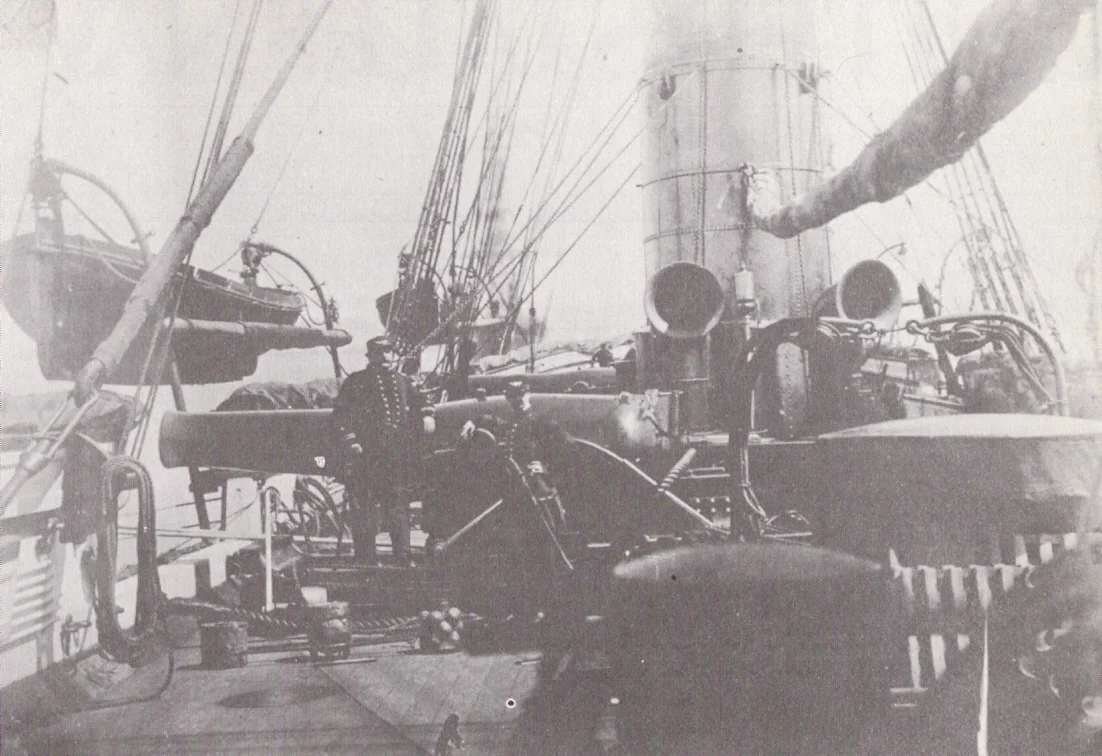
The two ships were similar in size, but not in protection. Kearsarge carried two eleven-inch Dahlgren guns that threw 166-pound solid shot, four 32-pounders, and a Parrott rifle. Alabama had six 32-pounders broadside and two heavier pivot guns. The decisive difference was hidden against Kearsarge's hull. Winslow had hung medium-weight chain cable in tiers along the port and starboard midsections, an improvised chain mail to protect the boilers and steam engine. Alabama scored only two hits in that area during the entire battle, both well above the waterline. Either of her heavier pivot guns could have penetrated the chain. Neither hit it. The other inequality was harder to fix. Alabama's powder, after years at sea, had gone damp.
An Hour and Eleven Minutes
Alabama left harbor under escort of the French ironclad Couronne, whose orders were to make sure the fight happened outside French waters. Kearsarge withdrew, turned, hoisted the Union jack, and waited for the range to close. Alabama fired first, then kept firing, more than 370 rounds in the course of the action, fast and inaccurate. Kearsarge fired slowly, deliberately, and well. After about an hour Alabama was holed below the waterline and beginning to fill. Semmes struck his colors. Kearsarge kept firing until a white flag appeared, raised by a Confederate sailor who waved it with his hand. Then Semmes sent his last serviceable dinghy across to ask for aid. Nineteen of his men were dead or had drowned, twenty-one were wounded, and his ship was going down. About seventy were picked up by Kearsarge. Three French pilot boats and an English yacht called Deerhound came out to help with the rest.
The Deerhound's Choice
Captain Winslow had personally asked the yacht to help evacuate Alabama's crew. Instead her owner, John Lancaster, took Semmes and fourteen of his officers aboard, turned east, and made for Southampton without delivering the prisoners. Kearsarge's crew begged Winslow for permission to open fire on the yacht. He refused. Semmes escaped to England and lived to be paroled, write his memoirs, and serve briefly as a Confederate brigadier general before the war's end. Three sailors aboard Kearsarge were wounded; one of them died the next day. The Battle of Cherbourg was over so quickly that many of the spectators on the cliffs had been still settling in when it ended. The Confederacy had lost its most famous and successful commerce raider. The Union had silenced it just under a year before Appomattox.
What the Sea Kept
When word reached the northeast, Northerners celebrated. Edouard Manet's painting The Battle of the Kearsarge and the Alabama went on view at the Galerie Cadart in Paris before the year was out. It hangs now in the Philadelphia Museum of Art. American sailors made a sea shanty called Roll, Alabama, Roll, mourning the ship, not the cause. In November 1984 a French naval team located Alabama's wreck about six miles north of Cherbourg in sixty meters of water. France and the United States agreed in 1989 to treat the site as common historic heritage of both nations. The CSS Alabama Association has been excavating since, recovering the ship's bell, her guns, parts of her structure, table settings, furniture. In 2004 a human jaw was found beneath one of the cannons and was buried with honors at Mobile, Alabama. The cause both crews fought for was unequal in ways that history has since judged. The men on both ships, on this June Sunday in the Channel, fought and died and survived alongside one another, and what the sea has returned belongs to both.
From the Air
The Alabama wreck site lies about ten kilometers north-northwest of Cherbourg at roughly 49.75 deg N, 1.70 deg W, in sixty meters of water. The battle was fought a few miles further offshore in international waters. Cherbourg-Maupertus Airport (LFRC) is ten kilometers east of the city. From altitude the long curve of the Cherbourg breakwater and the deep rade are unmistakable. The Channel Islands of Alderney and Guernsey are visible to the northwest.
Nearby Stories
- Alderney Lifeboat Station 14 km away
- Orglandes German War Cemetery 19 km away
- History of the Jews in Guernsey 21 km away
- HMS Warrior (1917) 31 km away
- Durlston Castle 61 km away
- D-Day: The Longest Day 67 km away
- Fishbourne Roman Palace 84 km away
- Basilica of Sainte-Therese, Lisieux 121 km away