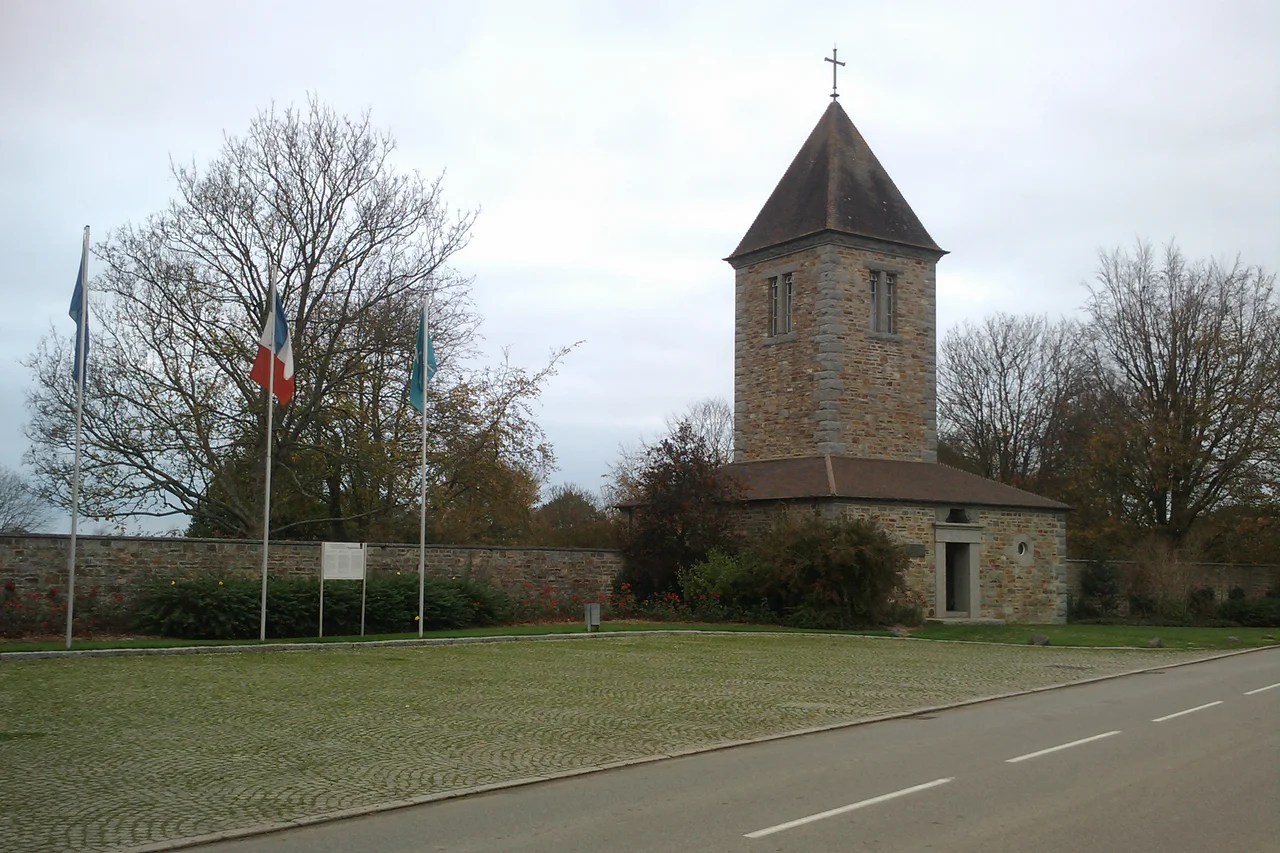

Orglandes German War Cemetery
Each stone cross at Orglandes carries six names. Six dates of birth, six dates of death - and the math is always the same. The soldier born in 1925 died in 1944. The one born in 1926 died in 1944. Page after page across 28 rows, more than 10,000 young Germans share the ground here on the Cotentin Peninsula, 30 kilometres southeast of Cherbourg. They never made it home from the summer of D-Day. Most of them never got to be men.
A Field That Changed Hands
The cemetery began as something else entirely. On 20 June 1944, two weeks after the Normandy landings, the 603rd Quartermaster Graves Registration Company of the United States Army cleared this Norman field for the burial of American soldiers killed in the breakout from Utah Beach. A second plot was added for German dead, and the two armies that had just torn each other apart lay side by side in the same hedgerow country. By the war's end, more than 7,300 German soldiers had been laid here. Then the families back home in Pennsylvania, in Ohio, in Iowa began asking for their sons to come back, and the American Battle Monuments Commission obliged. Two-thirds were shipped across the Atlantic. The rest were moved to the white-cross fields above Omaha Beach at Colleville-sur-Mer. The American plots stood empty - until French authorities began bringing in the German dead from 1,400 scattered field burials across Normandy.
Six to a Cross
The headstones at Orglandes are unlike anything at the American cemetery. Where the United States gives each fallen soldier a single marble cross or Star of David, the Volksbund Deutsche Kriegsgräberfürsorge - the German War Graves Commission - groups its dead in sixes. Each dark stone cross at Orglandes is double-sided, three names facing one direction and three facing the other. The Franco-German War Graves Agreement of 1954 authorized the gathering, and between 1958 and 1961 the Volksbund redeveloped the site into what visitors see today. During those reinterments, names long lost to mud and improvisation were recovered: dog tags read, paybooks identified, soldiers who had been buried as unknowns finally given back their identities. The grounds were inaugurated on 20 September 1961. A small house surmounted by a bell tower marks the entrance. Beyond it, the rows stretch on - 10,152 graves in all.
The Ones Who Died After
Tucked among the rows is a single mass grave that does not belong to the Battle of Normandy. Twenty-two German prisoners of war are buried together here, killed on 25 October 1945 - months after the surrender, when the shooting was supposed to be over. They were a mine clearance team working at Asnières-en-Bessin near Bayeux, sweeping the Norman beaches that had been seeded with mines and demolition charges by their own army the year before. Something went wrong. The explosion was so violent that the men's remains could not be separated. They were buried as they were found: together. It is the sort of detail that resists tidy storytelling. The war that took them had officially ended. The mines they were clearing had been laid by men they once called comrades. They cleared Norman beaches so French children would not be blown apart, and the beaches killed them anyway.
Quiet Among the Hedgerows
Orglandes is the second smallest of the six German war cemeteries in Normandy, and that smallness is part of what makes it powerful. The famous American cemetery at Colleville draws millions; Orglandes draws hundreds. The crosses are darker, the grass less manicured, the atmosphere unmistakably more melancholy. The Volksbund maintains these sites not as victory monuments but as quiet apologies, places where the descendants of soldiers conscripted into Hitler's army can visit graves their grandmothers never saw. Many visitors leave small stones on the crosses, the Jewish custom of remembrance now adopted across faiths. The boys buried here did not choose the war. They were drafted, sometimes at sixteen or seventeen, and sent west to defend an Atlantic Wall against an invasion their leaders insisted would never come. Then it came, and the hedgerows of the Cotentin became the place where their lives ended.
Reading the Stones
Walk slowly here. Read a few of the crosses. The birth years cluster in the mid-1920s; the death dates cluster in June, July and August 1944. Some men were older - reservists, fathers, men who had survived the Eastern Front only to die in a Norman lane. But the great mass of them were 18, 19, 20. They died in the bocage country south of Cherbourg, in apple orchards turned into killing grounds, in fields the locals had farmed for a thousand years. The German War Graves Commission lists each name where it can. Where it cannot, the cross simply reads ein deutscher Soldat - a German soldier. The unknowns are buried alongside the named, six to a stone, facing one another in the dirt.
From the Air
Coordinates 49.43°N, 1.45°W on the central Cotentin Peninsula, roughly 30 km southeast of Cherbourg and 7 km west of Sainte-Mère-Église. The cemetery is a small dark rectangle on the northern edge of the village, surrounded by classic Norman hedgerow farmland. Best viewed at 2,000-4,000 feet AGL. Nearest airports: Cherbourg–Maupertus (LFRC) 28 km north, Carentan (LFAD) 18 km east, Caen–Carpiquet (LFRK) 90 km southeast. The flat Cotentin terrain offers excellent visibility in clear weather; expect coastal haze and Channel marine layer in mornings.
Nearby Stories
- Battle of Cherbourg (1864) 8.1 km away
- History of the Jews in Guernsey 16 km away
- German Submarine U-672 44 km away
- D-Day: The Longest Day 63 km away
- Mont Saint-Michel: The Abbey That Becomes an Island Twice a Day 65 km away
- Basilica of Sainte-Therese, Lisieux 94 km away
- Fishbourne Roman Palace 123 km away
- 1941 Santander Fire 654 km away