
Royal Albert Memorial Museum
A million objects sit inside the Royal Albert Memorial Museum, only a sliver of them on display at any one time. The rest live in the Ark, an off-site collections store built during the museum's £24 million refurbishment. The Gothic Revival sandstone building on Exeter's Queen Street looks small from the street. It is not. Founded in 1868 as a practical memorial to Prince Albert, the place was meant from the start to fuse a museum, art gallery, free library, reading room, and schools of art and engineering. RAMM kept growing into that vision, and it has never quite stopped.
Albert wanted something useful
After Prince Albert died in 1861, Britain wanted to remember him. Sir Stafford Northcote, MP, proposed something more interesting than another statue: a practical institution built around the principles Albert had championed. Land was donated by Richard Sommers Gard, MP for Exeter from 1857 to 1864. A design competition drew twenty-four entries; John Hayward's Gothic Revival proposal won. The original plan called for a tall central tower, like the one at the Oxford University Museum of Natural History, but the budget rejected it. A gable and a rose window took its place. The first phases opened in 1868. From the start, RAMM was a hub: Exeter's university, central library, and college of art all trace their origins to what locals simply called the Albert Memorial. The collection outgrew the building almost immediately. Extensions followed in 1894 and 1898.
Sladen's sea stars
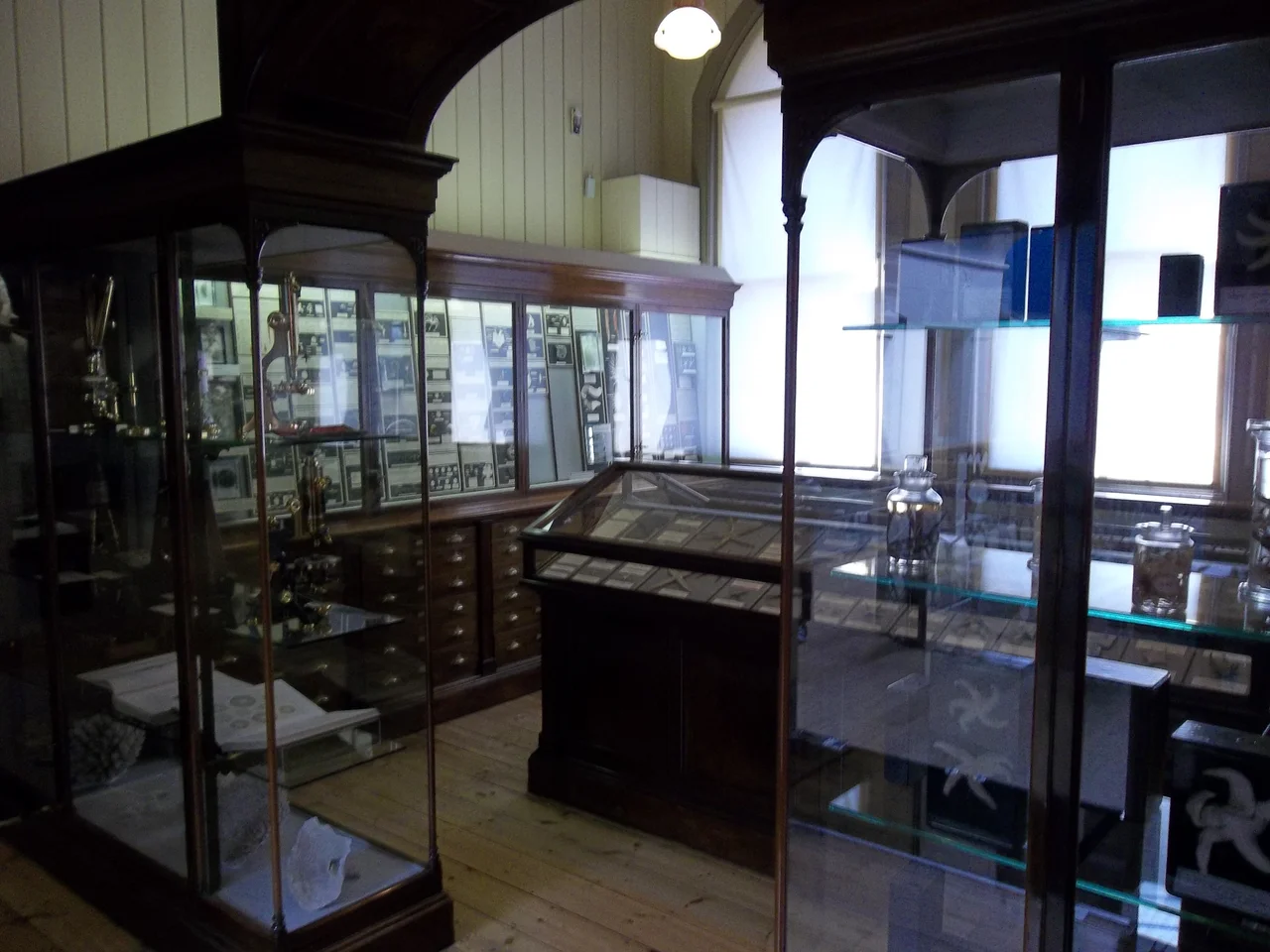
If you can name the four major collection areas at RAMM, you get a sense of how omnivorous Victorian curators could be. Antiquities. Art. Natural history. World cultures. The UK government has designated RAMM's world cultures collection as being of national and international significance, which is a polite way of saying it is one of the most important regional ethnographic collections in Britain. The natural history side holds Percy Sladen's collection of echinoderms, sea stars and brittle stars and their relatives. RAMM holds Sladen's collection, considered the most important of its kind held outside any national collection. The costume and textiles holdings are similarly remarkable: the University of Brighton rates them as among the most important outside London. They are not on permanent display because the materials are too delicate, which means visitors walk past tens of thousands of pieces of textile history without knowing it.
Names on the walls
The art collection runs to over 7,000 objects, leaning into the South West's contribution to British art. Gainsborough, Reynolds, Pompeo Batoni, Richard Wilson, Joseph Wright of Derby. Twentieth-century names: Walter Sickert, Barbara Hepworth, John Nash, Edward Burra, David Bomberg, Patrick Heron. William Powell Frith's 1872 painting The Fair Toxophilites hangs here, all crinolines and archery. George Townsend's local-history scenes show East Gate in 1483 and shipwrecks on Exmouth beach. Olive Wharry painted St Sidwell's Church after the Blitz reduced it to bones. Patron names matter too: Kent Kingdon, an upholsterer; Sir Harry Veitch of the great horticultural firm Veitch and Sons; John Lane, founder of The Bodley Head publishing house. The collection is partly a portrait of how Exeter's commercial and creative class chose to invest in itself.
The four-year overhaul
By the early 2000s the Victorian building needed serious work. A four-year, £24 million redevelopment closed RAMM and stripped it back. The Heritage Lottery Fund contributed nearly £10 million. The team repaired the fabric, refurbished the interiors, completely redisplayed the collections, added an extension, and opened a new entrance from the historic gardens at the rear. The off-site Ark was built and fitted to hold what could not be shown. RAMM reopened on 15 December 2011 and almost immediately started winning prizes. The Art Fund named it the United Kingdom's Museum of the Year in 2012, citing its 'ambition and imagination.' Since then, RAMM has collected more than a dozen awards, including three regional RIBA awards in 2013 and the American Event Design Award for Best Museum Environment in 2012.
Opening the doors wider
In 2024 RAMM announced an open access strategy: it would make its public domain collections available to anyone. The reasoning was both philosophical and practical. Wider awareness means longer preservation. A digital echinoderm photograph sitting on someone's website is one more record of a specimen that might, centuries from now, exist only in those images. Edward Bowring Stephens, the Devon-born sculptor, gave his own labour gratis when he carved the statue of Prince Albert that still stands on the museum's main staircase, inscribed 'E B Stephens ARA 1868.' He was a benefactor and a promoter of what RAMM would become. The doors are still free to enter, 10am to 5pm every day except Mondays and bank holidays, and Stephens's prince still presides over the staircase. The arrangement seems to be working.
From the Air
RAMM sits at 50.7251N, 3.5323W on Queen Street in central Exeter, three blocks north of Exeter Cathedral. The Gothic Revival sandstone facade is visible from medium altitudes when light catches the New Red Sandstone. Best viewed at 800 to 1,500 feet AGL during a tour of central Exeter. Exeter Airport (EGTE) is 4 nm east. The cathedral and RAMM together make Exeter's old core legible from the air; both are within a five-minute walk on the ground.
Nearby Stories
- Manor of Orleigh 1.4 km away
- Berry Pomeroy Castle 3.9 km away
- 1890 Norton Fitzwarren Rail Crash 5 km away
- North Cornwall Railway 6.9 km away
- St Germans Priory 8.7 km away
- Siege of Lyme Regis 16 km away
- Exmoor 19 km away
- HMS Formidable (1898) 26 km away