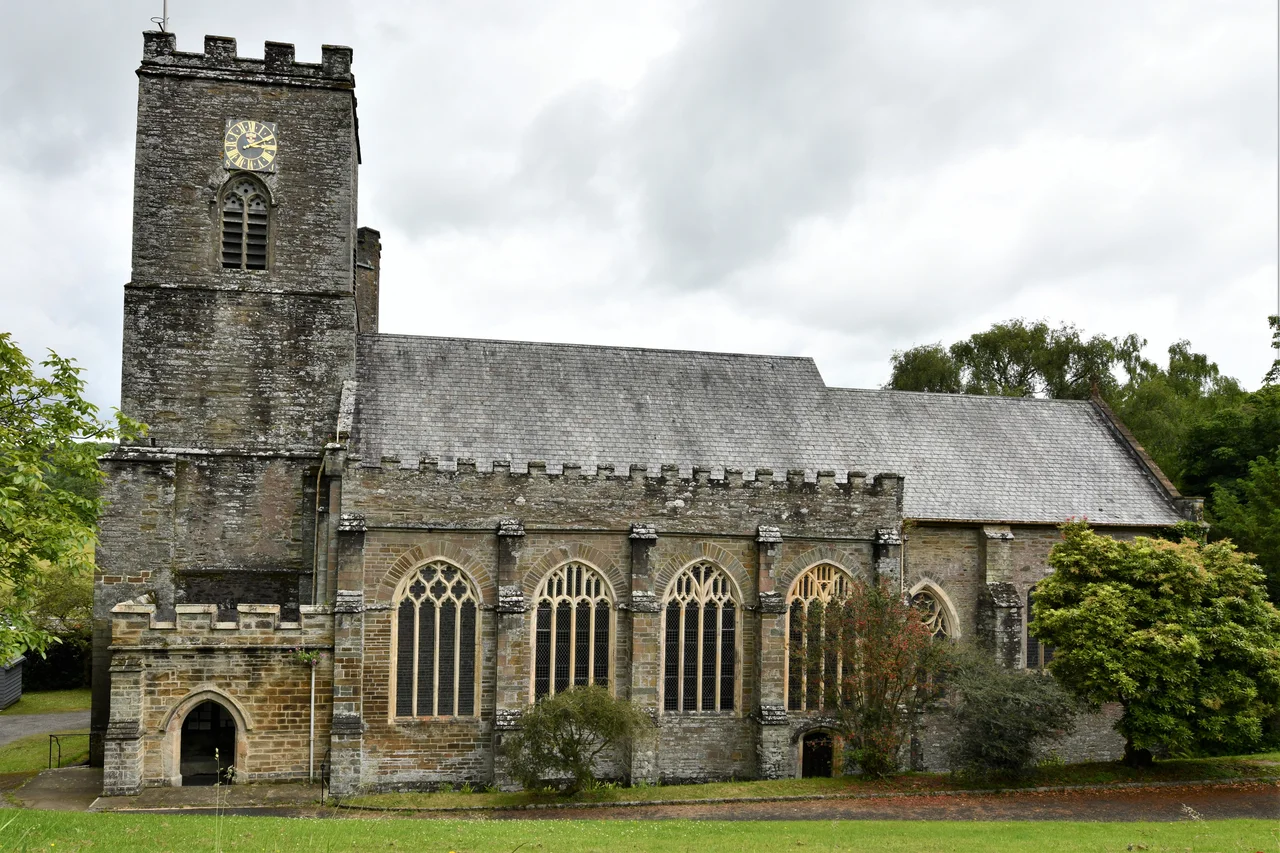

St Germans Priory
For 116 years, this was a cathedral. In 926 AD, King Athelstan settled with Cornwall by appointing Conan as the bishop of a new Cornish see, and he fixed the bishop's seat at the existing Celtic monastery of St Germans. The arrangement did not last long - in 1042 the see was moved to Crediton, and from there eventually to Exeter and then Truro - but the church here was already old when Athelstan arrived. Tradition says it was founded by St Germanus himself in the fifth century, and the Celtic monastery he or his followers established was important enough by the tenth century to host a bishop. The building that survives is Norman, rebuilt on a grand scale by Augustinian canons between 1161 and 1184, with two western towers and a nave 102 feet long. Step through the ornate elvan doorway and you are walking into a thousand years of Cornish ecclesiastical memory, much of it forgotten by Cornwall itself.
The Cathedral of Cornwall
Before there was a Truro Cathedral - before Cornwall existed as a coherent ecclesiastical region - there was a Celtic monastic community at St Germans, holding land granted by Saxon kings and recording its founders in the kind of layered tradition that makes early-medieval church history half-history and half-myth. King Canute confirmed two of its holdings in 1018, in Landrake and Landulph, originally granted by King Edmund. Both holdings stayed in the monastery's possession for the next five centuries. When the bishopric moved to Crediton in 1042, the lands were divided - one part for the monastery, one for the new Bishop of Crediton, who named his share Cuddenbeak. After the Norman Conquest a college of secular canons was established here, then around the 1160s the Bishop of Exeter reorganised them as Augustinian regular canons. They rebuilt the church on a much grander scale, intending it to look like what it had briefly been: a cathedral.
Norman Stone, Cornish Quarries
The Norman features that survive are concentrated at the west end. The large arched western doorway is particularly ornate, carved from elvan - a hard, fine-grained Cornish volcanic rock quarried at nearby Landrake - and decorated with the kind of chevron and beak-head moulding that Norman masons used to signal importance. Two western towers flank the entrance, an unusual configuration for a parish church and a clear vestige of the building's cathedral ambitions. A mortuary chapel for the Moyle family of Bake sits within the church. A peal of eight bells hangs in the tower. At Dupath Well a few miles away, the surviving well-house is said to have been built by the monks of St Germans in 1510 - one of the most complete medieval wellhouses in Cornwall, with its barrel-vaulted granite roof still in place. The priory's reach extended across the south-east of the county. St Germans parish was once the largest in Cornwall.
The Eliot Family Takes Over
At the Dissolution of the Monasteries under Henry VIII, the priory was abolished and its buildings - the cloister, the prior's lodgings, the domestic ranges - were granted to the Eliot family, who converted them into a private house. The house is called Port Eliot. It is still in Eliot hands, more than four hundred and fifty years later. A number of the family are interred in the church, including John Eliot, 1st Earl of St Germans, Henry Eliot, 5th Earl of St Germans, Edward James Eliot, and Edward Craggs-Eliot, 1st Baron Eliot. The priory church itself, freed from monastic ownership, became the parish church of St Germans, which it remains - managed today by the Church of England and the St Germans Priory Trust. The transition is unusual in its smoothness. Most dissolved priory churches were either demolished entirely or reduced to a fraction of their former scale. This one kept most of itself.
Rysbrack and Burne-Jones
Inside, two later monuments stop people most. Under the north tower stands a magnificent and almost incongruous Baroque tomb in black and white marble, dedicated to Edward Elliot, MP for the rotten borough of St Germans from 1705 to 1710. The sculpture is by John Michael Rysbrack, the Flemish master who would become one of the most celebrated sculptors in early-Georgian England. He was commissioned in 1723, when this was one of his first major English works, and the monument is now considered an important early example of his career. The other showpiece is the great east window. Glazed in 1896 by Morris and Co. to designs by Edward Burne-Jones, the five-light Perpendicular window shows Christ flanked by a centurion and St Mary, sister of Lazarus, with St Mary Virgin and St Paul to the right, and below them St Stephen with the Four Evangelists - a choir of angels filling the tracery lights above. Two further three-light windows in the south wall, also Burne-Jones and Morris, installed in 1902, depict the Virtues. The donor of the east window was Alfred Burton. Burne-Jones never visited St Germans, but his images have been the first thing the morning sun has touched inside the building for more than a century.
What the Doorway Remembers
It is the west door that does the deepest work. Stand outside it - facing two Norman towers, an arched portal carved from local elvan, a building that has been a Celtic monastery, an Anglo-Saxon cathedral, an Augustinian priory, a private house, and a parish church - and you are looking at a thousand years of Cornish negotiation with its own identity. The church has outlasted the bishopric it was built to serve. It has outlasted the monastery that rebuilt it. It has outlasted the rotten borough whose MP commissioned its grandest tomb. It is Grade I listed, managed by a trust, surrounded by the estate of the family that has owned it since the Reformation, and entered every Sunday by a parish that knows very little of any of this. The doorway opens. The service begins. The Norman stone holds.
From the Air
Located at 50.397°N, 4.310°W in the village of St Germans, south-east Cornwall, just inland from the River Lynher tidal estuary. Recommended viewing altitude 1,500-3,000 ft AGL. Visual landmarks: the priory's two western towers are the most prominent feature of the village; Port Eliot estate occupies the parkland to the south and east; the river Tiddy joins the Lynher half a mile south. The mainline railway crosses the Tiddy estuary on a 1908 deviation viaduct that replaced one of Brunel's wooden originals. Plymouth lies 6 nm east. Nearest civilian airports: Exeter (EGTE) 40 nm east-north-east, Newquay (EGHQ) 36 nm west.
Nearby Stories
- Launceston Castle 2.7 km away
- East Wheal Rose 8.5 km away
- Castle Drogo 8.8 km away
- Hope Cove Lifeboat Station 13 km away
- Goonhilly Satellite Earth Station 19 km away
- Battle of Plymouth (1652) 20 km away
- HMHS Glenart Castle 55 km away
- HMS Affray 70 km away