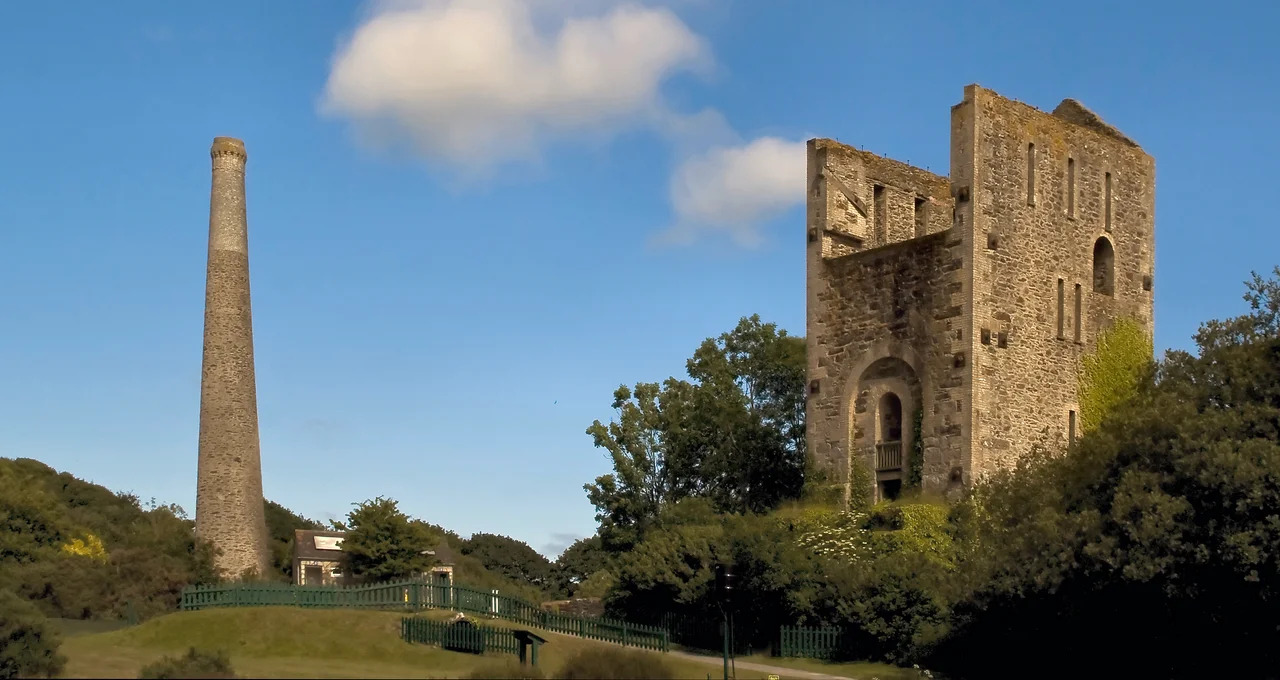

East Wheal Rose
On the afternoon of 9 July 1846, the sky over St Newlyn East darkened from one horizon to the other and split. Witnesses said the rain came down in sheets, not drops. The thunderstorm broke directly above the workings of East Wheal Rose, a lead mine where over 1,200 men, women and children worked the shafts and dressing floors. Water poured into the shafts faster than any pump could lift it. Men trapped below ground heard it coming. Some climbed for their lives. Some did not get clear in time. By evening, 39 men were dead, drowned in their own mine. The West Briton, reporting eight days later, called it one of the worst accidents in Cornish mining memory.
Lead from the Killas
East Wheal Rose lay southeast of the village of St Newlyn East, about four miles inland from Newquay on the north Cornwall coast. The country rock was killas, soft and crumbling, run through with two main lead lodes that the miners called Middleton's Lode and East Lode, both trending roughly north to south. Lead was first found in the area in 1812. The mine itself opened in 1834. By 1846 it was one of the largest employers in this corner of Cornwall, with over twenty separate shafts driven down to a deepest working of 150 fathoms, or 900 feet below the surface. The principal product was galena, a heavy grey lead sulphide ore, but as is usual with lead, the rock also yielded commercial quantities of silver and zinc, and the mine sold all three. The soft killas required so much underground timbering that the shafts looked, in some descriptions, more like underground forests than mineshafts.
The Storm
What happened on 9 July 1846 was a freak event even by Cornish standards. A summer thunderstorm of extraordinary intensity broke over the mine. Rain fell so hard that the surface streams could not contain it. The water ran across the dressing floors and poured straight down the open shafts, turning the workings into vertical waterfalls. Underground, the men who realised what was happening climbed for the ladders. Many made it to the surface, soaked and frightened. Thirty-nine did not. Some were swept off the ladders by the weight of falling water. Some were trapped at depth by rising water in lower levels. They were ordinary working miners, fathers and sons and brothers, drawn from St Newlyn East and the surrounding hamlets. The community lost a generation of them in a single afternoon. The disaster is now categorised by historians as the worst Cornish mining accident of the 19th century, and one of the worst in British mining history before the great coalfield disasters later in the century.
The Mine Reopens
What surprises modern readers is what happened next. The mine did not close. The setback, as the historical sources call it with the understatement of the time, was absorbed. The pumps were cleared, the bodies recovered, the shafts dewatered, and East Wheal Rose continued producing ore. It worked for forty more years, finally closing in 1886. On 3 June 1882 a new 90-inch pumping engine, supplied by Messrs Harvey and Company of Hayle, came into operation. Lady Innes christened it "Inne's Engine." When the 900-fathom main adit level was cleared, miners discovered new lodes and found that Middleton's Lode ran further than anyone had realised. Between 1845 and 1885 the mine produced 48,200 tons of 62 percent lead ore, 212,700 ounces of silver, and 280 tons of zinc ore. The numbers are real. The men who died in 1846 were also real, and the mine continued because that was the bargain that 19th-century miners had been forced into.
What Remains
The Lappa Valley Steam Railway, a popular narrow-gauge tourist line, now runs through part of the East Wheal Rose site, and the 1882 engine house still stands beside its track. The shafts have been capped or fenced, the dressing floors have gone back to grass, and the village of St Newlyn East rolls quietly down its lanes about a mile north of where the storm broke in 1846. There is no large public monument to the men who died, though the parish church has memorials and the date is remembered locally. The disaster is what the historians call a constitutive event for Cornish mining safety conversations, but reform was slow, and the same patterns recurred at other mines for decades. Stand on the spoil tips above the engine house on a summer afternoon, watching cloud shadows move over the fields toward Newquay and the sea, and the silence has a weight to it. Thirty-nine names, and a sky that opened on the wrong day.
From the Air
East Wheal Rose sits at 50.362 N, 5.041 W approximately 4 miles southeast of Newquay, near the village of St Newlyn East. The Lappa Valley Steam Railway now runs through part of the site. The remaining engine house from 1882 is the most visible landmark. Nearest airport is Newquay (EGHQ), about 4 nautical miles to the northwest. Best viewed below 2,000 feet AGL.
Nearby Stories
- Brane Barrow 0.7 km away
- Polperro 4.9 km away
- Goonhilly Satellite Earth Station 8.2 km away
- Launceston Castle 15 km away
- Pendeen Lighthouse 22 km away
- St Materiana's Church, Tintagel 24 km away
- Battle of Plymouth (1652) 30 km away
- SM U-27 123 km away