
Royal Victoria Park
She was eleven years old, and the throne was still seven years away. On a spring day in 1830, Princess Victoria stepped out into the bowl of green grass at the foot of Bath's Royal Crescent and declared a public park open. It would be the first park anywhere to carry her name, and it would outlast every other claim she would ever lay upon a piece of ground. Nearly two centuries later, the Crescent still looks down on the same lawns, and the same Pulteney-coloured Bath stone still glows in the morning sun. The park itself has accumulated layers: an obelisk for the girl who became empress, a Roman temple borrowed from a Wembley exhibition, two Medici lions who lost their iron skeletons to a war, and a sunken dell planted with conifers from a continent she would never see.
A Princess Opens a Lawn
The Victorian public park movement was just beginning to flower in 1830, and Bath wanted in. Private subscribers funded the new grounds, intending them as a polite refuge for the genteel city above. Victoria's role was symbolic, but the symbol stuck. She returned at age eighteen, the year of her coronation in 1837, to find a tapering triangular obelisk waiting for her near the east entrance. G. P. Manners, the city architect, had designed it as a coming-of-age tribute. Three stone lions couchant guard its base; a low relief of the young princess is carved into the plinth. The whole monument was unveiled on coronation day itself, 28 June 1838. For nearly a century the park stayed in private hands, run as part of that distinctly Victorian experiment in respectable public leisure. Bath Corporation took it over only in 1921.
The Temple That Travelled
In the north-west corner of the park, the Botanical Gardens opened in 1887, and they have since gathered one of the finest collections of limestone-loving plants in the West Country. Walk among them long enough and you arrive at something unexpected: a small replica of a Roman temple, sitting calmly under English skies. It was originally built for the British Empire Exhibition at Wembley in 1924, the same blockbuster spectacle that gave London its first Wembley Stadium. When the exhibition ended in 1926, the temple was dismantled, freighted to Bath, and reassembled in the gardens, where it has stood ever since, eventually extended into a modest interpretation centre. Above it, the Great Dell drops away into the trees, a former stone quarry that 1840s gardeners planted with North American conifers tall enough now to swallow conversation. Sound goes quiet there. The temperature drops a degree or two.
Iron, Lions, and a Scrap-Metal War
Visit the Queen's Gate entrance and you meet two bronze-coloured Medici lions on plinths, each with a gilded ball under its front paw. They look untroubled, but they have a story. The original wrought-iron gates and railings that ringed the park were torn out during the Second World War as part of Britain's national scrap-metal campaign, melted down for the war effort along with countless garden fences and church railings across the country. The lions themselves stayed, but their iron armatures rusted inside. In 2007, with Heritage Lottery Fund support, Bath and North East Somerset Council ran a programme of repair: new armatures, fresh bronze patina, restored gates with gilded decoration, and over a mile of reinstated perimeter railings. The bandstand was rebuilt. The Royal Crescent's ha-ha was tidied. Even the cast-iron lanterns that once flanked the gates were replicated and re-hung.
What Happens in a Public Lawn
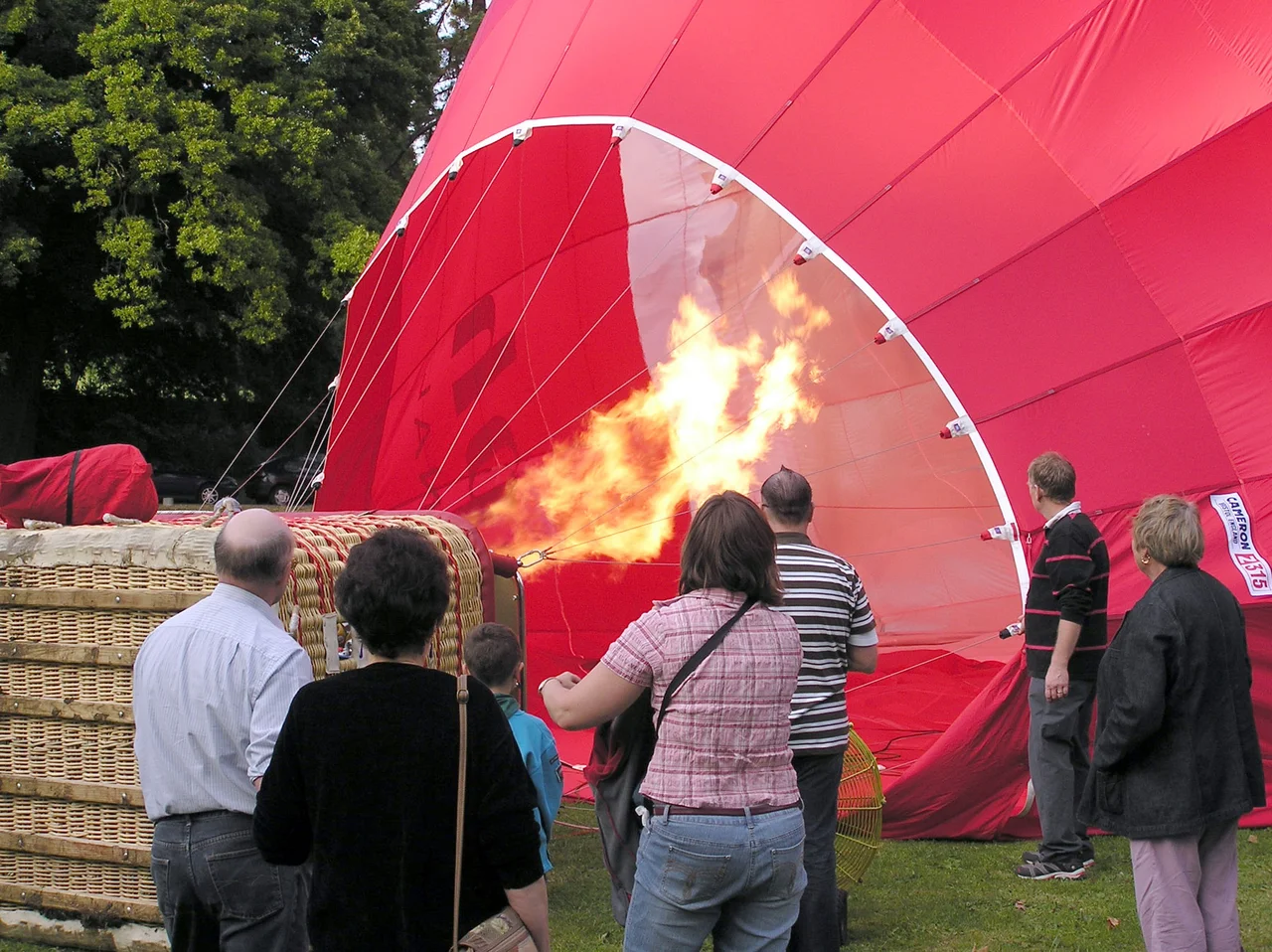
Forty-nine acres of park can absorb a lot of life. The lawns hold a bowling green, a putting green, twelve- and eighteen-hole golf courses, tennis courts, a skateboard ramp, and a children's play area that families spread out across all summer. Hot-air balloons inflate over the grass during the Vintage FunFair, sending their burners hissing into the morning. In winter an ice rink appears; in spring the Bath Children's Festival fills the May bank holiday with noise and bunting. The Tour of Britain has rolled through. Movie nights flicker across open ground. The park holds a Green Flag award and a Grade I listing on the National Register of Historic Parks and Gardens, but the honours feel almost beside the point. What matters is that a city of golden stone has, in its middle, a great breathable lung where everyone, from the toddler with a kite to the pensioner with a putter, walks free.
From the Air
Located at 51.39 degrees N, 2.37 degrees W, immediately west of central Bath and beneath the south-facing curve of the Royal Crescent. The park reads clearly from above as a roughly rectangular green expanse hemmed by Georgian terraces, with the Botanical Gardens visible as a denser planted block in the north-west corner. Nearest major airport is Bristol (EGGD), about 12 nm to the west; RAF Lyneham (closed) and Filton (EGTG) also lie within easy reach. Best viewed from 2,000 to 3,500 feet AGL in clear conditions.
Nearby Stories
- Marlborough Castle 1.4 km away
- Clevedon Pier 4.6 km away
- Stourhead 5.6 km away
- Siege of Bridgwater (1645) 8.4 km away
- Raglan Castle 10 km away
- Berkeley Castle 12 km away
- Mottisfont Abbey 20 km away
- Blenheim Palace 33 km away