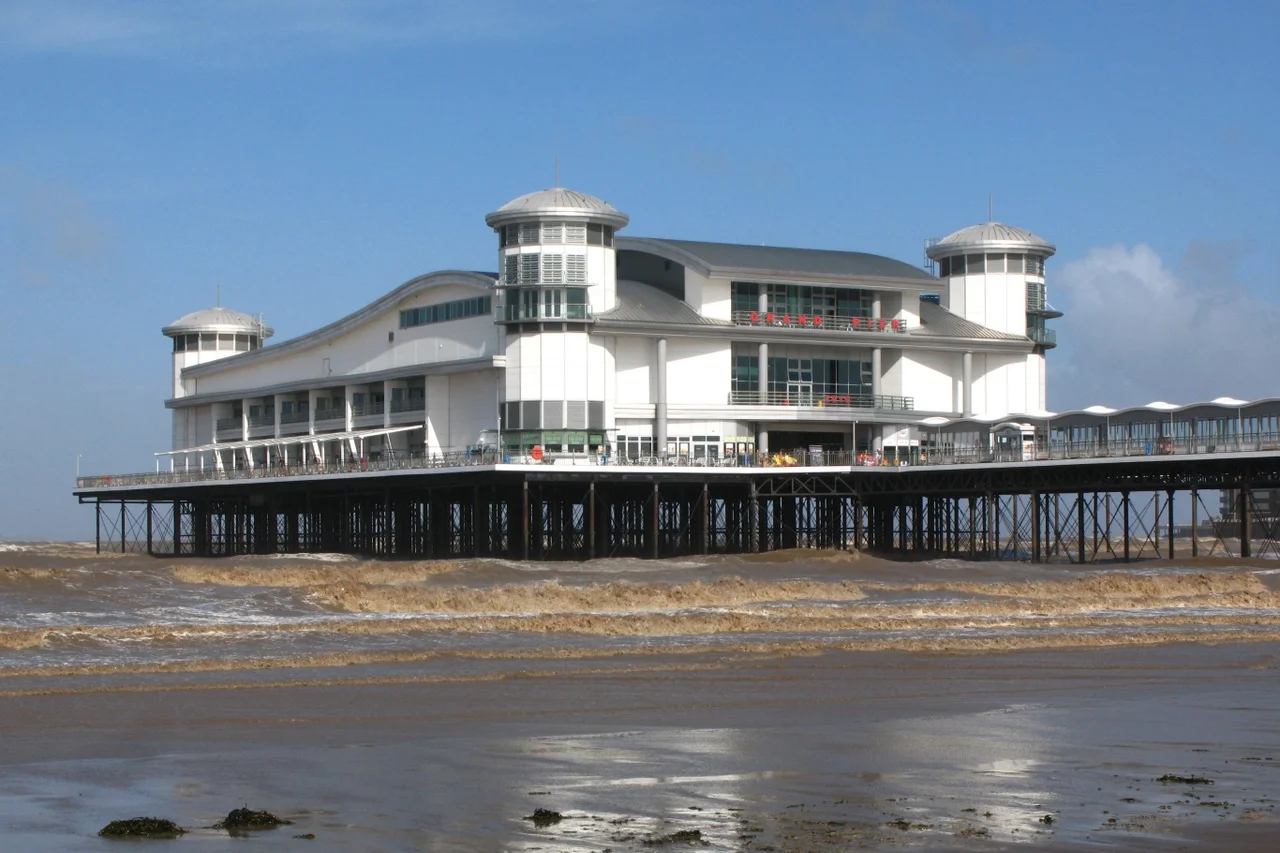

Grand Pier, Weston-super-Mare
On 28 July 2008, a security alarm went off at the Grand Pier and an Essex-based monitoring company couldn't reach the key-holder by mobile. Hours passed. By the time Avon Fire and Rescue arrived at 06:46 BST, the pavilion at the end of Weston-super-Mare's pier was already going up. Thirteen fire engines and more than 85 firefighters fought what they could. A pier employee named Robert Tinker ran into the heat to drag out gas canisters before they could explode, an act that may well have saved the seafront from far worse. By breakfast, a 2,000-seat funfair was a charred husk over the Bristol Channel. It was the second time the pier had burned to the waterline.
Theatre at the End of the Sea
When the Grand Pier opened on 11 June 1904, its centrepiece was a 2,000-seat theatre right at the seaward end - a place where you could hear opera or watch ballet 366 metres out into the Bristol Channel. Construction had begun seven months earlier with P. Munroe as engineer. In 1907, a 500-yard extension was added with the idea that the pier could double as a docking point for steamers crossing to Cardiff. The Bristol Channel had other ideas. Currents proved too dangerous, the boats stayed away, and the extension was eventually demolished. The theatre, though, became a fixture: music hall, stage plays, opera season after opera season, all of it framed by the open Channel and the long view back to the Somerset shore.
The First Fire, the Funfair, and the Second Fire
On 13 January 1930, the theatre burned down. The pier was underinsured. The owners sold up, a man named Leonard Guy bought it, and three years later he opened a new pavilion - not a theatre this time but a covered funfair, all helter-skelters and dodgems. That building lasted seventy-five years before the 2008 fire took it. The cause turned out to be a cluster of deep fat fryers in the pavilion. In January 2013, the security company that had failed to respond was ruled responsible in court, and pier owners Kerry and Michelle Michael were awarded damages. By then the third pavilion - designed by Bristol architects Angus Meek, built by John Sisk and Son - was already standing. It opened for half-term on 23 October 2010 and was formally reopened by Anne, Princess Royal in July 2011.
Twice Pier of the Year
In 2001, the National Piers Society named the Grand Pier its Pier of the Year. After the fire and the rebuild, it won the same award in 2011 - the first pier in Britain to win it twice. The list of films and television shot here keeps growing. The Remains of the Day in 1992. The TV series Bliss in 2017. Come Dine with Me, Don't Tell the Bride, Flog It!, BBC Breakfast, Saturday Kitchen - the pier has become a kind of all-purpose backdrop, equally at home with celebrity chefs and wedding-show contestants. A short scare in March 2019 brought another, smaller fire and a quick evacuation, but the pier reopened the next day.
Two Piers, One Town
Weston-super-Mare has always had two piers. The other is Birnbeck, a Victorian iron walkway out to a tiny island, designed by Eugenius Birch and finished in 1867. It closed in 1994 and has stood derelict ever since, slowly succumbing to the Channel. The Grand Pier, by contrast, keeps reinventing itself - theatre to funfair to whatever its third pavilion will become as another century opens. Pleasure piers are a peculiarly British invention, a Victorian solution to the problem of a seaside town with shallow water and a railway: stick a long walk out into the sea, put a building at the end of it, and let the day-trippers have an excursion that requires no boat. Few stuck to that brief as faithfully as Weston's. Even fewer have burned and risen the way this one has.
From the Air
The Grand Pier is at 51.347736°N, 2.984604°W, projecting from Weston-super-Mare's seafront roughly 18 miles southwest of Bristol. At 366 metres it is one of the longest pleasure piers in Britain and clearly visible from cruising altitude in good light, its third pavilion forming a distinctive box-shape at the seaward end. Nearest airport is Bristol (EGGD), about 18 miles to the northeast. Cardiff (EGFF) lies across the Channel some 25 miles west. The Bristol Channel's huge tidal range is particularly visible here - long mudflats appear at low water, while high tide brings the water nearly up to the pier deck. Best photographed in clear weather with sun off the water.
Nearby Stories
- Berkeley Castle 1 km away
- Tower Colliery 5.9 km away
- Battle of Sedgemoor 5.9 km away
- Royal Victoria Park 7.1 km away
- Ewenny Priory 8.9 km away
- Crumlin Viaduct 10 km away
- Stourhead 11 km away
- Exmoor 16 km away