
Central Government War Headquarters
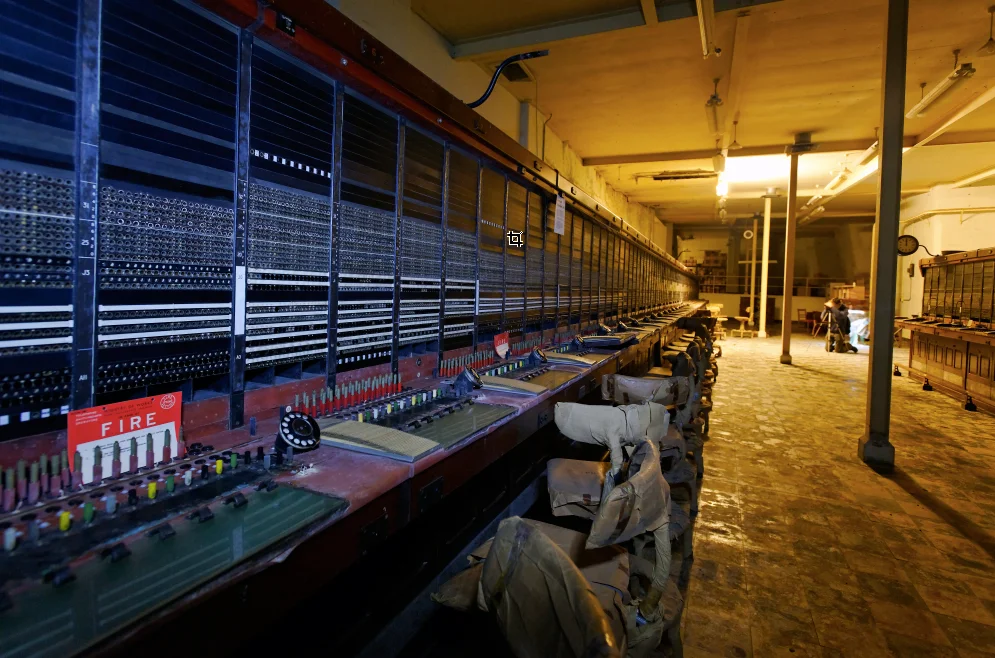
A hundred and twenty feet beneath the Wiltshire countryside, hidden inside a former Bath stone quarry, the British government built a city. Thirty-five acres of it. Over sixty miles of roads. Dormitories for four thousand people, a hospital, kitchens and bakeries, the second-largest telephone exchange in Britain, an underground lake to drink from, twelve fuel tanks to keep four generators running for three months. A BBC studio so the Prime Minister could address the surviving nation. The plan was that if the Soviet Union ever launched, the senior civil service would vanish here for a quarter of a year while above them, on the surface, everything they had known was gone. The complex went by many code names - Stockwell, Subterfuge, Burlington, Turnstile - and its existence was secret until journalist Duncan Campbell named it in 1982.
Spring Quarry
The site began as Spring Quarry, one of the great Bath stone workings that supplied the honey-coloured limestone of Bath and London. In the Second World War it was requisitioned and converted, at enormous expense, into underground aircraft engine factories. Most of the underground manufacturing was abandoned after 1945, but the quarry was already there - dry, deep, immune to anything short of a direct nuclear strike on the chalk above. In the early 1950s, as the Cold War hardened, planners returned. Burlington was developed through the late 1950s and into the 1960s as the Central Government War Headquarters: the place where what was left of British sovereignty would be administered, in absolute isolation, while the country above tried to survive the unsurvivable.
Twenty-Two Areas
The complex was divided into twenty-two numbered areas, each with a function. Area 14 held the Prime Minister, the War Cabinet, the Cabinet Secretariat, and the Chiefs of Staff. Area 16 contained the BBC studio and the Ministry of Health. Area 18 was the Admiralty, the Army and the Ministry of Defence. Area 19 was workshops and power generation. The kitchens and bakeries were in Area 6; canteen and laundry in Area 12; a hospital in Area 9. An internal Lamson tube system - compressed-air canisters - shuttled messages between areas, because telephone capacity, even with Britain's second-largest exchange installed, was finite. The air could be held at constant humidity and warmed to about twenty degrees Celsius. The lights would have stayed on for three months. The maps and schematics that survive describe an entire civilization compressed into one quarry.
Getting There
Plans for moving people into the bunker were elaborate and, in their bureaucratic precision, faintly chilling. Four thousand essential workers would assemble at a place called Check Point - the town of Warminster fulfilled that role - from which army lorries would have driven them the final twenty-three miles to Corsham. About two hundred and ten senior Whitehall officials, kept unaware of their destination until the last moment, would have boarded a special train at Kensington Olympia station on the West London line, travelled to Warminster, transferred to buses to the Warminster Infantry Training Centre, and then been broken into small groups for the lorry ride to the quarry. The Prime Minister would have stayed at Downing Street to the very end, then been lifted out by helicopter. The drills assumed the country had hours, perhaps days. Real warning times in the 1980s were thought to be closer to four minutes.
What Survives Below
Burlington was never used. The Soviet Union dissolved in 1991, and the Ministry of Defence took over the complex and put it on standby in case of future nuclear threat. In 1989, one section was sold to Octavian Wines, who began using it to store fine wine at constant temperature and humidity - by 2012, around twelve million bottles worth over a billion pounds sat in racks where dormitories were once planned for cabinet ministers. In December 2004 the rest was decommissioned: reservoir drained, fuel removed, staff reduced to four. In 2013, parts of the complex were made scheduled monuments. The most poignant items down there are not the telephone exchanges or the Prime Minister's quarters but the murals - cheerful pre-war paintings by the artist Olga Lehmann, made in 1943 for the underground factory canteen and now Grade II* listed. They were painted to remind workers of normal life. They have outlasted the war they were made for, and the war they were preserved against.
Scale of What Was Imagined
Standing on the surface at Corsham today, there is nothing to see. A few low buildings of MoD Corsham. The undisturbed Wiltshire countryside. The Bath stone walls of a town that has produced limestone for two thousand years. But beneath, in the quiet and the dust, four thousand cots wait. The calculations that went into Burlington imagined the deaths of tens of millions of British civilians, and treated the survival of two hundred civil servants and one Prime Minister as a sufficient continuity of government. That arithmetic is what the place memorialises - a sober reminder of how close, and how routinely, the second half of the twentieth century contemplated its own end.
From the Air
The Central Government War Headquarters lies beneath the Wiltshire countryside at 51.42 N, 2.22 W, near the town of Corsham about 7 nm east-northeast of Bath. From the air there is very little to see on the surface - the entire complex sits 120 feet below ground in a former Bath stone quarry, accessed through the MoD Corsham facility. Look for the small town of Corsham, the A4 trunk road running east-west, and the open Wiltshire farmland that conceals one of the largest Cold War installations in Europe. Bristol Airport (EGGD) is 17 nm west-southwest; Kemble (EGBP) is 12 nm northeast. Recommended viewing altitude 2,500-4,000 feet.
Nearby Stories
- Marlborough Castle 1.4 km away
- Clevedon Pier 4.6 km away
- Stourhead 5.6 km away
- Siege of Bridgwater (1645) 8.4 km away
- Raglan Castle 10 km away
- Berkeley Castle 12 km away
- Mottisfont Abbey 20 km away
- Blenheim Palace 33 km away