
Museum of the Great Western Railway
The walls of the museum are made from stone dug out of the Box Tunnel. Isambard Kingdom Brunel's great two-mile bore through Box Hill west of London was the most ambitious engineering project of his Great Western Railway, and the squared rubble left over from blasting it became, in 1842, the walls of the engineering workshop now housing STEAM - the Museum of the Great Western Railway. Behind those walls, for almost a century and a half, men built and rebuilt locomotives at a rate that no other works in Britain could match. At its peak, Swindon Works turned out three locomotives a week. It was one of the largest railway works in the world.
Brunel's Town
Swindon barely existed as a town when Brunel decided to put his locomotive works here in the early 1840s. He chose the spot for engineering reasons - it was where his broad-gauge railway from London met the steep climb up to the Cotswolds, the place a fresh locomotive needed to be swapped in. The town grew up around the works. By the late Victorian period, the company was housing thousands of workers in purpose-built terraces, providing a hospital, a swimming pool, a mechanics' institute and a New Year tea for the children of employees. The works covered more than 300 acres at its height. When Brunel laid out the original works, he could not have imagined the scale it would eventually reach. By the time it closed in 1986, the works had been operating continuously for 143 years.
The Locomotives
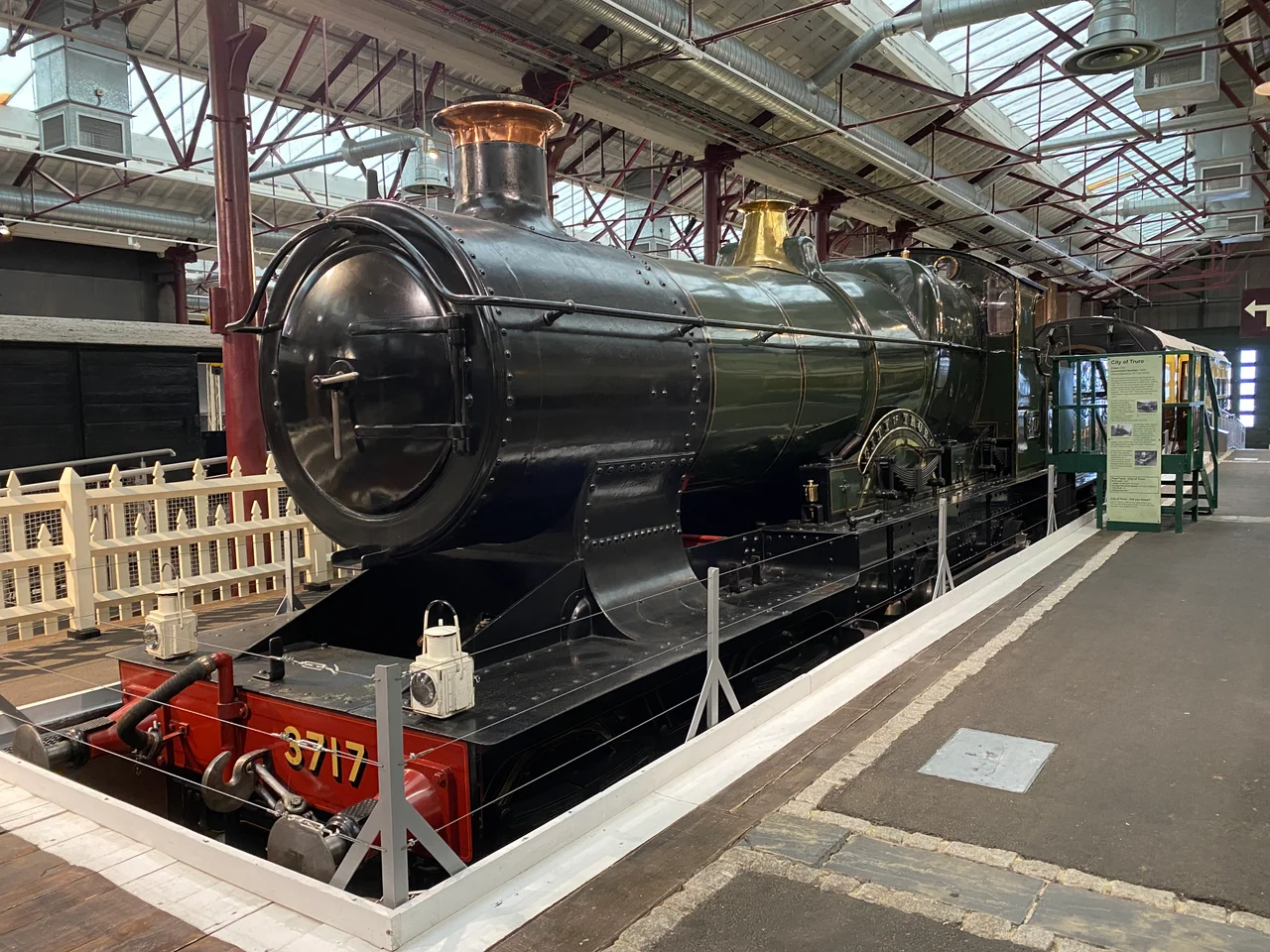
Inside the museum sit a remarkable line-up. North Star is a replica of an early broad-gauge locomotive of the GWR Star Class - the type that hauled the first GWR services in the 1830s. The 2301 Class 2516, built in 1897, is one of William Dean's elegant goods engines. The 4073 Class 4073 Caerphilly Castle, built in 1923, is a Charles Collett four-cylinder express locomotive of the kind that took the Cornish Riviera Express down to Plymouth. Most famous of all is the 3700 Class 3717 City of Truro, built in 1903, which on 9 May 1904 allegedly reached 102.4 mph descending Wellington Bank in Somerset hauling a mail train - if confirmed, this would have been the first locomotive in the world to exceed 100 mph. The claim is disputed and the timing methods of the era were imperfect, but the legend has outlasted every challenge. The locomotive lives at Swindon on loan from the National Railway Museum, alongside the King Class 6000 King George V, built in 1927.
Female Boilersmiths
The most striking thing about the museum is that it tells the social story alongside the engineering. A photograph in the gallery shows women working as boilersmiths at Swindon Works in 1943. The men were away at war, and the work of the railway did not pause - so women picked up the riveting hammers, the welding torches and the heavy lifting that had been exclusively male for a century. Recorded personal experiences from former workers play throughout the exhibits. Enthusiastic ex-railway employees, many of whom worked at the actual workshops the museum now occupies, are on hand to explain what visitors are looking at. They will tell you what it sounded like inside the workshop - the constant ring of hammers, the hiss of steam, the smell of coal smoke and machine oil. They will tell you what their fathers and grandfathers did here. They will tell you, sometimes, what they themselves did before the works closed.
The Site Today
Most of the old works buildings have been repurposed. The McArthurGlen Designer Outlet now occupies the great brick-and-stone sheds where the locomotives were built, and shoppers walk past restored gantries and pillars that once supported overhead cranes. The National Trust's national headquarters - the modern Heelis building, named after Beatrix Heelis, better known as Beatrix Potter, who left her Lake District properties to the Trust - sits on the same site. English Heritage has offices here too. The 7800 Class 7821 Ditcheat Manor, built in 1950, is displayed inside the Designer Outlet itself, which is one of the more surprising places in Britain to come face to face with a steam locomotive. STEAM opened in 2000 in a converted 6,500 square metre former workshop, replacing the smaller GWR Museum that had opened on Faringdon Road in 1962.
Reconstructions and Archives
Throughout the museum, lifelike reconstructions show areas of work that the actual workshops once contained: an office with paper records and Bakelite telephones; a stores counter with the kind of carefully sorted brass fittings that a foreman might demand by part number; a workshop bench with tools laid out as if the worker has just stepped away for lunch; a signal box; a foundry with sand-casting moulds. The museum holds an extensive archive of books, periodicals, photographs, drawings and original plans relating to the Great Western Railway - the kind of archive that researchers from all over the world come to consult. Two rooms are dedicated to Brunel himself and to Daniel Gooch, the GWR's first Locomotive Superintendent, who designed many of the company's earliest engines and went on to lay the transatlantic telegraph cable from Brunel's monstrous ship the Great Eastern. The pairing of Brunel and Gooch built the railway. The works at Swindon built what they imagined.
From the Air
STEAM Museum sits at 51.563 degrees north, 1.795 degrees west, in central Swindon, Wiltshire. Best viewed from 2,000 to 4,000 feet. The site is unmistakable from the air - a rectangular complex of long stone sheds with the McArthurGlen Designer Outlet roof immediately east, and the M4 motorway running east-west three miles to the north. The original Great Western main line still runs through Swindon station half a mile north of the museum. Nearest airport is Brize Norton (EGVN) 18 miles north-northeast; Bristol (EGGD) is 35 miles west-southwest.
Nearby Stories
- Highclere Castle 3.1 km away
- Sudeley Castle 10 km away
- Severn Bridge 12 km away
- Abingdon-on-Thames 13 km away
- Stonehenge Cursus 18 km away
- Wells Cathedral 18 km away
- Treago Castle 20 km away
- Death of Harry Dunn 21 km away