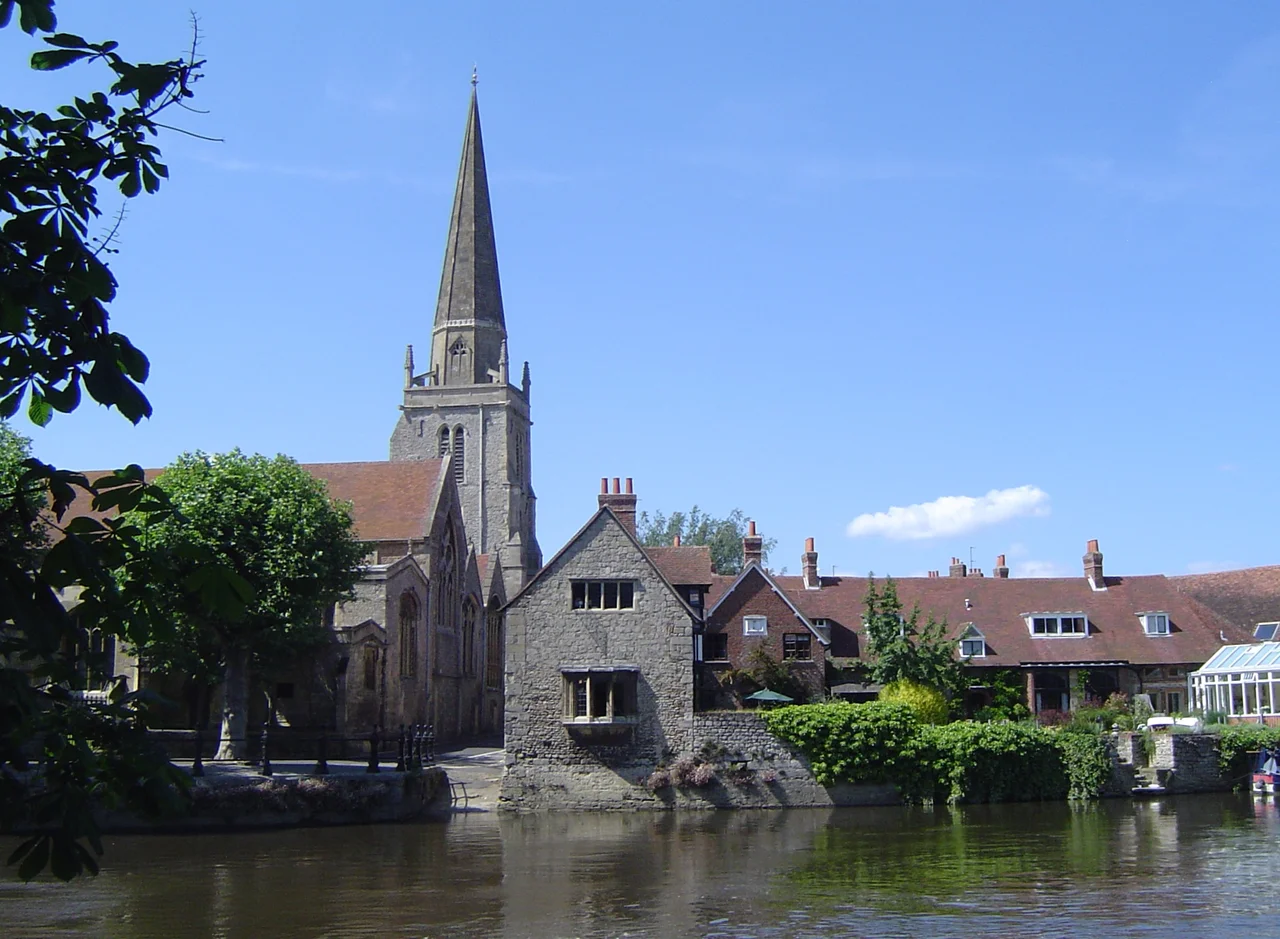

Abingdon-on-Thames
Every time the British state has something to celebrate, the mayor and councillors of Abingdon climb onto the roof of the County Hall Museum and throw buns at the crowd below. They have done this since 1761, when the trigger was the coronation of King George III. The most recent bun-throwing was for the Platinum Jubilee of Queen Elizabeth II in 2022, when five thousand buns rained down into the market square. The museum keeps a collection of these buns, dried and varnished, dating back to the nineteenth century. There have been thirty-five bun-throwings in all. Abingdon does this because Abingdon has been doing things in roughly the same square mile for fifteen hundred years, and feels entitled to a tradition or two.
An Oppidum Beneath the Town
Abingdon's claim to be the oldest continuously occupied town in England rests on what lies under the modern streets. A late Iron Age defensive enclosure, an oppidum, sits beneath the town centre and was in use throughout the Roman occupation. A Neolithic causewayed enclosure dating from the thirty-sixth or thirty-seventh century BC was found in 1926 during gravel quarrying. A Neolithic hand axe from Abingdon turned out, on petrological analysis, to be made from stone quarried at Stake Pass in the Lake District, two hundred and fifty miles north. People have been bringing things to this bend of the Thames and not leaving for a long time. Abingdon Abbey was founded around the year 676, possibly by a man called Æbba or a woman called Æbbe, and the abbey gave the emerging town its name. In 1084 William the Conqueror celebrated Easter at the abbey. It is possible that his son, the future Henry I, received some of his education within its walls.
Wool, Riots, and a Charter
Through the thirteenth and fourteenth centuries Abingdon prospered on wool. The abbot ran the markets and fairs and held the town firmly under his hand. In 1337 there was a famous riot in protest at the abbot's control of trade; several of the monks were killed in the street fighting. The abbey survived that, but not Henry VIII. After the Dissolution of the Monasteries in 1538, Abingdon sank. In 1556 the town's representatives went to Queen Mary I and showed her the pitiable state of the place. Mary granted a royal charter incorporating Abingdon as a borough governed by a mayor, two bailiffs, twelve chief burgesses, and sixteen secondary burgesses. Abingdon became the county town of Berkshire and held assize courts from 1570. To assert its dignity over Reading, which was vying for the same status, Abingdon built a magnificent county hall between 1678 and 1682, reputedly designed by Christopher Kempster, who had worked with Sir Christopher Wren. The building stands today on Doric columns, leaving the ground floor open as a market. Pevsner called it the grandest of the free-standing town halls of England.
Lost to the Railway
The eighteenth and nineteenth centuries gave Abingdon two great engineering gifts. Abingdon Lock opened in 1790 and rerouted the Thames navigation away from the old Swift Ditch. The Wilts and Berks Canal opened in 1810, linking Abingdon to the Kennet and Avon Canal at Semington and connecting the town to Bristol, London, Birmingham, and the Black Country. The railway should have continued the rise. Instead Abingdon accepted only a branch line, opened in 1856, and was sidelined in favour of Reading, which took the county town status in 1869. The branch closed to passengers in 1963. The line stayed open for goods until 1984, mainly to serve the MG sports car factory that operated in Abingdon from 1929 until British Leyland closed it in October 1980. The Wilts and Berks Canal was abandoned in 1906. A volunteer trust is working to restore and reopen it.
Bun-Throwing and Morris Dancing
Abingdon takes its rituals seriously. Every October the Michaelmas Fair runs through Market Place, High Street, and Ock Street, claimed locally as the longest and oldest street fair in Europe. Every year a Mayor of Ock Street is elected by the inhabitants of Ock Street alone and parades through town behind the Horns of Ock Street, the totem of the local Morris dance troupe. The Friends of Abingdon's Unicorn Theatre, housed in the surviving Abbey buildings, has staged the first productions of many of Stephen Briggs's stage adaptations of Terry Pratchett's Discworld novels. Old Speckled Hen ale was originally brewed by Morland of Abingdon to commemorate the MG factory; Greene King still brews it after taking over the brewery in 1999. The brewery site is now housing.
Radiohead at Abingdon School
In 1985, five sixth-formers at Abingdon School began rehearsing on Friday afternoons in the school music room. The band initially called themselves On a Friday. The members were Thom Yorke, Jonny and Colin Greenwood, Ed O'Brien, and Phil Selway. They renamed themselves Radiohead after a Talking Heads song. The first three of them grew up around Abingdon. The town has produced an unusually high number of notable people across the centuries: Saint Edmund of Abingdon, the thirteenth-century Archbishop of Canterbury, was born here. So was Ælfric of Abingdon, his tenth-century predecessor in that office. Kate Edger, the first New Zealand woman to earn a university degree, was born in Abingdon. So was David Mitchell the comedian and Kate Garraway the broadcaster. The novelist Terry Pratchett's stage adaptations debuted at the Unicorn. The population at the 2011 census was 33,130, which is small for a town that has produced two archbishops, a rock band, and a major British sports car marque.
From the Air
Abingdon-on-Thames sits on the River Thames at 51.67°N, 1.28°W in the Vale of White Horse district of Oxfordshire. The town is six miles south of Oxford and eight miles north of Didcot. Visual landmarks include the Thames itself, St Helen's Church spire on the north bank, the seventeenth-century County Hall in the market square, and the remains of the MG factory site west of town now redeveloped. Most of the area is Class G outside controlled airspace, but the Brize Norton MATZ (Military Air Traffic Zone) extends within range to the west. Nearest active GA airfields are EGTK Oxford (Kidlington) 10 nautical miles north, EGUB Benson 11 nautical miles east (military, but with civilian access), and EGTB Booker 22 nautical miles east. The dismantled Abingdon RAF airfield, used by 6 Squadron RAF Regiment until the 1990s, is now Dalton Barracks.
Nearby Stories
- Great Train Robbery (1963) 3.4 km away
- Museum of the Great Western Railway 4.1 km away
- Brookwood Cemetery 4.1 km away
- Highclere Castle 9.1 km away
- St George's Chapel, Windsor Castle 14 km away
- Woodhenge 16 km away
- Death of Harry Dunn 16 km away
- Sudeley Castle 17 km away