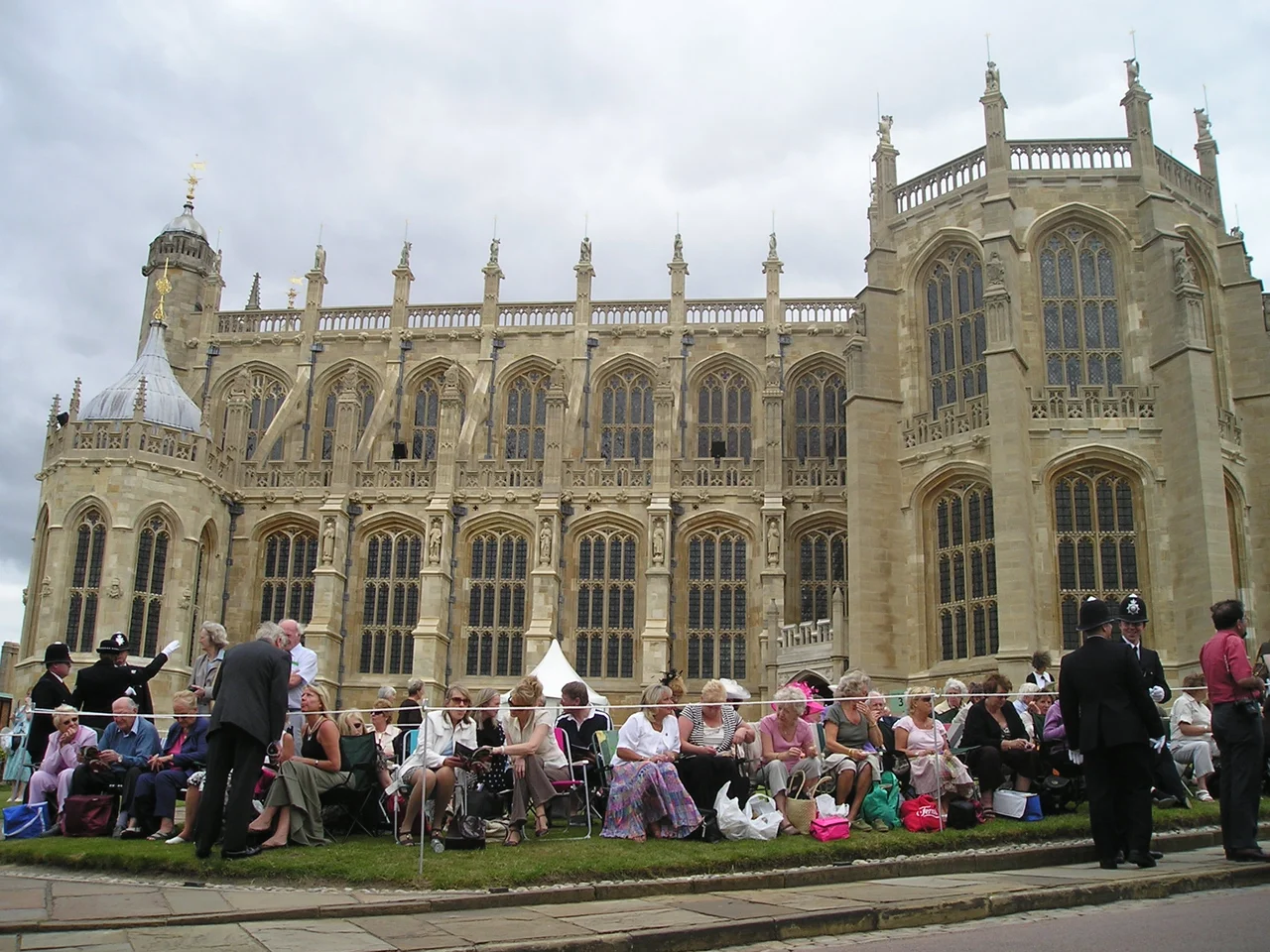

St George's Chapel, Windsor Castle
Beneath the choir floor of St George's Chapel, in a small vault dug in 1649, the coffin of King Charles I rests alongside those of Henry VIII and Jane Seymour. Three monarchs in one cramped space - one killed by Parliament, one who killed his own wives, and the one wife who managed to die before he changed his mind. The vault was a hasty compromise. Charles I had just been executed at Whitehall and Parliament needed somewhere to put the body. They lowered him through the chapel pavement and closed it up. The chapel was already what it remained: the most royal church in England outside Westminster, the home of the Order of the Garter, and the place where English monarchy buries its dead. Eight hundred stall plates affixed to the choir stalls record every knight and lady since 1348. Edward IV is here. Henry VI was reburied here. Edward VII, Edward VIII, George V, George VI, Elizabeth II - they all came back to this Perpendicular Gothic chapel in the Lower Ward of their castle.
A King's Two Colleges
Edward III founded two religious colleges on the same day in 1348: St Stephen's at Westminster and St George's at Windsor. The Windsor college absorbed an older chapel of St Edward the Confessor that Henry III had built a century earlier. The dedication added the Virgin Mary and George the Martyr, but only George's name stuck. Edward also built the Aerary Porch in 1353-54, a small vaulted entry that survives today. The chapel sat modestly for over a century until Edward IV and then Henry VII undertook a radical redevelopment between 1475 and 1528. Henry VII's chief minister Sir Reginald Bray supervised the work; the master mason Henry Janyns shaped the fan vaulting. The thirteenth-century chapel became something much grander: a cathedral-sized space in Perpendicular Gothic, the late-medieval style that England made entirely its own.
Parliament's Pillage
On 23 October 1642, three months into the English Civil War, parliamentary forces broke into St George's Chapel and plundered the treasury. They returned in 1643 to destroy the fifteenth-century chapter house and strip lead from the roofs. Elements of Henry VIII's unfinished funeral monument disappeared. In 1648 the Commonwealth sold the chapel's metalwork to pay the garrison of Windsor Castle. The following January, Charles I was executed. They buried him quietly in the choir vault that already held Henry VIII and Jane Seymour - no monument, no inscription, the location only certain because of the small lead casket marked with his initials and the date. When the monarchy was restored in 1660, the chapel was a wreck. It would take decades of patching to undo the damage. Sir Christopher Wren, surveying the building in 1682, ordered the medieval Royal Beasts removed from the roof pinnacles because their Reigate sandstone was crumbling. The current set, seventy-six heraldic statues representing fourteen different beasts - the panther of Jane Seymour, the falcon of York, the yale of Beaufort, the unicorn of Edward III - dates from the 1925 restoration.
The Order of the Garter
Edward III's chivalric order, founded in 1348, makes St George's its spiritual home. Every June the surviving Knights and Ladies of the Garter process on foot from the State Apartments down to the chapel for the annual service - a tradition King George VI revived in 1948 for the order's 600th anniversary. Each member is assigned a stall in the choir, above which their heraldic banner hangs and beneath which their crested helmet sits. When a member dies, the helmet, banner, and crest are removed and a final service held - the Military Knights of Windsor carrying the banner to the Dean, who lays it on the altar. The Garter stall plate, an enamelled brass affixed to the back of the stall, stays forever. The choir's woodwork is crusted with 800 of them, each recording a name and arms, the oldest dating from the 1390s. Walking the choir is walking through six and a half centuries of English nobility, every stall a small biography in brass.
Anne of York and a Forgotten Marriage
In the Rutland Chantry, on the chapel's north side, a monumental brass commemorates Anne of York and her husband Sir Thomas St Leger. Anne was Edward IV's elder sister, born in 1439 - and she had a story the chapel quietly preserves. Her first marriage was political; her second, to the commoner St Leger, was reportedly for love. She died in 1476 giving birth to their daughter. Sir Thomas was executed seven years later for taking part in the Duke of Buckingham's failed rebellion against Richard III. He founded the chantry chapel where he wished priests would pray for his and Anne's souls "for evermore." The inscription survives: "Wythin thys Chappell lyethe beryed Anne Duchess of Exetur suster unto the noble kyng Edward the forte... On whose soule god have mercy." Their descendants became the Earls of Rutland, which is how the chantry got its name. The alabaster effigies of George Manners and Anne Manners - granddaughter of Anne of York - lie in the chapel today, a continuous line of memory stretching from the Wars of the Roses to the present.
From the Air
St George's Chapel sits in the Lower Ward of Windsor Castle, on the north side. From above, the chapel reads as a long buttressed nave running east-west, with the Albert Memorial Chapel to its east, the Curfew Tower at its west end, and the great Round Tower of the castle rising to the southeast. Heathrow's western approach corridor passes overhead constantly, jets descending at flight level 60 and below as they line up for the southerly runways. The chapel itself is forbidden airspace at low altitude when the monarch is in residence, which is most weekends. To see what Henry VI saw across the Thames at Eton, or what Charles I would never see again after January 1649, you fly the river bend at moderate altitude and let the castle climb out of the Windsor Great Park beneath you - a thousand years of monarchy compressed into one tight site.
From the Air
Located within Windsor Castle's Lower Ward at 51.4836 N, 0.6069 W. Best viewed at 1,500-3,000 feet AGL when overflying Windsor. Nearest major airport: London Heathrow (EGLL), 7 nm east. RAF Northolt (EGWU) 11 nm east-northeast. The chapel is unmistakable from above as the long buttressed building in the castle's western section. Royal flight restrictions apply when the monarch is in residence - check NOTAMs before any low-altitude flight near Windsor.
Nearby Stories
- Waltham Abbey 0.7 km away
- Queen Victoria Hospital 1.9 km away
- Hither Green rail crash 3.3 km away
- Ufton Nervet rail crash 4.2 km away
- Kings Langley Palace 5.8 km away
- Magdalen College, Oxford 16 km away
- Hyde Abbey 20 km away
- Amberley Museum & Heritage Centre 28 km away