.jpg)
Kings Langley Palace
There was a lion. There was a camel. There was a young king who loved music and horse racing and the company of one particular man, and who kept all three at his country palace west of the Hertfordshire village now called Kings Langley. Almost nothing remains. The site sat empty for centuries, then served as a Rudolf Steiner school until 2019, and even that has now closed. But beneath the grass, beneath the gymnasium that once stood here, archaeologists found the cellars of a vanished royal household, the place where Edward II reburied the man he loved after Parliament had him beheaded.
Eleanor's Estate
The story begins not with Edward but with his mother. In 1276, Queen Eleanor of Castile acquired the manor of Langley from a forest that stretched, unbroken in those days, from London out to Berkhamsted. The land was thick with deer and already held a hunting lodge from the reign of Henry III. Eleanor, the formidable Spanish queen of Edward I Longshanks, set about transforming it into something grander. Records from 1279 to 1281 detail private chambers for the king and queen, a cloister paved for Eleanor, a vineyard planted on the chalk slope, a well dug, and a moat enlarged. By the time their son Edward of Caernarfon was born in 1284, Langley was already a family home. The future Edward II spent much of his childhood here, and when Eleanor died unexpectedly in 1290, the palace passed in time to him.
The King Who Kept a Lion
When Edward II inherited Langley outright in 1302, he made it the centre of a court that scandalised his realm. He brought in musicians. He raced horses. He assembled a menagerie that, in addition to the usual hounds and hawks, included a lion and a camel - exotic creatures wandering the Hertfordshire countryside while England's barons grumbled. And he installed his favourite, Piers Gaveston, as a companion in residence. The relationship between the king and Gaveston - whether romantic, fraternal, or simply too close for medieval comfort - infuriated the nobility. In 1312, while the king was away, a group of magnates seized Gaveston and had him summarily executed. Edward never forgave them. Three years later, in January 1315, he reburied Gaveston with full ceremony in King's Langley Priory, the Dominican house he had founded next door to the palace in 1308. The king visited the grave often. Today no trace of the priory church or the tomb remains.
Plague Capital
Langley outlasted Edward II. His grandson, Edward III, gave the palace its most famous moment when, in July 1349, with the Black Death tearing through London, he moved the entire royal court out to Hertfordshire. For a brief, terrified period, the seat of English government was Kings Langley. Edward III's fifth son, Edmund of Langley, was born here in 1341 and took his name from the manor; when Edmund died in 1402 he was buried in the priory beside Gaveston's vanished grave. Geoffrey Chaucer almost certainly walked these courtyards too, between 1389 and 1391, while serving as Clerk of the King's Works under Richard II - which means the author of the Canterbury Tales would have known the palace as a working royal residence, not the ruin it became.
The Rubbish of Royalty
A fire damaged the palace in 1431, and though repairs followed - including bricks fired by William Veyse, the king's own brickmaker, drawn from a kiln at le Frithe near St Albans - Langley's days as a court were ending. The last recorded official banquet here came in 1476, hosted by the Abbot of St Albans for the Bishop of Llandaff. By 1591 only the gatehouse and a few walls still stood. In 1626 Charles I granted the estate to Sir Charles Morrison; after the Civil War, the Royalist Arthur Capell who married into the family was executed in 1649 and the land changed hands again. By 1675 the royal park had been ploughed for tenant farms. Writing in 1728, the historian Nathanael Salmon found only fragments and remarked, drily, that 'here the rubbish of royalty exists.' The triple-courtyard palace - with its bath house, great kitchen, bakery, and the famously long building the records called *le Longrewe* - had simply been ploughed under.
What the Spades Found
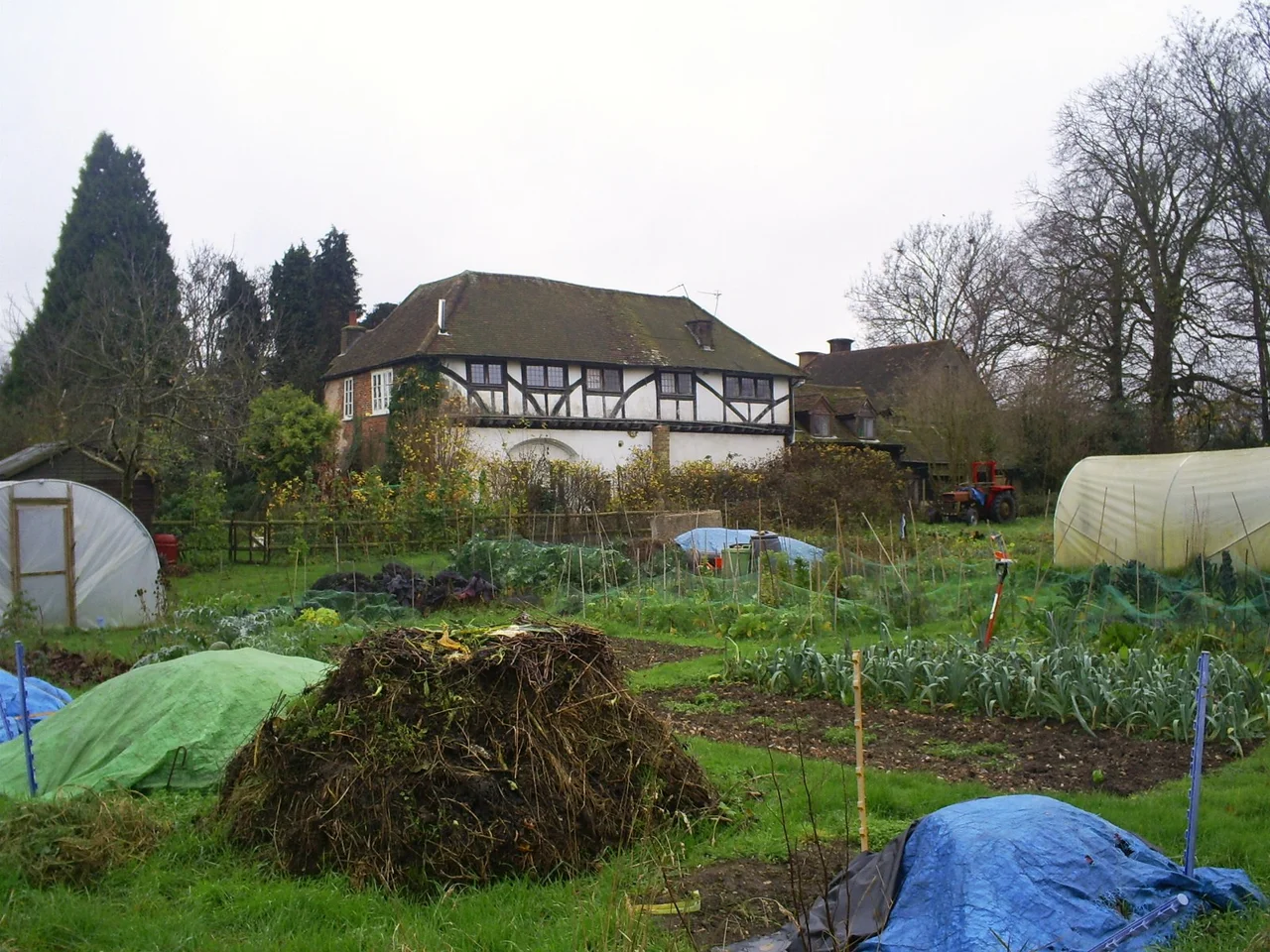
In 1970, archaeologists excavating the site of the Rudolf Steiner School discovered something extraordinary beneath the gymnasium floor: a vast medieval wine cellar, built around 1291 to 1292, sitting on the west side of what had been the kitchen court. Just east of it, they found foundations consistent with a substantial gatehouse opening onto Langley Hill. The great hall must have run east to west between them. Today even the school is gone - it closed in March 2019 - and the site sits as a scheduled ancient monument, quiet and overlooked. The only standing fabric you can still see belongs not to the palace itself but to ruined flint walls in the garden of 80 Langley Hill, thought to be remnants of a Tudor house Sir Charles Morrison built around 1580, when the medieval palace was already collapsing around him. The lion is long gone. The camel is long gone. Edward and Gaveston lie somewhere under the chalk and the allotments, two men whose entanglement once shook a kingdom and now barely registers as a footnote in the parish.
From the Air
Coordinates 51.7116 N, 0.4602 W, just west of the village of Kings Langley in Hertfordshire. The site sits about 1.5 miles east of the M25 and 3 miles south of Hemel Hempstead. Nearest major airport is London Luton (EGGW), 12 nautical miles north-northeast; London Heathrow (EGLL) lies 17 nautical miles south. Recommended viewing altitude 2,000 to 3,500 feet AGL in clear conditions - look for the wooded ridge above the village where the surviving priory building and the school site sit on the high ground; the Grand Union Canal threads the valley below.
Nearby Stories
- Millennium Dome 0.2 km away
- Ampthill Park 1.9 km away
- Heathrow Airport 5.4 km away
- Fowlmere Airfield 6.6 km away
- Waltham Abbey 9.2 km away
- Ufton Nervet rail crash 11 km away
- Sulgrave Manor 12 km away
- Magdalen College, Oxford 13 km away