
Heathrow Airport
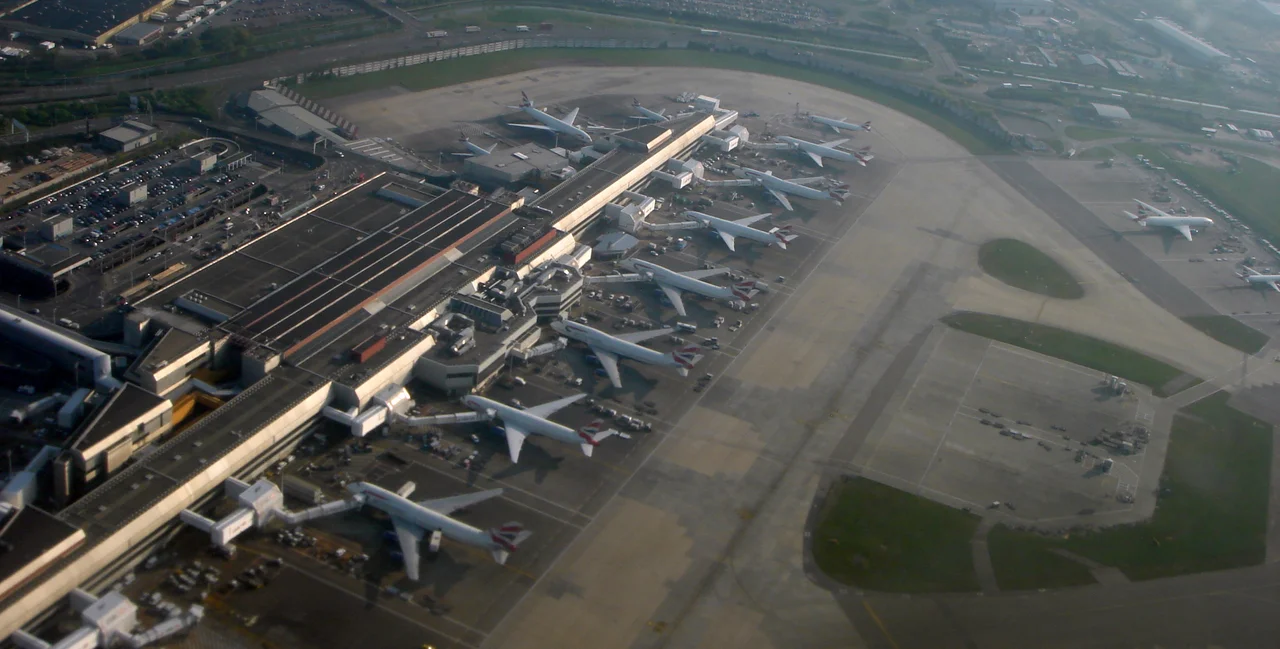
Between Hatton Cross and Hayes, fourteen miles west of central London, sits a piece of ground where someone takes off or lands roughly every forty-five seconds during daylight hours. London Heathrow Airport opened on 25 March 1946 as London Airport, on a site that had been a small airfield since 1930. Within a generation it had become the busiest international airport on Earth. It is still, in 2024 and 2025, the busiest in Europe, fifth in the world by total passengers, and second in the world by international passengers - Dubai recently passed it in the international category but trails it in connections. From above, the two parallel east-west runways are unmistakable: two grey ribbons cutting across the green fields of Middlesex, the four terminals strung between them, the great rectangular cargo zone to the south, the holding stacks where inbound aircraft circle in the sky above Buckinghamshire and Surrey, waiting their turn to descend.
Six Runways, Then Two
In the 1950s, Heathrow had six runways arranged as a hexagram - three pairs at different angles, so that no matter which way the wind blew, at least one pair was within thirty degrees of useful. The permanent passenger terminal sat in the middle of the star. As jet aircraft grew larger and required longer takeoff rolls, the hexagram was abandoned and the two east-west runways - 09L/27R and 09R/27L - were extended. From the air today, the ghosts of the other four runways are still visible, repurposed as taxiways and aprons threaded through the airfield. The Central Terminal Area, designed by Sir Frederick Gibberd, was laid out so passengers reached the terminals through a tunnel under one of the runways - which is why driving in to Terminals 2 or 3 still involves a long underground passage that emerges in the middle of an active airfield.
Concorde
From 21 January 1976 until 24 October 2003, British Airways flew Concorde from Heathrow to New York and back. A Concorde could cross the Atlantic in three and a half hours - leaving London at 10:30 and arriving in New York at 09:25 local time, a fact that astonished travellers because Concorde technically arrived earlier than it had left. The aircraft cruised at Mach 2.04, about 1,350 mph, at 60,000 feet, where you could see the curvature of the Earth from the small oval window. After the Air France Concorde crash at Gonesse in July 2000 and the subsequent costly modifications, both airlines retired their fleets in 2003. A forty-percent-scale model of Concorde G-CONC sat at the entrance tunnel to Heathrow as 'gate guardian' for many years; it was replaced in 2008 by a model of an Emirates A380, marking the changeover from supersonic to superjumbo. A full-size preserved Concorde sits next to runway 27L threshold, just inside the perimeter fence.
The Holding Stacks
Heathrow's airspace is organised around four named holding points - Bovingdon to the north-west, Lambourne to the north-east, Biggin to the south-east, and Ockham to the south-west. Inbound aircraft are sent to one of these stacks, where they fly racetrack-shaped patterns at assigned altitudes, separated by a thousand feet vertically. As slots open on final approach, Heathrow Approach Control - based not at the airport but seventy miles south in Swanwick, Hampshire - peels aircraft off the stacks and merges them into a single stream of traffic, sometimes spaced as close as 2.5 nautical miles apart. On a busy weekday morning the approach controller is handling more than forty arrivals an hour, threading the needle. The pilots on board cannot see most of the other aircraft. They see only the radar returns the controllers see, and they trust them. The system has been working this way for sixty years.
Runway Alternation
Heathrow runs in westerly-preferred operation most days, meaning aircraft take off to the west and land from the east, flying over London. This is the noisier configuration for passengers but the quieter one for residents under the approach path. To share the burden, the two runways alternate: from the start of operations until 15:00 local time, one runway handles all the arrivals and the other handles all the departures; at 15:00 they switch. Residents under 27L get respite from morning landings; residents under 27R get respite from afternoon ones. The system is called runway alternation, and it was introduced because aircraft generate significantly more noise on departure than on arrival, and because the Cranford Agreement once banned departures over the village of Cranford - an agreement now rescinded but whose ghost still shapes the operation. Easterly mode, used when wind requires it, does not yet alternate; works are in planning.
The Tunnels Underneath
Beneath Heathrow runs a small underground city. Three tunnels connect the Central Terminal Area to the outside world. The Piccadilly line of the London Underground reaches Heathrow through deep tubes - the airport has its own dedicated branch with three stations, opened in 1977 - making it the only major hub in the world with a 24-hour Tube connection to the city centre. The Heathrow Express runs from Paddington in fifteen minutes. Beneath the airside, the Track Transit System carries passengers between Terminal 5 and its satellite buildings on a driverless people-mover; the cargo tunnel system links the apron with the south side cargo zone; and St George's Chapel, the Anglican chapel commissioned by Sir Frederick Gibberd, sits in an underground vault adjacent to the old control tower, with services on Sundays. Above ground, eighty-three million passengers a year. Below, a complete second airport just for moving them between gates.
From the Air
London Heathrow Airport (EGLL) sits at 51.47°N, 0.45°W, 14 nautical miles west of central London. The airport is unmissable from altitude: two parallel east-west runways (09L/27R 12,799 feet, 09R/27L 12,802 feet), four passenger terminals (Terminals 2, 3, 4, and 5) arranged in a rough U around the central area, and an extensive cargo zone on the south side. The Wraysbury and King George VI reservoirs lie immediately south of the airport, and the M25 motorway loops around the western perimeter. The four holding stacks (Bovingdon BNN, Lambourne LAM, Biggin BIG, Ockham OCK) are at altitudes from 7,000 to 15,000 feet, depending on traffic. Westerly operations (landing on 27L/R) are preferred when wind permits. Heathrow is enclosed in Class A controlled airspace within the London TMA; only IFR traffic is normally cleared. Heathrow's Class D Control Zone extends to 2,500 feet AAL. VFR overflights at 4,500 feet and above are possible with clearance, but most traffic is routed around. Nearby airports for general aviation: Booker / Wycombe Air Park (EGTB), Fairoaks (EGTF), Denham (EGLD), White Waltham (EGLM), Blackbushe (EGLK).
Nearby Stories
- Waltham Abbey 0.7 km away
- Queen Victoria Hospital 1.9 km away
- Hither Green rail crash 3.3 km away
- Ufton Nervet rail crash 4.2 km away
- Kings Langley Palace 5.8 km away
- Magdalen College, Oxford 16 km away
- Hyde Abbey 20 km away
- Amberley Museum & Heritage Centre 28 km away