
Hyde Abbey
Convicts dug the foundations of a small Winchester prison in 1788, and at almost every stroke of their spades they hit something old. Stone coffins. Croziers, double-gilt. Buckles, chasubles, the leather of medieval boots. A local Catholic priest, Dr Milner, watched in horror as the inmates threw the bones around. "Miscreants couch amidst the ashes of our Alfreds and Edwards," he wrote. He was being literal. The grave the prisoners had broken open was almost certainly that of Alfred the Great.
A King's Restless Body
Alfred died in 899, only a few years after laying out a new Saxon street plan for Winchester. He was buried first in the Old Minster beside the cathedral. His son Edward the Elder, completing a project Alfred had begun in the last year of his reign, built the New Minster directly next to it. Around 903 the new church was consecrated under the learned abbot Grimbald of Saint-Bertin, and Alfred was dug up and laid to rest there with his wife Ealhswith and, in time, Edward himself. The New Minster also acquired, in 1041, the head of Saint Valentine - a gift from Queen Emma, Cnut's widow. For two centuries it ranked among the most important Benedictine houses in England, partly on the strength of the royal bones beneath its floor.
Move and Rebuild
Cities grow, and minsters get crowded. In 1109, Henry I ordered the New Minster moved to Hyde Mead, a stretch of ground just outside the city's north gate. When the new abbey church was consecrated in 1110, Alfred, Ealhswith, and Edward were carried in procession through Winchester and reinterred before the high altar. They drew pilgrims, and their pilgrims drew prosperity. The abbey expanded through the twelfth century until 1141, when fire took it during the civil war between King Stephen and the Empress Matilda. It was rebuilt, refounded its routines, and accumulated estates across Wiltshire that still bear its memory in their names: Collingbourne, once called Collingbourne Abbot's, and the village still known as Manningford Abbots.
Dissolution and Silence
In 1539 Henry VIII's commissioners arrived. The monks were pensioned, the buildings stripped, and the library scattered - though three relics survive: a cartulary now in the British Library, a late-medieval breviary, and the Liber vitae, the book in which the monks had written the names of the men and women they prayed for. Three years later the antiquary John Leland passed through. "In this suburbe stoode the great abbay of Hyde," he noted - already past tense. He recorded that Alfred and Edward had been laid before the high altar. After that, the abbey's east end - precisely where the royal bones lay - was simply forgotten. The southwest corner became a grand house. The lower ground returned to grazing. Mounds of rubble accumulated. Two hundred and fifty years passed.
The Prison
In 1788 the county took the land for a bridewell, a small local prison, and put the convicts to work clearing ground. They were not archaeologists. They were forced labour, and what they uncovered they exploited. Captain Howard, an antiquarian who interviewed the warden Mr Page some years later, learned the rest. The stone coffin thought to be Alfred's - a single block encased with lead - was broken open. The bones were thrown about. The lead was sold. The prison's grave pit was deepened, the broken coffin reburied, and that, for another two centuries, was that. Excavations in 1999 found exactly such a pit before the location of the high altar, dug down to the water table, just as the warden had described.
What Survives Above Ground
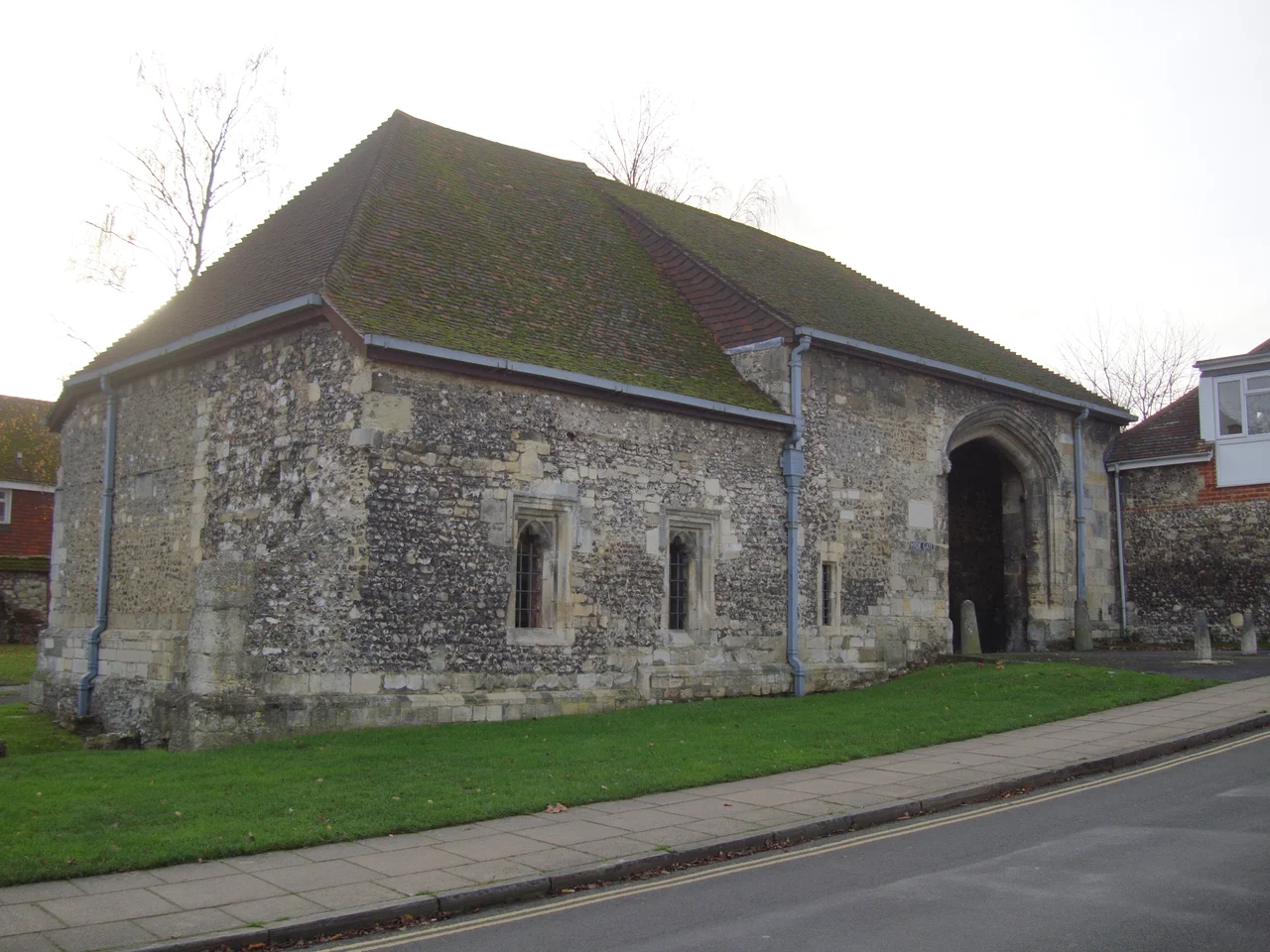
Almost nothing of the abbey itself remains visible. The gatehouse that once stood between inner and outer precincts is still there. An arch that once spanned the abbey's millstream still stands. The pilgrims' and lay-brothers' church, built for the abbey's dependants and parishioners, became the parish church of St Bartholomew - and its medieval nave and chancel are now the surviving body of Hyde's old foundation. A Romanesque capital from the original 1110 church has also come to light, its carving still sharp despite eight centuries of weather. The 1999 dig revealed two phases of building: flint and chalk rubble from 1110, and a later, finer limestone from the rebuilding that may have followed the miracles at the shrine of St Barnabas in 1182.
Looking for Alfred
In the nineteenth century a local antiquary claimed to have recovered Alfred's bones and reburied them in a simple grave outside St Bartholomew's. Modern testing has been inconclusive. There is something fitting and something unbearable in this: the king whose laws, ships, and Burhs are usually credited with creating the very idea of an English people lies somewhere under Hyde, but no one can say exactly where. The graves in front of the high altar were almost certainly never reached by Henry's commissioners. They were reached, by accident, by prisoners with spades. What remains is the gatehouse, the millstream arch, the parish church - and the patient, ongoing work of archaeology, trying to recover what was thrown around for the price of a coffin's worth of lead.
From the Air
Hyde Abbey lies just north of Winchester's city walls at 51.069°N, 1.314°W. Visible from low altitude on approach to Southampton (EGHI), about 12 nautical miles south. Winchester Cathedral, with its long Norman nave, is the unmistakable landmark - Hyde sits a short walk to its north, in what is now a quiet residential quarter.
Nearby Stories
- 2021 Salisbury Rail Crash 2.5 km away
- 1958 BOAC Bristol Britannia Crash 3.8 km away
- Norris Castle 5.1 km away
- Newbury, Berkshire 10 km away
- West Kennet Long Barrow 11 km away
- Eton College 14 km away
- Charterhouse School 16 km away
- Tide Mills, East Sussex 54 km away