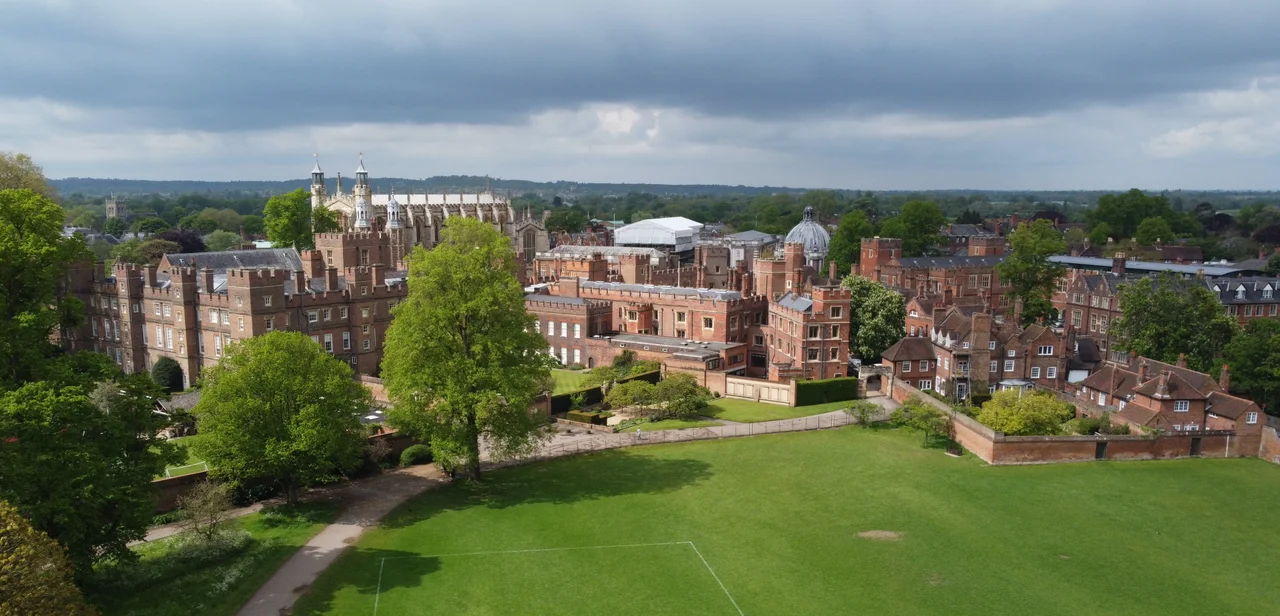

Eton College
Henry VI was nineteen years old when he founded a school for seventy poor boys across the Thames from his own castle. He visited the model he had chosen - Winchester College - at least eight times, copied its statutes word for word, and even poached its headmaster. He intended his chapel at Eton to have the longest nave in Europe and persuaded the Pope to grant indulgences usually reserved for far grander churches. Then, in 1461, Edward IV deposed him, annulled the grants, and shipped the treasures across the river to St George's Chapel. The cathedral Henry imagined was left half-built, only the Quire ever completed. Six centuries later, that truncated chapel and the brick gatehouses around it still stand, and Eton has become something Henry could never have predicted: the school that has educated twenty British prime ministers, including the most recent royal heirs in line of succession.
A King's Half-Finished Dream
The foundation charter of 1440 named it Kynge's College of Our Ladye of Eton besyde Windesore - a charity school yoked to King's College, Cambridge, which Henry founded the following year. The two were meant as siblings: a boy would learn Latin grammar at Eton, then proceed up the educational ladder to read theology at Cambridge. Seventy scholars were the target number, chosen for poverty and promise. Henry packed his foundation with relics - reputedly a fragment of the True Cross, even a thorn from the Crown of Thorns - and granted it land from the dissolved alien priories. Then the Wars of the Roses swept Henry from the throne. Legend says Edward IV's mistress Jane Shore pleaded for the school and saved part of it, though the construction stopped where it stood. The eight bays of chapel you see today were meant to be seventeen or eighteen. The dream survives in fragments.
Long Chamber and the Boys Who Slept There
For four centuries, the King's Scholars - the original seventy on the foundation - lived in a single long room above the schoolroom called Long Chamber. Conditions there were, by any honest reckoning, inhumane. Boys slept on shared straw beds, fought their own battles, ate cold meals, and endured the kind of discipline that left scars both visible and hidden. In 1844, after generations of complaints, the architect John Shaw Jr designed New Buildings to give the collegers proper accommodation. The transformation was overdue. By then, Eton had also developed its parallel system of Oppidans - boys from wealthy families who paid their own fees and lodged in town houses run by housemasters and dames. The two streams still coexist: seventy King's Scholars wear black gowns over their tailcoats, while around 1,300 Oppidans live in twenty-four houses scattered through the town.
The Stuff That Won Waterloo
The Duke of Wellington, schooled at Eton from 1781 to 1784, never actually said that the Battle of Waterloo was won on the playing fields of Eton. What he reportedly said - decades later, passing a cricket match on those same fields - was "There grows the stuff that won Waterloo." A sympathetic biographer construed this as a remark about English boys and games in general, not Etonians specifically. The misquotation hardened into a national myth anyway, because it captured something the country wanted to believe about its institutions: that character was forged in House matches and the Wall Game, that future generals learned to lead by leading boys. Two centuries later, the proportion of Old Etonians among British prime ministers - twenty out of fifty-eight - suggests the school's influence was less mythic than the quotation made it sound.
Glass, Bombs, and Rebuilding
In December 1940, at the height of the Blitz, a bomb fell on Eton's grounds. Part of the Upper School was destroyed. The stained glass of the chapel - the chapel that was meant to be the longest in Europe - blew out into the cloisters. The replacement is one of the school's quieter glories. Irish artist Evie Hone designed a vast modernist Crucifixion window for the east wall in 1952. After her death the following year, John Piper took over the scheme with glassmaker Patrick Reyntiens. Their eight nave windows depict Christ's miracles and parables - the Feeding of the Five Thousand, the Stilling of the Waters, the Lost Sheep - in a luminous mid-century idiom that converses with Hone's east window across the medieval space. Twentieth-century glass in a fifteenth-century shell, made necessary by Luftwaffe bombs aimed at the heart of England.
From the Air
From above, Eton reads as a tight cluster of red-tiled roofs on the north bank of the Thames, directly opposite Windsor Castle. The chapel's truncated outline - the unfinished cathedral of a deposed king - dominates the central courtyard. Beyond it, the playing fields stretch toward the river, eighteen hectares of registered historic gardens including the sunken King of Siam's Garden, created in 1929 to honour Prajadhipok of Siam, an Old Etonian whose gift rebuilt the former stable yard. The school sits within the Windsor-Heathrow corridor, so departing flights bank south or west almost directly overhead. From altitude, the chapel of Henry VI's school and the chapel of his enemy Edward IV - St George's at Windsor - face each other across the Thames like the two halves of a quarrel that has not quite ended in six hundred years.
From the Air
Located at 51.4408 N, 0.6097 W in Eton, Berkshire, on the north bank of the Thames opposite Windsor Castle. The campus is best viewed at 1,500-3,000 feet AGL. Nearest major airport: London Heathrow (EGLL), 7 nm east-southeast. Departures from Heathrow's southwesterly runways often overfly the Eton-Windsor area at low altitude. RAF Northolt (EGWU) lies 11 nm east. Visibility favours clear winter mornings; in summer the haze from London often softens the view.
Nearby Stories
- Waltham Abbey 0.7 km away
- Queen Victoria Hospital 1.9 km away
- Hither Green rail crash 3.3 km away
- Ufton Nervet rail crash 4.2 km away
- Kings Langley Palace 5.8 km away
- Magdalen College, Oxford 16 km away
- Hyde Abbey 20 km away
- Amberley Museum & Heritage Centre 28 km away