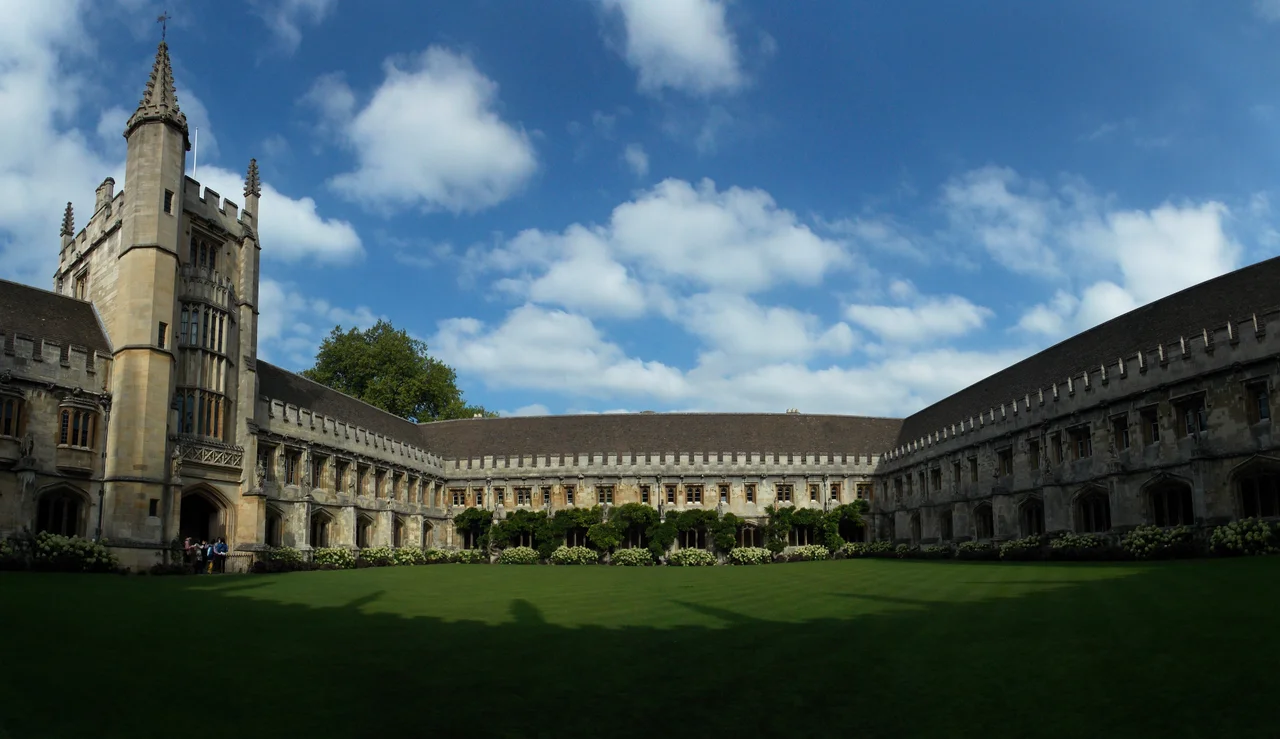

Magdalen College, Oxford
Every May 1, at 6 a.m., the Magdalen College Choir climbs the inside of a 144-foot bell tower and sings Hymnus Eucharisticus to the crowds below on Magdalen Bridge. The tradition is at least 500 years old. People come from across England to stand on the bridge in the cold gray dawn and listen to choristers no one can see. The bells ring after. The Dean of Divinity blesses the city and the university. The crowd, after centuries of practice, then turns and goes to breakfast - sometimes with morris dancing in the streets. It is the loveliest piece of unbroken pageantry in English academic life, and it happens at the same place every year.
A Bishop, a Knight, and a Hospital
William of Waynflete, Bishop of Winchester and Lord Chancellor of England, founded Magdalen in 1458. The money came in part from Sir John Fastolf, a knight who fought at Agincourt and Verneuil and who left a fortune intended to fund a religious college. Waynflete acquired the site of the dissolved Hospital of St John the Baptist, alongside the River Cherwell. New construction began in 1470 under the master mason William Orchard, who built the wall, the chapel, the hall, and the cloister with its Founder's Tower and Muniment Tower. Work was substantially complete by 1480. The cloister survives largely intact - though the north range was demolished in 1822, supposedly for disrepair, and rebuilt almost immediately after the protests of fellows and the press. The grotesques carved around the cloister are intentional teaching devices. The lion and pelican outside the Senior Common Room represent virtues - courage and parental affection. The manticore, the boxers, and the lamia outside the Junior Common Room represent the vices to be avoided: pride, contention, and lust.
The Tower
Magdalen Tower took ten years to build, from 1492 to 1509, and is 144 feet tall. It dominates the eastern approach to central Oxford. The tower is the spiritual center of the May Morning ceremony, the largest single annual gathering in the city, and a building so admired that it has been copied - All Saints' Church in Churchill, Oxfordshire, and First Presbyterian Church in Manhattan both used Magdalen Tower as their model. The tower's silhouette appears in countless prints, paintings, and films of Oxford. Charles I climbed it during the first siege of Oxford in 1644 to survey the Parliamentarian lines. From the top you can see north up the Cherwell toward the Botanic Garden, west across the spires of the colleges, and east into the deer park. The deer have lived in the Grove since at least the 1720s, and by the early 19th century had displaced the formal gardens entirely. The herd is still maintained today.
Cromwell, Cardinal Wolsey, and the King's Plate
Magdalen was Royalist during the Civil War. In 1642 the college donated more than 296 pounds of silver and gold plate - the largest contribution by weight of any Oxford college - to fund the King's war. From 1643 to 1645, the Grove was full of Royalist ordnance, with forges and foundries operating where the deer now graze, and Prince Rupert is thought to have quartered in the college. When Oxford fell, Parliament sent visitors to purge fellows for political and religious reasons. The president John Oliver was removed in 1647. Twenty-eight fellows, twenty-one demies, and almost every servant were expelled when they refused to swear loyalty to Parliament. Among the alumni who had become famous before the Civil War: Thomas Wolsey, son of an Ipswich butcher, who took his Oxford degree at fifteen, became a fellow of Magdalen, and rose to be Cardinal, Archbishop of York, and Lord Chancellor of England. Wolsey founded Cardinal College down the road in 1525. Six years later he was dead and his college had been refounded by Henry VIII as Christ Church.
Snake's Head Fritillaries and a Walk Named Addison
Behind the college runs Addison's Walk, a circular path named for Joseph Addison, the 17th-century essayist and Magdalen fellow whose journal The Spectator helped invent modern English prose. The walk loops through Addison's Meadow, which floods most winters. Because of the flooding, the meadow is one of the few places in Britain where the snake's head fritillary, Fritillaria meleagris, still grows wild - a checkered purple bell-flower that blooms in late April, just before May Morning. Records of the fritillaries in this meadow go back to about 1785. C. S. Lewis was a fellow at Magdalen and walked this path with J. R. R. Tolkien on the September 1931 evening when they discussed myth and Christianity - a conversation Lewis later credited with his conversion. Oscar Wilde read Greats at Magdalen from 1874 to 1878, won the Newdigate Prize for poetry, and took a double first. Edward VIII attended as Prince of Wales from 1912 to 1914 and left without a degree. Dudley Moore arrived in 1954 on an organ scholarship and became one of the great British comedians.
Nobel Laureates and the Daubeny Lab
Magdalen has produced or housed an extraordinary number of Nobel laureates. Howard Florey, who developed penicillin into a usable drug, was a Rhodes Scholar at Magdalen and shared the 1945 Nobel Prize in Physiology or Medicine. Peter Medawar, supervised by Florey, shared the 1960 Nobel for his work on acquired immune tolerance, the principle behind organ transplantation. John Eccles, also a Rhodes Scholar, shared the 1963 Nobel for synapse research. Peter Ratcliffe shared the 2019 Nobel for the oxygen-sensing of cells. Erwin Schrodinger was a fellow when he received the 1933 Nobel in Physics, and Anthony Leggett shared the 2003 Nobel for the same field. The Daubeny Laboratory across the street, founded by the polymath Charles Daubeny in 1848 because the university's chemistry facilities were 'notoriously unworthy of a great University,' became the university's principal chemistry lab. It is now a conference space. Behind it lies the Oxford Botanic Garden, founded in 1621 - the oldest in Britain. Magdalen is unusually rich among Oxford colleges, partly because it owns the Oxford Science Park, which it sold a 40 percent stake of in 2021 for £160 million.
From the Air
Located at 51.7519N, 1.2464W on the eastern edge of central Oxford, immediately west of Magdalen Bridge over the River Cherwell and just north of the Oxford Botanic Garden. Magdalen Tower, 144 feet tall, is the most prominent visual landmark on the eastern approach to the city and is clearly visible from low altitude. Best viewed from low altitude (1,500-3,000 feet AGL). Nearest airports: London Oxford Airport (EGTK, 7 nm north-northwest) and RAF Benson (EGUB, 11 nm south). London Heathrow (EGLL) lies 38 nm southeast. From the air, look for the rectangular tower at the east end of the High Street, the deer park inside the college walls, and the curving line of the Cherwell.
Nearby Stories
- St George's Chapel, Windsor Castle 7 km away
- RAF Honeybourne 7.8 km away
- Sulgrave Manor 8.9 km away
- Cotswolds 9 km away
- Chesham 9.4 km away
- Avebury 11 km away
- Donnington Castle 12 km away
- Ampthill Park 14 km away