
Chesham
Boots, beer, brushes, and Baptists — the four Bs of Chesham. The town in the Chiltern Hills was once known across the Home Counties for all four. It supplied London with footwear, with paper pulp turned from grain mills along the River Chess, with brooms and shovels and the small wooden goods that came from the beechwoods on the hills above, and with the dissenting Christianity that had taken root here in the seventeenth century. It also, since 8 July 1889, has been the terminus of a single-track spur of the London Underground's Metropolitan line — the furthest outpost the Tube reaches from central London, twenty-six miles north-west of Charing Cross. Step off the train at Chesham station and you are technically still inside Transport for London's network, in a market town surrounded by Chiltern farmland that was here long before London began.
The River Chess and the Mills
Chesham is not named after the river. The river is named after the town. The earliest record of the place dates from around 970, in the will of Lady Aelfgifu — possibly the former wife of King Eadwig — who bequeathed an estate here to Abingdon Abbey. The Old English name was Caestaeleshamm, "the river-meadow at the pile of stones." By the Domesday Book of 1086 there were four water-powered corn mills along the Chess, producing surplus flour that travelled south to London. The Chiltern chalk gave the river a fast, clear flow that turned mill wheels reliably for nine hundred years. In the eighteenth century the mills converted to paper-making — London's hunger for paper had become enormous — and then back to flour again in the 1850s, when machine-made paper from elsewhere undercut them. The mills are gone now. The river is still here, a chalk-stream rising from springs at Pednor Vale and Higham Mead, threading through the town past pubs and houses before bending south-east toward Latimer.
The Lollards and the Four Bs
Long before the four Bs became a slogan, Chesham was a centre of religious dissent. The Lollards — followers of John Wycliffe, who had translated the Bible into English in the 1380s — were active here from the late fourteenth century. One of them, Thomas Harding, was burned at the stake on White Hill above the town in 1532. A memorial in the churchyard of St Mary's and another on White Hill itself record his death. The local Baptist tradition, descended from these dissenters, became Chesham's defining religious culture. Broadway Baptist Church traces its origins to at least 1706 and celebrated its three-hundredth anniversary in 2006. Today the town still has four Baptist churches, four Anglican parishes, a Methodist chapel, a Quaker meeting house in Bellingdon Road, a Roman Catholic church, and a purpose-built mosque opened in 2005 — a religious landscape rooted in a tradition of saying no to bishops.
The Civil War and the Townsfolk
Chesham's dissenting heritage made it a Parliamentarian town during the English Civil War. In 1635, when Charles I's sheriff Sir Peter Temple tried to collect Ship Money from the townsfolk — a tax that was the constitutional crisis of the decade — Chesham refused. By 1642 the Parliamentarian leaders John Pym and the Earl of Warwick had headquartered themselves and their troops in the town. In 1643 a Parliamentary company of horse from Chesham clashed with Royalists from Prince Rupert's army near Great Missenden. The local sympathies are easy to read from a Tudor-era timeline: a town that had burned a Lollard for translating scripture was not going to take kindly, a century later, to a king claiming to tax by divine right.
The Metropolitan Line
On 8 July 1889 the Metropolitan Railway reached Chesham. The line had been intended to carry on to Tring, with connections to the West Coast Main Line. The route was abandoned, and Chesham became a terminus instead. The original goods yards beyond the station, where coal arrived for London merchants, are now mostly the Waitrose car park. Electrification arrived in 1959. The branch line — a single track running from Chalfont and Latimer station up the valley to Chesham — became the deepest point the London Underground reached into open country. For most of its life the branch was served by a shuttle train operating between Chesham and Chalfont, with a handful of through services to London at peak times. In December 2010 direct trains to Baker Street and Aldgate began running all day. Stand on the platform at Chesham on a winter morning, look at the Underground roundel on the wall, and remind yourself that you are in a market town in the Chilterns, with sheep grazing the slopes a mile away.
The Town That Survives
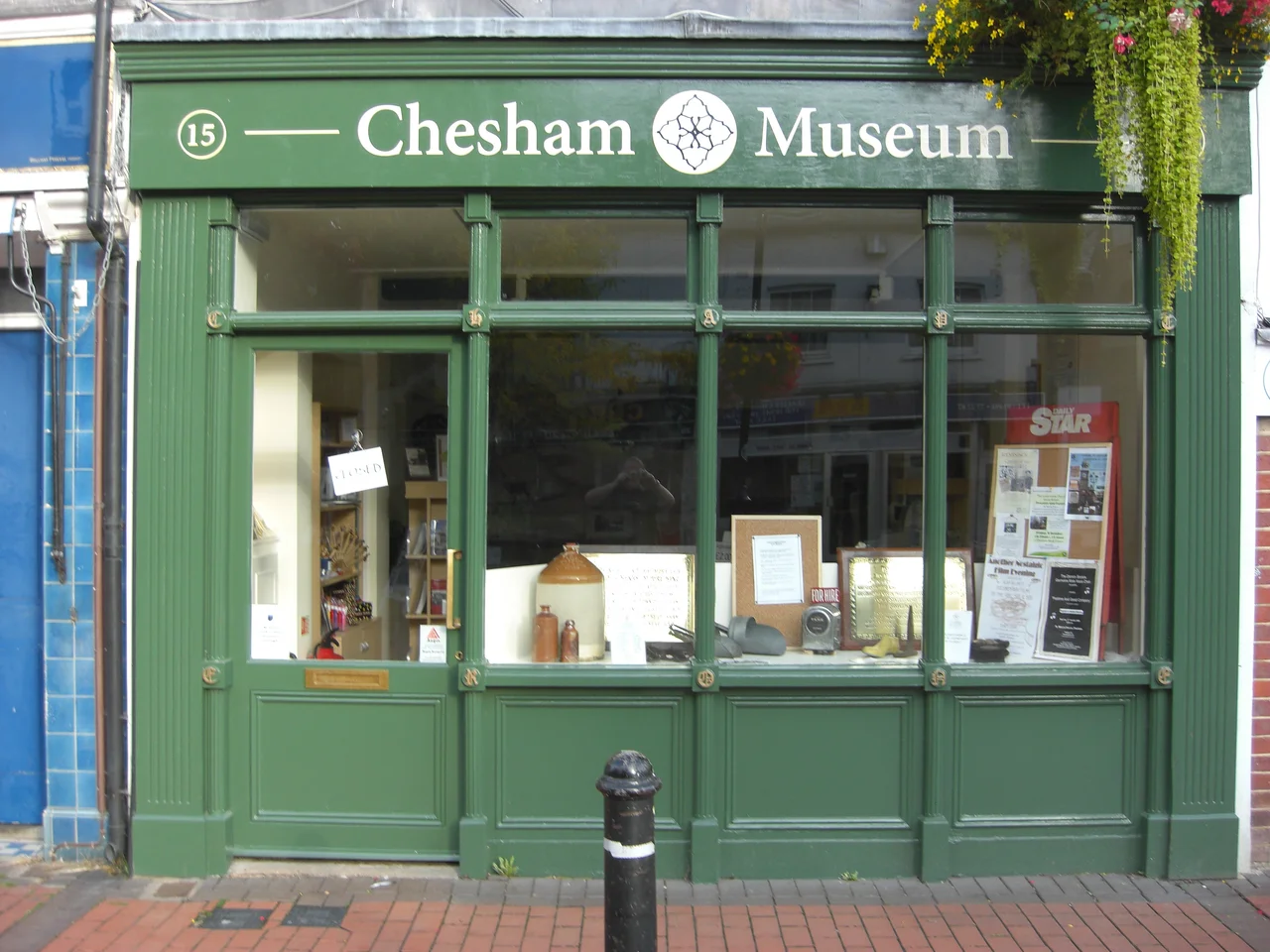
The High Street was pedestrianised in 1990, after a new bypass routed the A416 around it. The clock tower in Market Square, rebuilt in 1992, uses the original mid-nineteenth-century glass-dialled clock face from the town hall demolished in 1965. The Bury, a Queen Anne house built in 1712 for William Lowndes, Secretary to the Treasury, still stands. So does the war memorial in the Broadway, designed by Arthur George Walker and unveiled in 1921, commemorating the 188 Chesham servicemen killed in the First World War — among them Corporal Alfred Burt of the Bedfordshire and Hertfordshire Regiment, who was awarded the Victoria Cross for his actions in September 1915. Chesham is twinned with Friedrichsdorf in Germany, Houilles in France, and Archena in Spain. It has a museum, a 300-seat theatre called the Elgiva, an outdoor swimming pool at the Moor that has been there since the council enclosed the old bathing spot in 1912, and a Tuesday and Saturday market chartered by Henry III in 1257. The mills are gone, the boots are no longer made here, the brushes are mostly imported. The Baptists, and the dissenting spirit beneath them, are still very much in residence.
From the Air
Chesham sits at 51.7065 N, 0.6094 W in the Chiltern Hills, twenty-six miles north-west of central London. From the air the town occupies a valley confluence where four dry valleys meet at the headwaters of the River Chess, surrounded by chalk uplands and beechwood. The single-track Metropolitan line branch from Chalfont and Latimer is clearly visible threading the valley floor. Nearest airports: Heathrow (EGLL) twenty-two miles south, Luton (EGGW) sixteen miles north-east, Northolt (EGWU) sixteen miles south-east, RAF Halton five miles north-west. The Bovingdon stack — a holding pattern for aircraft inbound to Heathrow — lies directly above Chesham, so depending on traffic patterns you may pass through it on a typical approach. The Chiltern Hills Area of Outstanding Natural Beauty surrounds the town on all sides; the deepest the London Underground reaches into open country.
Nearby Stories
- Millennium Dome 0.2 km away
- Ampthill Park 1.9 km away
- Heathrow Airport 5.4 km away
- Fowlmere Airfield 6.6 km away
- Waltham Abbey 9.2 km away
- Ufton Nervet rail crash 11 km away
- Sulgrave Manor 12 km away
- Magdalen College, Oxford 13 km away