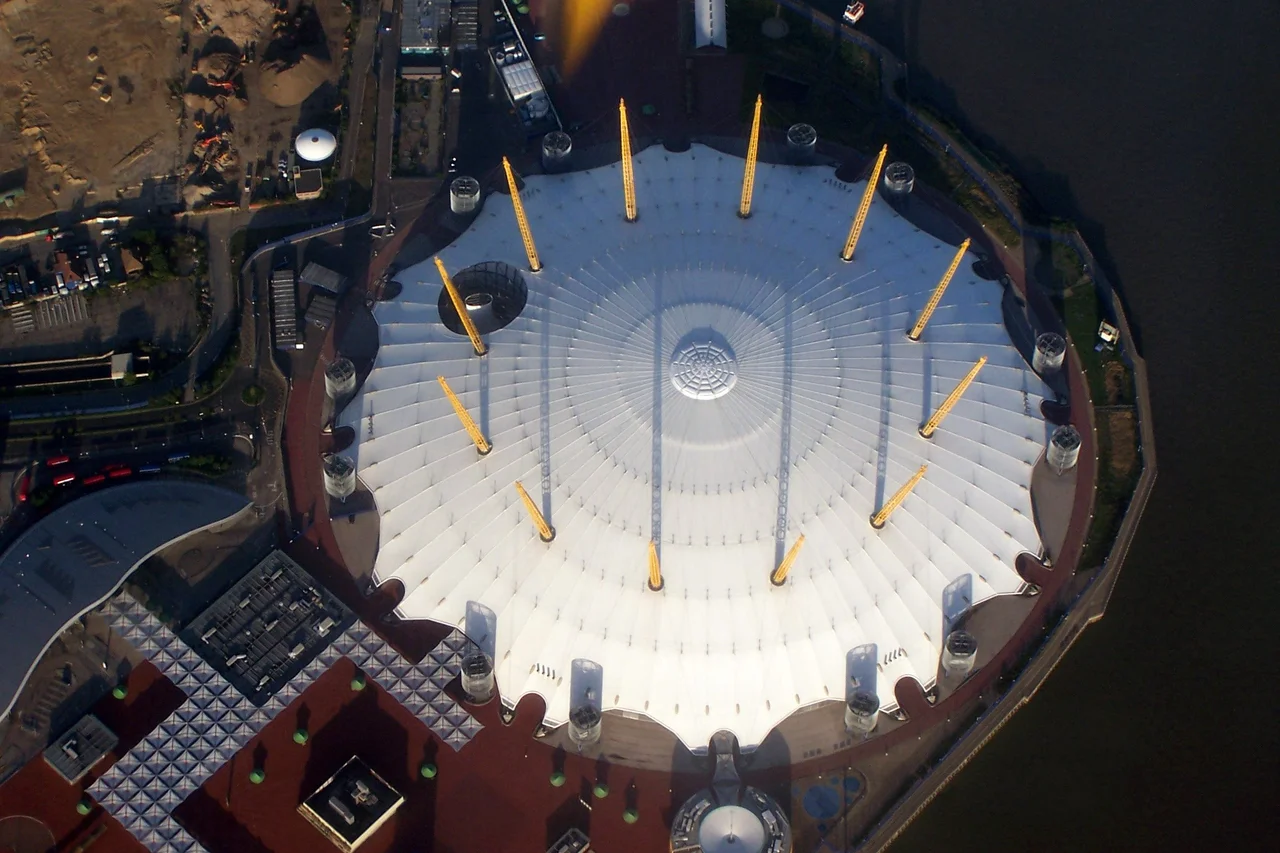

Millennium Dome
It is 365 metres across, one for every day of the year. It is 52 metres high in the middle, one for every week. Twelve yellow steel masts, each 100 metres tall, hold up its white Teflon-coated canopy, one for every month, or every hour on a clock face, in homage to the Greenwich Mean Time that runs along the meridian a few metres to the west. The Millennium Dome is the largest building of its type in the world. It is also one of the most cordially despised buildings ever erected in Britain, and one of the most successful conversions in modern entertainment. Both things are true. Both happened on the same Greenwich Peninsula site.
A Festival to Mark the Year 2000
The idea began modestly under John Major's Conservative government in the mid-1990s: a Festival of Britain-style showcase to mark the millennium. When Tony Blair's Labour government took over in 1997, the project was greatly expanded in scope, scale and cost. Construction began in June 1997 on a Greenwich Peninsula previously contaminated by toxic sludge from the East Greenwich Gas Works, which had operated from 1889 to 1985. The clean-up was vast: the Dome was less a building than a reclamation. Richard Rogers was the architect; Buro Happold engineered the tensile roof, which weighs less than the air it contains. The entire structure was completed by June 1999. Just before opening, Blair claimed the Dome would be a triumph of confidence over cynicism, boldness over blandness, excellence over mediocrity. It was, in other words, set up for either glory or ridicule, with no middle ground.
The Year of the Experience
The Millennium Experience opened to the public on 1 January 2000, after a private New Year's Eve celebration attended by Queen Elizabeth II. The interior was divided into fourteen themed zones: Body, Faith, Mind, Self-Portrait, Work, Learning, Rest, Play, Talk, Money, Journey, Shared Ground, Living Island, and Home Planet. At the centre, twice a day, the Millennium Dome Show was performed: an acrobatic spectacle with music composed by Peter Gabriel, performed 999 times across the year by a cast of 160. In Skyscape, a separate cinema sponsored by BSkyB, the specially-commissioned film Blackadder: Back and Forth played continuously. Outside, the Hanging Gardens, the Millennium Map, and various art installations were scattered across the site. The projected visitor target was 12 million. Roughly 6.5 million came. By most measures, that figure made the Dome the most popular paying tourist attraction in Britain in 2000, with almost twice as many visitors as Alton Towers. But it was just over half of what had been forecast, and the financial model collapsed.
The Press Pile-On
By any objective measure, 87 percent of those who actually visited the Dome said they were satisfied with their day. But the press was relentless. The ticketing chaos on the opening night, when VIP guests including newspaper editors were kept waiting outside in the cold for hours, set the tone. Subsequent reports of management changes (chief executive Jennie Page was sacked in February 2000 and replaced by Pierre-Yves Gerbeau) and repeated requests for additional Lottery funding kept the story alive. The critic Jonathan Meades called the project a Museum of Toxic Waste. The diatribe Sorry Meniscus by Iain Sinclair, published before the Dome even opened, set the literary mood. A November 2000 break-in at the diamond exhibit, where De Beers had loaned the Millennium Star, was foiled by waiting police; four men were jailed in 2002 for the attempted robbery. The Dome closed on 31 December 2000, exactly one year after opening, having attracted what was, in absolute terms, an enormous number of visitors and, in relative terms, a famous shortfall.
The Empty Year, and Then the Pivot
After closure, the Dome sat largely empty and expensive, costing the government over 1 million pounds a month to maintain. The political careers of Peter Mandelson and John Prescott took knocks. Selling the site proved difficult. In December 2001 a deal was reached: Meridian Delta Ltd, backed by the American billionaire Philip Anschutz, took on the Dome and 150 acres of surrounding land. In May 2005 the building was renamed The O2, in a 6 million pound per year deal with the mobile telecoms company. The Anschutz Entertainment Group spent 600 million pounds redeveloping the interior. The result, designed by HOK SVE and Buro Happold, gutted everything inside the original Rogers shell and built a new entertainment district within: an indoor arena, a music club, a cinema, exhibition space, bars, restaurants. It opened on 24 June 2007 with a concert by Bon Jovi.
The Dome That Refused To Fail
By any contemporary measure, The O2 has become one of the most commercially successful entertainment venues in the world. The O2 Arena routinely tops global rankings of best-selling concert venues. The 2012 Olympics held artistic gymnastics here, calling the venue the North Greenwich Arena for sponsorship reasons. Up at The O2 lets visitors clamber along the roof itself. Cable cars from the Emirates Air Line glide over the peninsula. Eight segments of the original canopy were torn off by Storm Eunice on 18 February 2022, and have since been repaired. The white tent and yellow masts that everyone loved to hate now stand on a peninsula transformed by tens of thousands of new homes. The Prime Meridian still passes the western edge. From the air, the Dome is one of the most recognisable buildings in London. The press, which was so sure the project had failed, was simply early. The Dome itself was just waiting for what it would become next.
From the Air
Located at 51.503 degrees north, 0.003 degrees east, on the Greenwich Peninsula. The Dome sits in a tight bend of the Thames, with Canary Wharf's towers immediately to the north across the river and the City to the west. The IERS Reference Meridian passes the Dome's western edge. London City Airport (EGLC) is just 2 nautical miles east; London Heathrow (EGLL) is about 16 nautical miles west. The distinctive 12-mast tent is one of the most recognisable building shapes in London from any altitude.
Nearby Stories
- Hampton, London 1.1 km away
- Queenborough Castle 3.2 km away
- Groombridge Place 4 km away
- North Weald Airfield 4.9 km away
- Kings Langley Palace 8.3 km away
- White House Farm murders 11 km away
- Port Lympne Mansion 22 km away
- Amberley Museum & Heritage Centre 31 km away