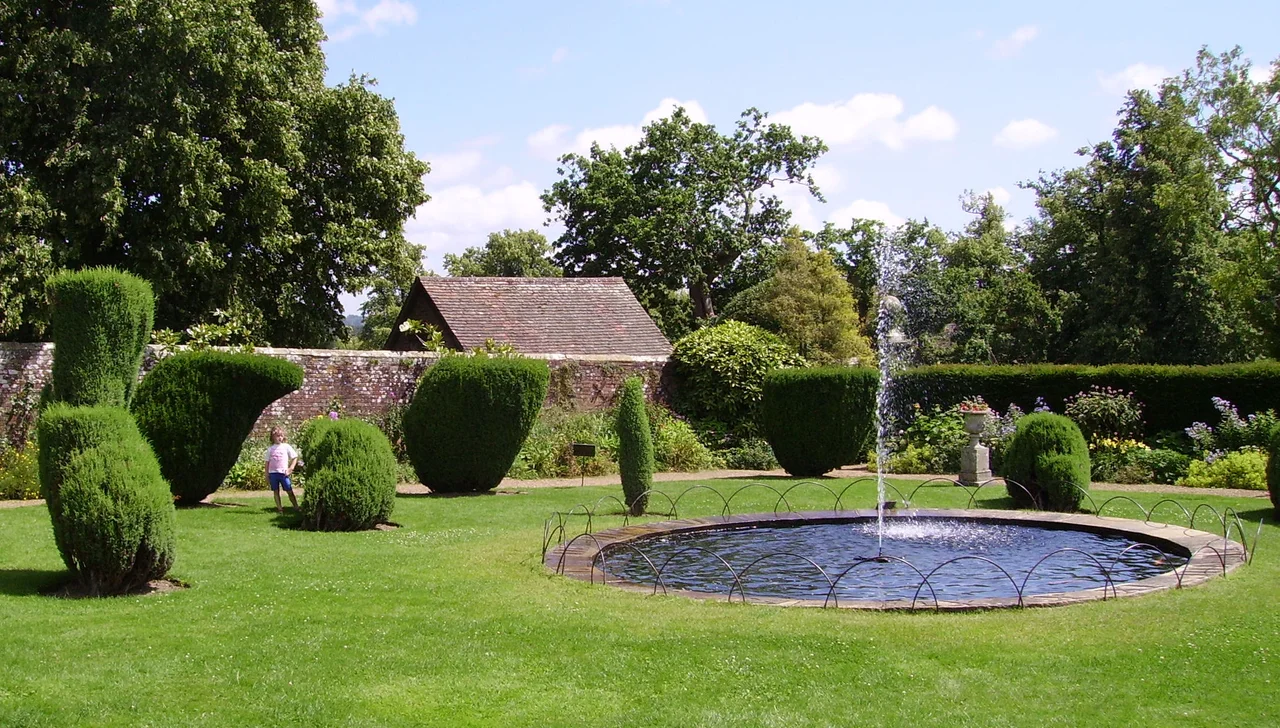

Groombridge Place
In 1415, after the Battle of Agincourt, Sir Richard Waller brought home a particular prisoner: Charles, Duke of Orleans, a French royal and one of the finest poets of the late Middle Ages. Charles spent twenty-five years in English captivity, much of it at the Tower of London but also, for stretches, at Groombridge Place. Two centuries later the medieval manor was demolished and rebuilt as the moated, sandstone-faced house that stands today, by an English barrister named Philip Packer with the help of his friend Sir Christopher Wren. The diarist John Evelyn laid out the gardens and is said to have planted the two Scots pines that still flank the front moat bridge. Groombridge Place wears its history quietly; the house keeps to itself behind its water, and the visitor walks the gardens, the formal terraces, the woodland.
Seven Centuries of Owners
There has been a manor house here since at least 1239, when William Russell received the lordship of Groomsbridge. He and his wife Haweis built a small moated castle and a chantry chapter authorised by Henry III. After Russell's death in 1261 the lordship passed to the de Cobham family. By the mid-14th century it had moved on to Sir John de Clinton, and then around 1400 to Thomas Waller of Lamberhurst. The Wallers held Groombridge for over two centuries. In 1604 the estate was bought by Sir Thomas Sackville, 1st Earl of Dorset, Elizabeth I's Lord Treasurer. His grandson Richard, the 3rd Earl, lost it to John Packer in 1618 to settle gambling debts. The Packers held it for a long generation, and it was Philip Packer who rebuilt the house in 1662.
Wren's Friend Builds a House
Philip Packer was an English barrister with literary friends and architectural ambitions. He had married the heiress Isabella Berkeley in 1652, but his finances stayed precarious and Isabella died at 32. In 1662 he tore down the medieval manor and built the present sandstone house inside its medieval moat - a tall, formal rectangle with a steep roof and tall chimneys, the kind of restrained classicism that the early Restoration favoured. His friend Christopher Wren helped with the design, though Wren's signature later style had yet to emerge fully. John Evelyn, the diarist and horticulturist whose *Sylva* would shape English forestry, laid out the leisure gardens, and is said to have planted the two Scots pines at the front moat bridge; one of them is still alive. Packer himself died in 1686, reading a book in the secret garden by the moat. The house then sat empty for twenty years.
The Groombridge Gang
During that empty interlude the village became a base for one of the most notorious smuggling operations in Kent. The Groombridge Gang ran contraband from the coast inland to London through the 1730s and 1740s. Dragoons were called more than once to restore order in the village. A persistent local legend holds that a smugglers' tunnel ran between the cellars of Groombridge Place and those of the nearby Crown Inn; no such tunnel has ever been found, but the story has been retold so often that some visitors still ask. The house and gardens have remained largely unchanged since they were built. Electricity and bathrooms arrived in the 1920s. In 1986 the roof timbers and chimneys were rebuilt to original specifications after ivy had compromised them.
Holmes, Austen, Triffids
Arthur Conan Doyle knew Groombridge well and loved the Drunken Garden, a small enclosure of clipped yews so wind-bent they look mid-stagger. He set the first half of his 1915 Sherlock Holmes novel *The Valley of Fear* here, renaming the house Birlstone Manor. Vita Sackville-West, herself descended from the Sackvilles who owned Groombridge in the early 17th century, drew on it for her novel *The Heir*. The 2005 film of *Pride and Prejudice* used the house and gardens as Longbourn, the Bennet family home. Peter Greenaway shot *The Draughtsman's Contract* here in 1982. The BBC's 2009 *Day of the Triffids* filmed at the moat. The gardens include the secret garden where Packer died, a zeedonk, a small donkey and a herd of fallow deer.
A Pig in the Future
Groombridge Place is Grade I listed and protected at the highest level. The house remains a private home; the gardens have been open to visitors for years. In early 2023 Robin Hutson, the founder of Hotel du Vin and the Pig hotel group, acquired the property with plans to develop it as the tenth Pig hotel - the chain's first in Kent. A 2025 opening was initially announced. In November 2024 it was disclosed that opening would slip to 2026 because of the care needed for restoration work on a Grade I listed estate. The Pig at Groombridge, if it opens as planned, will be one of the few opportunities for visitors to sleep inside a house designed by a friend of Christopher Wren, on a moat that has held water since 1239.
From the Air
Groombridge Place sits at approximately 51.12 degrees north, 0.19 degrees east, in the village of Groombridge on the Kent/East Sussex border, about 4 miles southwest of Royal Tunbridge Wells. London Gatwick (EGKK) is about 17 miles to the northwest. From altitude, look for the rectangular moat and the formal gardens set in a wooded valley on the High Weald. The B2110 runs nearby. The house is a square sandstone block, easy to spot against the surrounding parkland.
Nearby Stories
- Lullingstone Castle 3.6 km away
- Belle Tout Lighthouse 7.5 km away
- Oatlands Palace 8.7 km away
- Queenborough Castle 10 km away
- The Mermaid Inn, Rye 13 km away
- Surrey 22 km away
- Fratton Park 50 km away
- Battle of Boulogne 65 km away