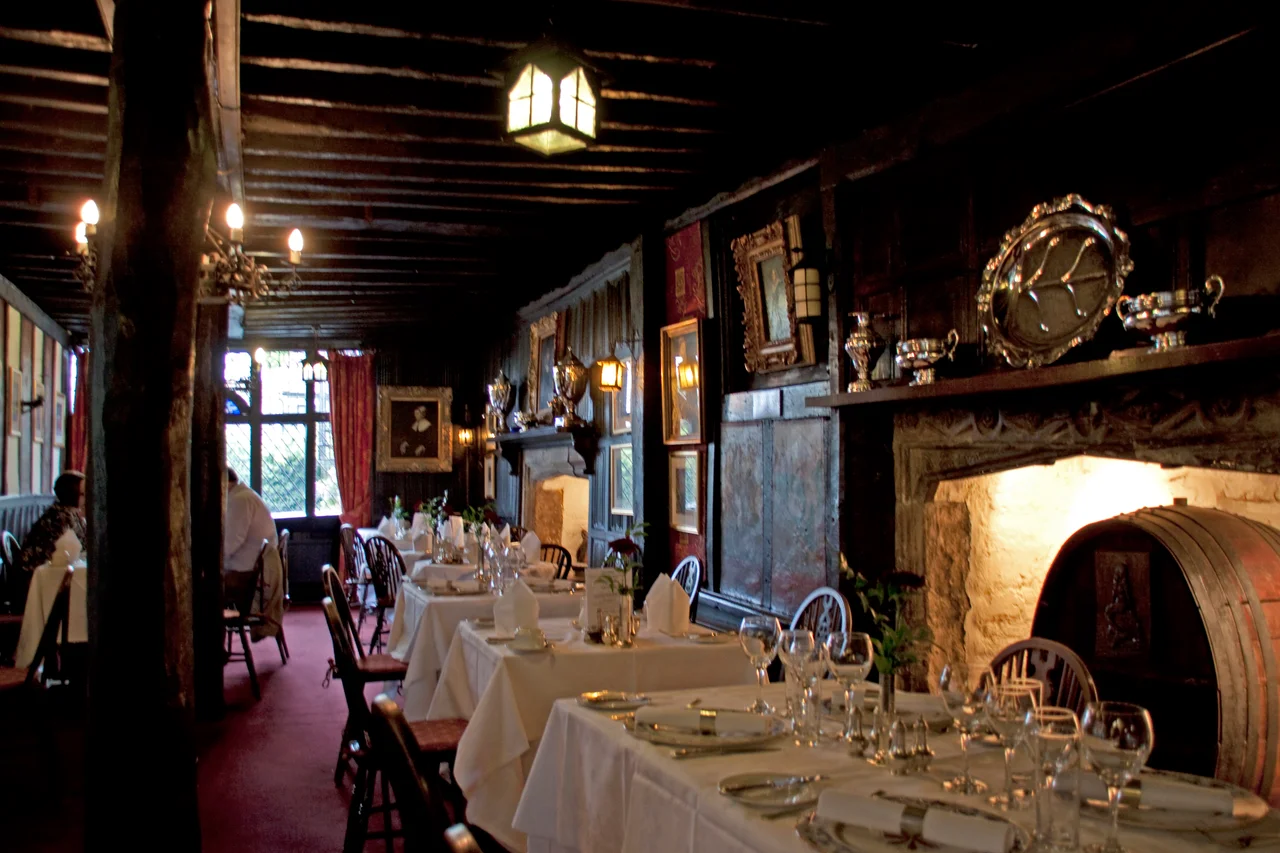

The Mermaid Inn, Rye
The cellars are older than the building above them. The Mermaid Inn's vaulted underground rooms date to 1156, which is unusual enough on a British high street; the timber-framed building they support dates to 1420, which is comfortably medieval; the Tudor additions came in the 16th century, when the inn was already three hundred years old. Walk in from Mermaid Street today and the floors slope, the doorways crouch, and the ceiling beams - thick, dark, made from ships' timbers - look like they remember things. The current owners, Judith Blincow and Robert Pinwill, have run the place since 1993. They are stewards more than proprietors of a building that has outlasted nine centuries of England.
Cellars and a Cobblestone Street
The cellars of the Mermaid have been variously dated. Nikolaus Pevsner, the great architectural surveyor, and English Heritage both placed them in the 13th century, but the inn's own records and earlier scholarship pin them to 1156, the founding year of the original alehouse. The first building was wattle and daub, lath and plaster - the standard materials of the medieval English townscape. It charged a penny a night for lodging and brewed its own ale. Mermaid Street itself was once the town's main thoroughfare, running down the steep hillside to the medieval Rye harbour - and the street name was originally Middle Street, with the present Middle Street being something else again, the kind of overlapping nomenclature that comes of being a working town for nine hundred years rather than a planned one. The inn occupies the north side of the street; other houses that the Hawkhurst Gang used as Rye safe houses - the London Trader Inn, the Flushing Inn, the Olde Bell - were all within shouting distance.
Priests, Mayors, and a Hymn in Latin
Long before the smugglers, the Mermaid was a refuge of a different sort. In 1530, Catholic priests fleeing the Reformation in continental Europe sheltered here, and one of them left a quiet record of his stay - the Latin abbreviation IHS, for Jesus Hominum Salvator, carved into the oak panelling of what is still called Syn's Lounge. By the mid-16th century the inn had become the official venue for Rye's municipal life: the Town Corporation held its Sessions Dinner, its Mayoring Day feast, its Gentlemens Freeman's Dinner, and the wonderfully named Herring Feast within these timbered rooms, between 1550 and 1570. By 1847 the inn had ceased to function as an inn and was simply being used as a house, owned by Charles Poile; the rear yard, with its footway through to High Street, was known as the Mermaid Yard. It was only in the 20th century that the Mermaid was returned to its original purpose.
The Hawkhurst Gang
In the 1730s and 1740s Rye was a major smuggling port, and the Hawkhurst Gang - the most feared smuggling outfit in 18th-century England - made the Mermaid one of its strongholds. Free trade, as the smugglers called their work, moved tea, brandy, lace, and tobacco in from France in defiance of the King's customs and excise. The gang reportedly sat at the bar with loaded pistols on the table, daring the local constables to interfere; the constables, sensibly, declined. Local legend - which is to say, unconfirmable but nicely consistent - holds that one of the gang's ghosts walks here still, alongside the ghost of a maid who was the girlfriend of one of the smugglers and was killed by his colleagues because they feared she knew too much. The story should be treated as folklore, but the smugglers themselves were thoroughly real, and so was the menace they brought into rooms exactly like this one.
Artists, Actors, and Bosie
By 1913 the inn had taken on yet another character. May Aldington, mother of the novelist Richard Aldington, bought it and ran it as a club, and through the 1910s and 1920s it became the place for a generation of English artists to drink and stay. Dame Ellen Terry, the great Shakespearean actress. Lord Alfred Douglas - Oscar Wilde's beloved "Bosie," by then a complicated middle-aged figure but still a literary one. The Benson brothers, A. C. and E. F., the latter the author of the Mapp and Lucia novels which gently lampooned the kind of small English town Rye most certainly was. The poet Rupert Brooke, who would die of sepsis in the Aegean in 1915 at the age of 27. They came for the inn, but also for Rye itself, which Henry James had made fashionable from Lamb House just up the hill. The Mermaid has never quite lost that artistic glow.
What You See Today
The Mermaid is Grade II* listed - the second-highest English heritage protection, applied to fewer than six per cent of listed buildings - and it has the documentation to prove it: in 2001 it was one of 75 Grade II* listed buildings among 2,106 listed buildings of all grades in the Rother district. The AA Rosette-winning restaurant serves British and French cuisine in rooms whose ceiling beams are heavy teak from broken ships and whose chairs were carved from the same. Eight bedrooms have four-poster beds; Room 16 the Elizabethan, where a duel was reportedly fought between two unidentified men at some unidentified time, is the room visitors ask for. The lead-framed diamond-paned windows at the back look out over the same view of Romney Marsh that the smugglers, the priests, and the actors all saw. The Mermaid keeps adding chapters; the building keeps holding them.
From the Air
The Mermaid Inn sits at 50.95 degrees North, 0.7314 degrees East, on Mermaid Street in the hilltop town of Rye, East Sussex. The whole town is best viewed at 1,500 to 2,500 feet AGL - the medieval town crowns a sandstone bluff above the surrounding Romney Marsh and Rye Harbour, with the dominant church tower of St Mary's, the citadel-like Ypres Tower, and the dense red-tiled roofscape forming an unmistakable visual reference from the air. Nearest airfield: Lydd (EGMD) about 7 nautical miles east-south-east. The English Channel lies a few miles south.
Nearby Stories
- Herstmonceux Castle 2.2 km away
- Tonbridge Priory 7.1 km away
- HMS Niger (1892) 7.9 km away
- Shrub's Wood Long Barrow 8.9 km away
- Battle of the Narrow Seas 13 km away
- Le Paradis Massacre 88 km away
- Courrieres Mine Disaster 145 km away
- D-Day: The Longest Day 160 km away