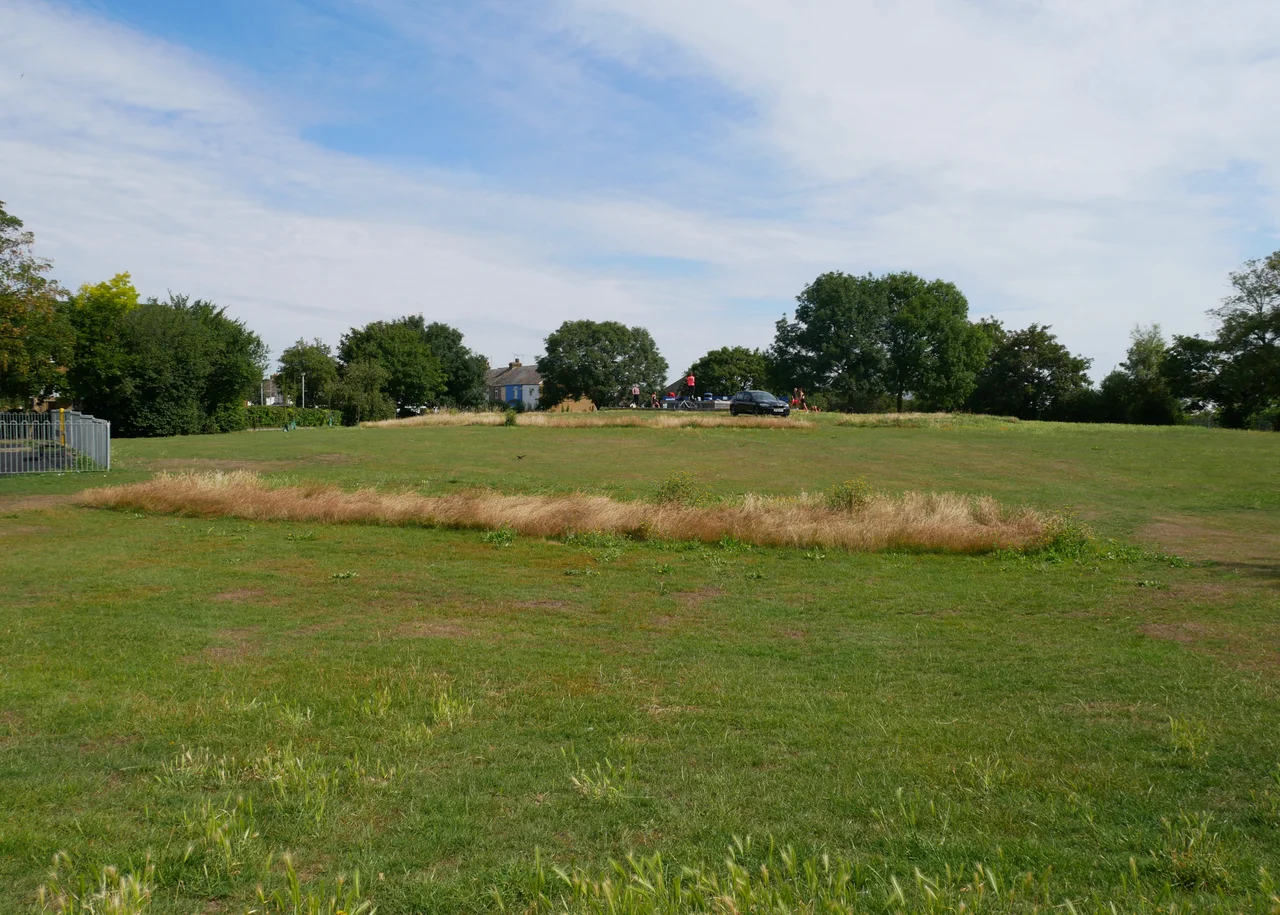

Queenborough Castle
Imagine a perfect stone wheel a hundred and seventy feet across, set on a low hill above the marshes of the Swale. Six round towers ring its outer wall at regular intervals. Inside, a circular curtain encloses a paved courtyard with a single deep well at its centre. There are no parallels in England before it - and almost no traces of it left today. Queenborough Castle was Edward III's experimental masterpiece, a concentric fortress that mounted some of the first cannon ever installed in an English royal castle. Built between 1361 and 1367, it stood for less than three centuries. Parliament's commissioners declared it unfit in 1650 and the stone was carted away to build farmhouses and dockyards. The plan survives in an Elizabethan manuscript at Hatfield House. Almost nothing else does.
A King's Plague Refuge
Edward III bought the land in 1361. The hamlet that stood there - Bynne, two houses worth - was demolished and its inhabitants rehoused. England was in the brief peaceful interval that followed the Treaty of Brétigny, ending the first phase of the Hundred Years' War. The plague had arrived a decade earlier, killing perhaps a third of the population, and Edward had buried two of his own children to it. The official purpose of the new castle was "the defence of the realm and for the refuge of the inhabitants of the island," but historians have long suspected it was also designed as a palace-fortress where the royal family could retreat from outbreaks of Black Death. Edward named the planned town beside it Queenborough, in honour of his wife Philippa of Hainault - mother of his thirteen children and the woman who, by then, had been his queen for more than thirty years.
The Circle of Yevele
Construction credits are uncertain. Some sources name the master mason John Box; others credit Henry Yevele, who would later design the nave of Westminster Abbey; others William of Wykeham, the future Bishop of Winchester. About 1,600 craftsmen and labourers worked on the site, and the total cost - around £20,000 - was an extraordinary sum for the period, equivalent to many millions today. The radical concentric plan was new to England: an outer curtain wall with six towers, enclosing an inner circular building described as a rotunda, around a paved courtyard. It was specifically designed to mount gunpowder artillery and to withstand it. In 1365, before the structure was even complete, two great guns and nine small ones were shipped to it from the cannon foundry at the Tower of London - taking priority over Dover. Originally rainwater drained from the lead-piped roofs into cisterns, but in 1393 a contractor spent sixty weeks digging a deep well in the courtyard.
Constables of Royal Blood
The constableship of Queenborough was a prize office. John of Gaunt, Duke of Lancaster - third surviving son of Edward III, sire of the House of Lancaster, and the most powerful nobleman in late-14th-century England - was appointed in 1377. Robert de Vere, Duke of Ireland, Richard II's controversial favourite, took the office in 1385. Thomas Arundel, Archbishop of Canterbury and brother of an executed earl, held it from 1409. George Plantagenet, 1st Duke of Clarence - the Yorkist prince later (and famously) drowned in a butt of malmsey wine - was constable from 1461. In 1450, Jack Cade's rebellion swept through Kent. Cade and his followers attacked Queenborough Castle in July of that year. The garrison repelled them easily. Cade himself was wounded in the attempt and died of his injuries weeks later. Henry VIII ordered the castle repaired in 1536. In 1629 a visitor described seeing Elizabeth I's coat of arms in the great hall accompanied by a Latin verse exhorting her to "live a virgin and a lion reign."
Demolition by Committee
The Civil War made castles politically suspect. In 1650 Parliament's commissioners surveyed Queenborough Castle, declared it unfit for use, and recommended demolition. The work was done quickly. Foundations went into the ground; ashlar facing stone went into the new houses of Kent. Only the well survived. In 1723 the Royal Navy surveyed it and found it 200 feet deep and lined with Portland stone. After further deepening they extracted water described as "good, soft, sweet and fine" and piped it to the dockyard at Sheerness. When the Sheerness branch railway opened in 1860, the line was cut through the eastern part of the site, and a pump house was built over the well to supply water for the locomotives. A school went up on the western side. The most ambitious royal castle of late-medieval England was gone, leaving behind the most important asset it had built: clean drinking water.
Time Team's Trench
In September 2005 the Channel 4 archaeology series Time Team came to Queenborough for an episode broadcast in March 2006 under the title "Castle in the Round." Wessex Archaeology ran the dig. The geophysical survey was hampered by a 1970s concrete slab over the well, by imported clay from earlier landscaping, by buried pipes and by a wartime air-raid shelter. But the excavators were able to identify remnants of the outer curtain in a robber trench, demolition rubble that had been dumped into the moat, and fragments of internal walls thought to be from the corridors leading from the gate. They found sixteen sherds of medieval pottery, five coins and tokens including a 15th-century French jeton, fragments of moulded stone, Flemish brick, and two musket balls - traces of the Civil War demolition mingled with traces of Edward III's masons. The site today is a public park. Low earthworks trace where the wall once stood. A bowling green sits where the great hall once was. The well is capped beneath the lawn. Edward III's perfect circle has dissolved back into Sheppey clay.
From the Air
Queenborough Castle's site sits at 51.42°N, 0.75°E in the centre of Queenborough on the western edge of the Isle of Sheppey, Kent - on a low rise just inland from the Swale Channel. Recommended viewing altitude is 1,500-2,500 feet. The site is now a public park immediately west of Queenborough High Street; from the air it shows as a rough rectangle of open green among Victorian terraces. The Sheerness branch railway crosses the eastern edge of the site. Nearest airports: London Southend (EGMC) about 5 nm north across the Thames Estuary, Rochester Airport (EGTO) 12 nm south-southwest. The site is within the London TMA - coordinate with Southend or Thames Radar.
Nearby Stories
- Royal Tunbridge Wells 6.6 km away
- Broadstairs 6.8 km away
- Belmont Castle 8 km away
- White House Farm murders 10 km away
- Port Lympne Mansion 12 km away
- North Weald Airfield 14 km away
- Battle of the Narrow Seas 17 km away
- Maunsell Forts 25 km away