
North Weald Airfield
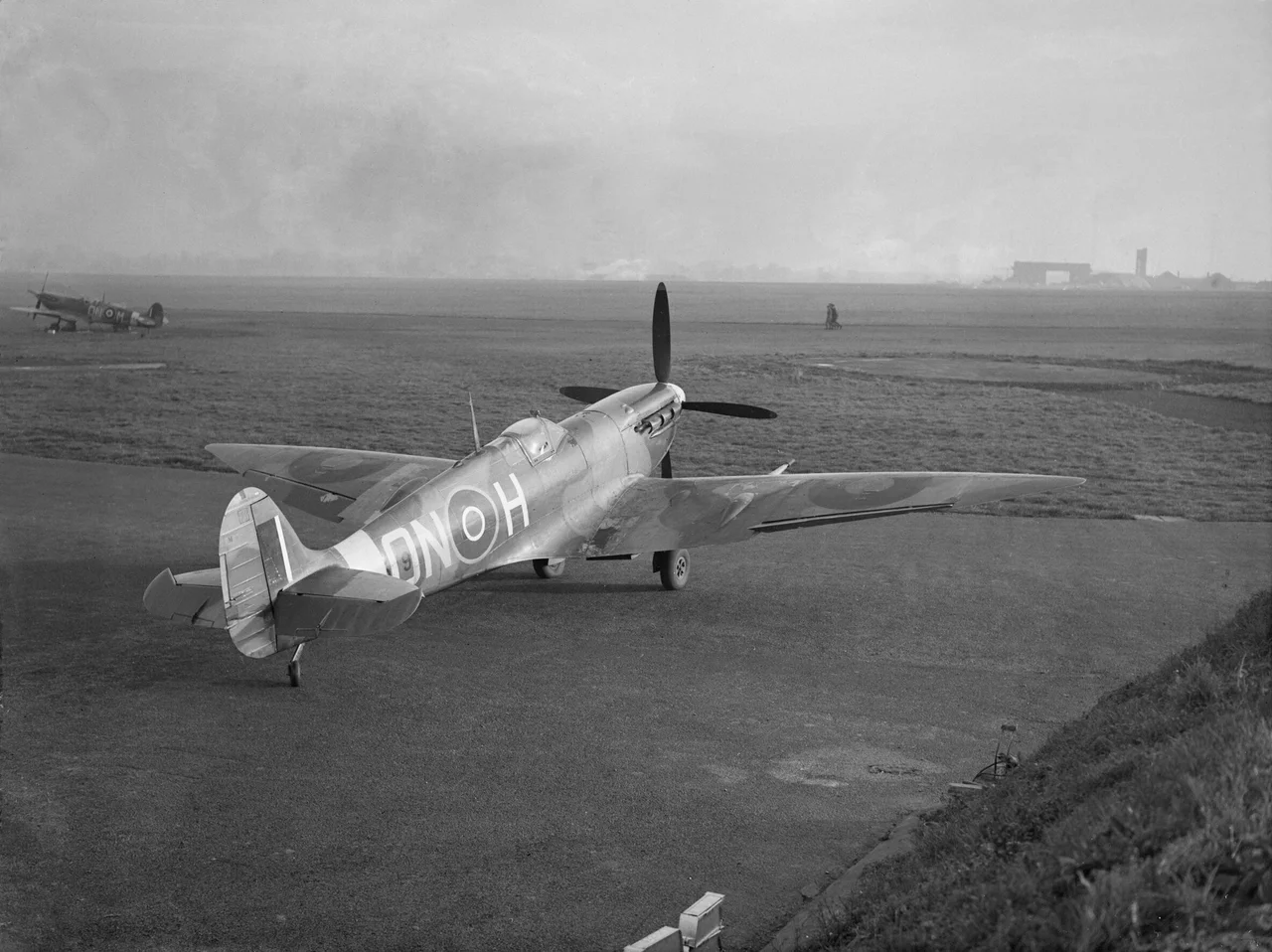
On 24 August 1940, the German bombers came in low over Epping Forest and hit RAF North Weald hard - cratering the runways, killing nine on the ground, and announcing that this small grass airfield was now a primary target. The Hurricanes of 56 and 151 Squadrons had taken off in time. They came back to a wrecked station. They would still be in the air the next morning. Eighty-five years later, the Hurricanes are gone but the Spitfires fly from here on summer weekends, and the 1952 control tower - one of only seven of its type ever built - still watches the same northwest-southeast runway.
The Royal Flying Corps Comes
The story begins in the summer of 1916. The Royal Flying Corps established an aerodrome on farmland in the parish of North Weald Bassett, choosing the site for its flat ground and its proximity to London - close enough to defend, far enough to be safe. When the RAF was created on 1 April 1918, North Weald passed to the new service. The interwar years brought permanent buildings: large hangars went up in the late 1920s (one 1927 hangar still stands), with accommodation blocks for personnel and the kind of solid red-brick architecture the RAF used everywhere from Lincolnshire to Lancashire. By the late 1930s North Weald was a front-line fighter station, part of 11 Group, ready for what was coming.
Hurricanes Over Dunkirk and Kent
When the Second World War began, the squadrons here flew Hawker Hurricanes alongside Bristol Blenheim night fighters. They covered the evacuation from Dunkirk in May and June 1940, taking heavy losses to protect the soldiers crowding the beaches below. Through the Battle of Britain that summer, North Weald was one of the airfields between London and the Channel that the Luftwaffe needed to destroy. The pilots scrambled multiple times a day, often into superior numbers, often back from the chaos of combat with engines smoking and ammunition spent. In autumn 1940 two American Eagle Squadrons - made up of US volunteers who had crossed the Atlantic before America entered the war - arrived at North Weald with Spitfires. Later they were joined by Norwegian squadrons in exile after their country's occupation. An obelisk erected by the people of Norway in 1952 still stands at the gate.
Jets, Hunters, and the Black Arrows
After the war the propellers gave way to turbines. Gloster Meteors and de Havilland Vampires were a common sight in the west Essex sky from 1949. The Control Tower was rebuilt in 1952 as part of Cold War modernisation - a hexagonal Type 5223 design that is now a Grade II listed building and considered one of the finest surviving examples of its kind. The last front-line combat unit, No. 111 Squadron flying Hawker Hunters, was the famous Black Arrows, the all-black aerobatic team that set a world record for 22 aircraft in formation loops at the 1958 Farnborough Air Show. They left North Weald that same year. In 1964 the RAF withdrew entirely. The field passed briefly to the Army and Royal Navy, then in 1979 to Epping Forest District Council, which still owns it.
Warbirds and Air Ambulances
Civilian aviation reclaimed the runways. North Weald is now one of the busiest general aviation airfields in southern England with over 40,000 movements a year - flight training in Cessna 172s and Piper PA28s, charter operations, maintenance shops. But the real draw is the warbirds. Hangar 11 Collection, Aero Legends and Kennet Aviation keep airworthy Supermarine Spitfires, North American P-51 Mustangs, Curtiss Kittyhawks, a Douglas Dakota, a Skyraider and a Seafire. Early jet fighters fly here too - Hunters, Venoms, Vampires, Folland Gnats. The Hawker Hunter that crashed at the 2015 Shoreham Airshow, killing eleven people on the ground, had been based here. The Essex and Herts Air Ambulance moved its rapid-response AgustaWestland AW169 to a purpose-built base on the field in 2021. The National Police Air Service operates three helicopters and a fixed-wing aircraft here under a 25-year lease, covering London and the surrounding counties.
The Saturday Market and the Crystal Maze
The other side of North Weald is gloriously unpretentious. The southern half of the field hosts what claims to be one of the largest open-air markets in the UK, drawing crowds from Essex and north London every Saturday for stalls of clothes, tools and street food. Supercar driving experiences thunder down the old crosswind runway. The site has been used for filming - in the 1990s the Aces High hangar housed Channel 4's game show The Crystal Maze, after Shepperton Studios needed the original soundstage for a movie. The transit camp for the 21st World Scout Jamboree was here in 2007. In January 2021 an inland border facility opened on part of the field to handle Brexit customs checks. The RAF North Weald Memorial near the main gate was dedicated in 2000, listing the names of those who flew from here and did not come back. The Norwegian obelisk stands at its centre.
From the Air
North Weald Airfield (ICAO EGSX) sits at 51.7217 degrees North, 0.1542 East, in the parish of North Weald Bassett in Epping Forest, Essex. Best viewed at 1,500 to 2,500 feet. The active runway is 02/20 with a hard surface, and the field is easily identified by the long single strip, the prominent hexagonal Cold War control tower, and the cluster of vintage hangars near the southern end. Stansted (EGSS) lies about 10 nautical miles north; London City (EGLC) sits 17 nm southwest. The M11 motorway runs about 2 miles west of the field.
Nearby Stories
- Gainsborough's House 1.9 km away
- Lesnes Abbey 3.7 km away
- White House Farm murders 7 km away
- Garrison Point Fort 7 km away
- Duxford Aerodrome 7.3 km away
- Heathrow Airport 8.2 km away
- Hemel Hempstead 8.3 km away
- Ampthill Park 11 km away