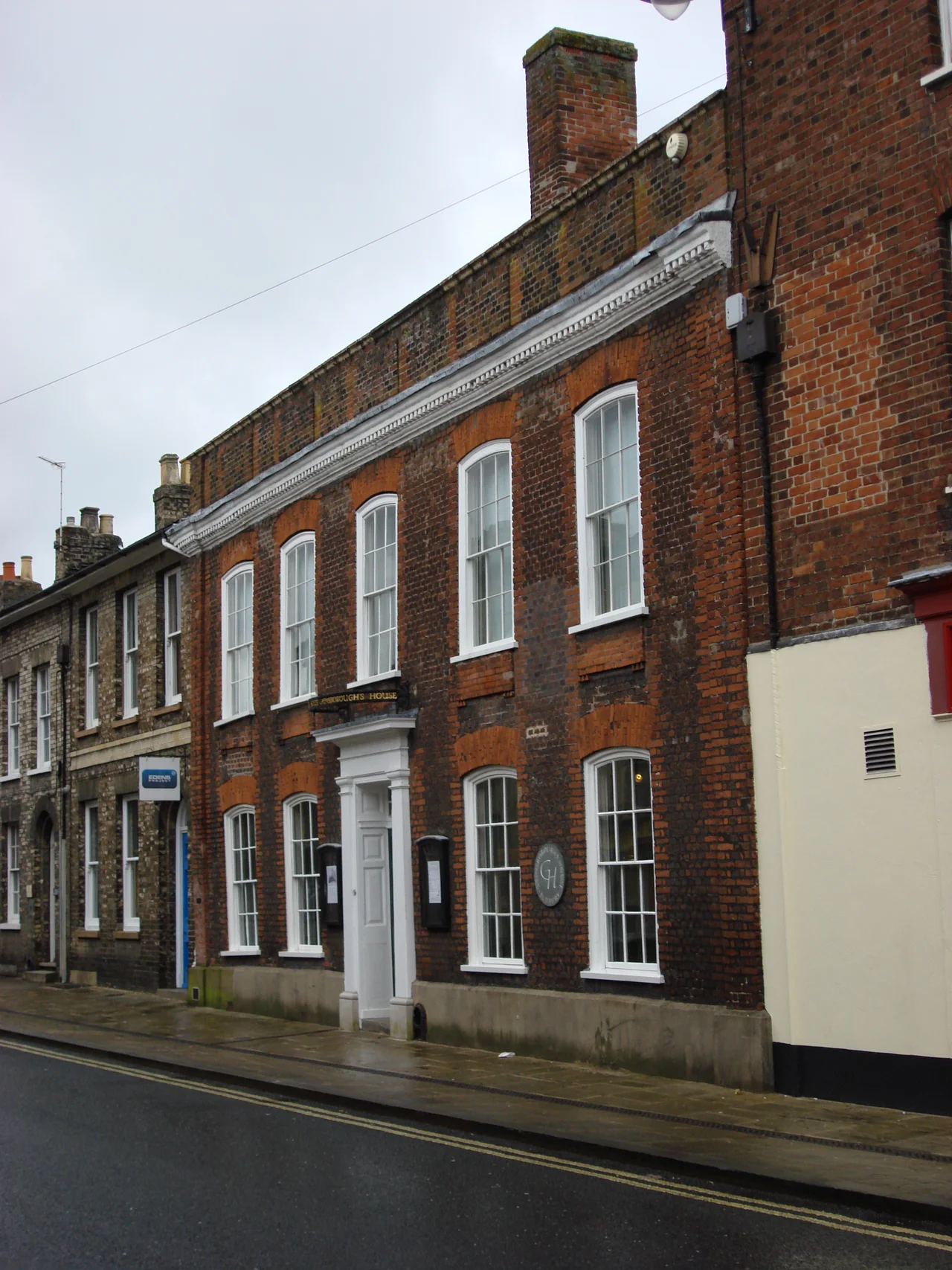

Gainsborough's House
Thomas Gainsborough left Sudbury at thirteen, and never really came back. The town made him in the way that provincial England makes its artists — by giving him a landscape to love and then a reason to leave it. But the house on what is now Gainsborough Street remained. His parents had bought it in 1722 for £230, and the youngest of their nine children grew up beneath its oak-beamed rooms, attended the grammar school nearby, and developed the eye that would later make him one of the great portraitists of the 18th century. That house, built around 1520, still stands in Sudbury — and is now one of the finest small art museums in Suffolk.
Where the Artist Began
The oldest visible part of the building is an oak doorway that may date to 1490, probably the original front door opening straight from the street into what is now the Entrance Hall. Four distinct building phases are visible in the structure — the earliest rooms date to around 1500, the walls filled with wattle and daub, clay soil mixed with reeds from the abundant East Anglian fens. By the time John and Mary Gainsborough moved in, the house had evolved through Tudor and Stuart additions into a substantial merchant's home. Thomas was born here in 1727, educated at Sudbury Grammar School, and at thirteen travelled to London to train with the French painter and illustrator Hubert-Francois Gravelot. He would not return to paint in Sudbury for long: after London came Ipswich, then Bath, then London again.
Portrait, Landscape, and the Problem of Money
Gainsborough was the first significant British artist to paint landscape consistently — and landscape paid poorly. The aristocracy and wealthy merchants who sustained painters in 18th-century England wanted their likenesses captured, not Suffolk hedgerows or imaginary pastoral visions. So Gainsborough painted both, but sold the portraits and kept many of the landscapes for himself. By the 1760s he was so in demand that he complained of overwork. His brushwork became lighter and more feathery in the London years, the figures almost dissolved into atmosphere. He was a founder member of the Royal Academy in 1768, eventually fell out with it by 1783, and held exhibitions in his studio at Schomberg House on Pall Mall instead. He died of cancer in 1788 and is buried at Kew.
A Community Saves the House
After the Gainsborough family sold the house in 1792, it passed through many hands — at various times a private residence, a guest house, and tearooms where locals hired the garden's tennis courts for summer afternoons. An art dealer named Doward bought it in the mid-1950s intending to live there, but his wife refused to move to Sudbury, and by 1956 it was for sale again. What happened next speaks well of the town. A National Appeal Committee formed under the Mayor of Sudbury, artists donated, Sir Alfred Munnings gave £1,500 from the sale of a painting of the Queen's horse Aureole, and the house was purchased in January 1958 for £5,250. By September, the Gainsborough's House Society was formally established, and the museum opened in April 1961.
The National Centre for Thomas Gainsborough
The museum expanded substantially in the twenty-first century. A £10 million refurbishment programme, supported by a £5 million National Lottery Heritage Fund grant, began in 2019, adding new gallery and exhibition spaces alongside the artist's original home. The revamped National Centre for Thomas Gainsborough reopened to the public in November 2022. Today visitors can move between the historic house — with its original oak doorway, early fireplaces, and Gainsborough memorabilia — and contemporary gallery spaces housing one of the finest collections of his work outside the national collections. The walled garden, which has attracted artists since the museum's first appeals in the 1950s, remains a particular pleasure.
From the Air
Located at 52.04°N, 0.73°E in Sudbury, Suffolk, a small market town on the River Stour. The town centre with its medieval church and compact streets is identifiable from the air. Nearest airports: Cambridge Airport (EGSC), approximately 25 miles northwest. Recommended viewing altitude 2,000–3,000 feet to appreciate the Stour Valley context. Clear weather reveals the rolling Suffolk farmland that Gainsborough painted.
Nearby Stories
- Ely Cathedral 6.2 km away
- Aldeburgh Festival 8 km away
- Bungay Castle 8.4 km away
- Thetford Castle 9.1 km away
- White House Farm murders 12 km away
- RAF Bottisham 12 km away
- North Weald Airfield 20 km away
- Broadstairs 55 km away