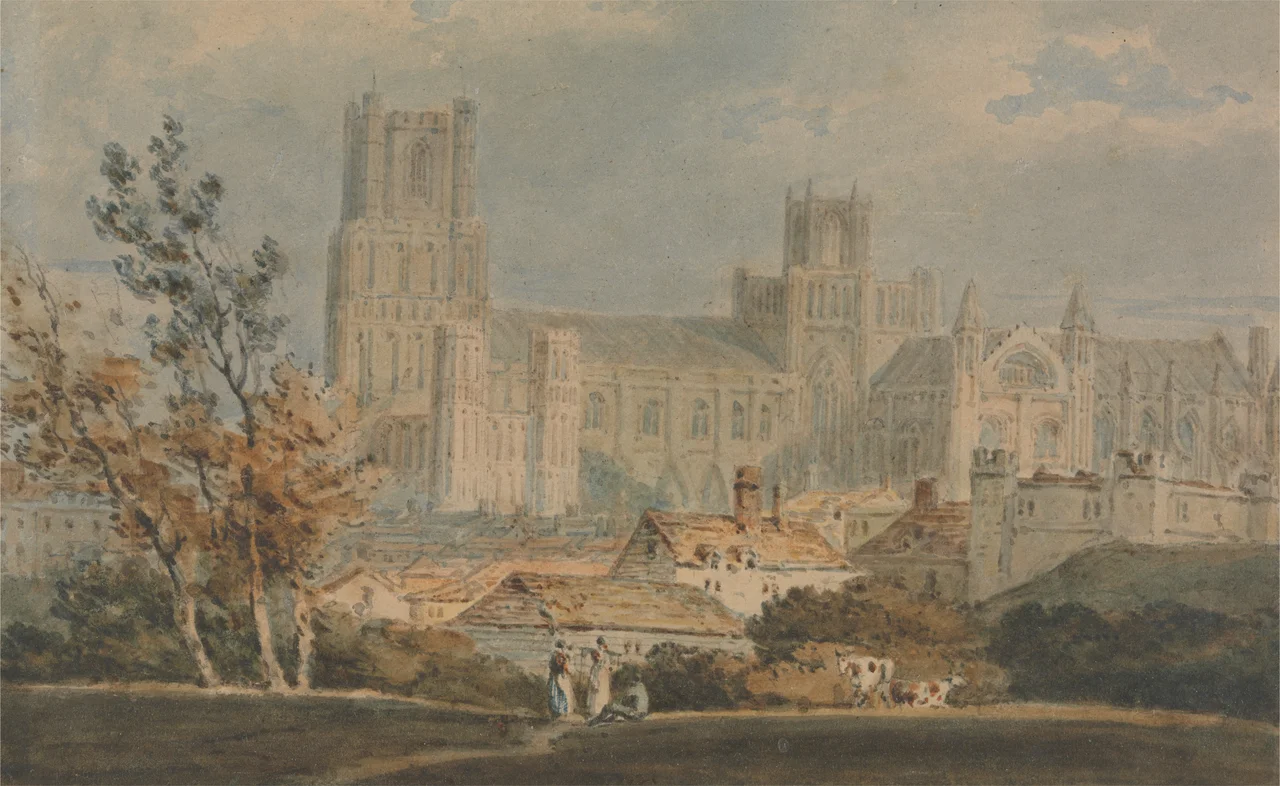

Ely Cathedral
On the night of 12–13 February 1322, possibly disturbed by the excavation of foundations for the new Lady Chapel, the Norman central crossing tower at Ely Cathedral collapsed. The disaster might have produced a replacement tower — another square Norman structure, re-built on the same plan. Instead, the cathedral's sacrist Alan of Walsingham did something without precedent: he removed all four of the original tower piers and enlarged the crossing to an octagon. The new structure that rose in its place — a vast stone octagon topped by an enormous timber lantern — became what the architectural historian Nikolaus Pevsner would later call Ely's "greatest individual achievement of architectural genius." It required timber so large that it could not be replicated today, because there are no trees big enough.
Founded in 672
Ely Cathedral traces its origins to the abbey founded here in 672 by Æthelthryth — St Etheldreda — a daughter of Anna, King of East Anglia. It was a mixed community of men and women, and the presence of Etheldreda's relics made it a significant pilgrimage destination in the early medieval period. Viking raids may have destroyed the original monastery, though it was refounded in 970 under the Benedictine rule. The church of 970 stood within or near the nave of the present building, progressively demolished as the Norman church rose alongside it from 1083. That Norman construction began under Abbot Simeon — brother of the Bishop of Winchester, aged 90 when building commenced — and it was one of the largest building projects north of the Alps at the time. The cathedral attained full cathedral status in 1109, when Hervey le Breton became its first bishop, having successfully argued that Ely should be independent of the Diocese of Lincoln.
What Was Built
The cathedral's statistics are imposing. Total length: 537 feet. The nave — over 75 metres long — remains one of the longest in Britain. The West Tower stands 66 metres high. The Octagon is 23 metres wide and 52 metres high; internally, from floor to the central roof boss, the lantern reaches 43 metres. The stone came from Barnack in Northamptonshire, purchased from Peterborough Abbey at the rate of 8,000 eels a year — an accounting detail that reveals how thoroughly the fenland economy operated on its own strange currency. Decorative elements are carved from Purbeck Marble and local clunch. The cathedral is built in cruciform form with an additional transept at the western end. The west front is richly decorated with intersecting arches and complex mouldings, completed under Bishop Geoffrey Ridel in the late twelfth century. Walking from the Galilee Porch to the choir, a visitor passes through layers of Romanesque, Early English Gothic, and Decorated Gothic — the accumulated ambitions of ten centuries of builders.
The Destruction and After
The Reformation came to Ely in 1539, when Henry VIII's commissioners took possession of the monastery. The cathedral was refounded in 1541, and Bishop Thomas Goodrich's orders were comprehensive: the shrines to the Anglo-Saxon saints were destroyed, nearly all the stained glass was removed, 147 carved figures in the Lady Chapel frieze of St Mary were individually decapitated, and sculptures throughout the building were defaced. The scale of the destruction in the 1540s was thorough enough that when Oliver Cromwell's army occupied the Isle of Ely in the 1640s, Parliament's request to demolish the buildings found relatively little remaining to destroy. Bishop Matthew Wren had already been arrested and sent to the Tower of London in 1642, where he remained for 18 years. That the cathedral survived the Commonwealth may have been due partly to Cromwell's protection — he was local, born in nearby Huntingdon — and partly to simple indifference.
The Cathedral in Culture
The cathedral appears on the horizon in the cover photograph of Pink Floyd's 1994 album *The Division Bell*, and David Gilmour recorded orchestral and choral parts for his 2024 album *Luck and Strange* in the cathedral. In 1973 Leonard Bernstein and the London Symphony Orchestra filmed a performance of Mahler's Second Symphony — the "Resurrection" — here. J.M.W. Turner painted the cathedral in watercolour around 1796. The building has doubled for Westminster Abbey in *The King's Speech* (2009) and *The Crown* (2016), and has appeared in *Elizabeth: The Golden Age*, *Assassin's Creed*, and *Macbeth*. Around 250,000 visitors come each year. The daily rhythm of services — morning and evening — continues as it has, with some interruptions, since the seventh century. The choristers at King's Ely school, supported by the cathedral, sing equal numbers of services from 2021, boys and girls receiving equal scholarships. The ship of the Fens sails on.
From the Air
Ely Cathedral is located at 52.399°N, 0.264°E, visible from considerable altitude across the flat fenland. The Octagon lantern tower and West Tower are the definitive visual landmarks of the region. From the northwest, the cathedral sits above the Great Ouse river plain. ICAO nearest airport: Cambridge (EGSC), approximately 15 miles south. Recommended viewing altitude: 1,500–3,000 feet for close approach; visible at cruising altitude from 20+ miles.
Nearby Stories
- Bed Burial 2.5 km away
- Thetford Priory 6.6 km away
- Oundle School 8.1 km away
- RAF Lavenham 9 km away
- John Bunyan Museum 11 km away
- King's Lynn Minster 15 km away
- Woolsthorpe-by-Colsterworth 21 km away
- Walsingham Priory 21 km away