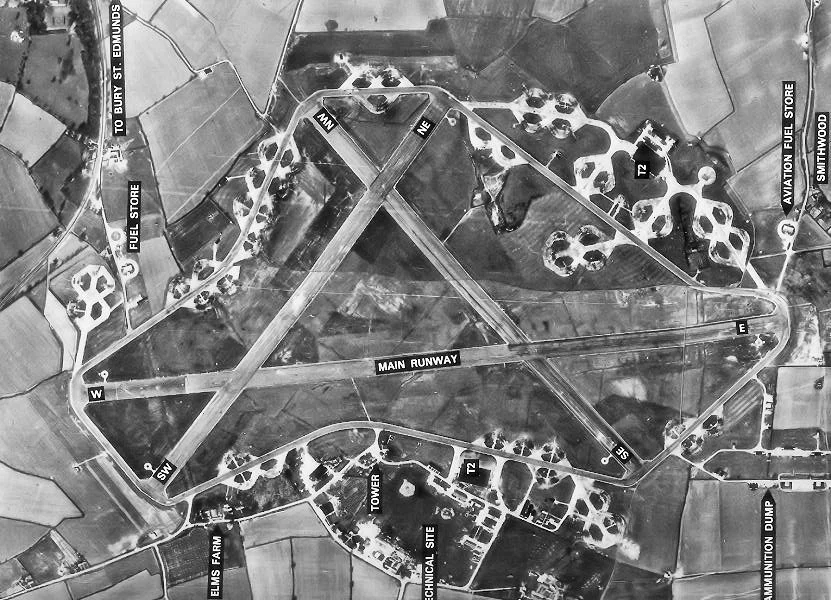

RAF Lavenham
His portrait hangs in the Swan Hotel in Lavenham to this day. The landlord was his friend, and he came up to the village from the airfield to drink in the bar with the timbered ceiling. On Christmas Eve 1944, Brigadier General Frederick Castle took off from RAF Lavenham at the head of the largest Eighth Air Force mission of the entire war: more than 2,000 heavy bombers covered by over 800 fighters, sent against eleven German airfields east of the Rhine. An engine failure forced him out of the lead. Rather than jettison his bombs over friendly troops, he stayed slow, became a target, and gave the bail-out order while remaining at the controls so his crew could get out. He went down with the aircraft. The Medal of Honor was awarded posthumously - the last one given to a member of the Eighth Air Force in Europe, and the highest decoration ever bestowed on a man who had taken off from this particular Suffolk field.
Building Station 137
RAF Lavenham was not in Lavenham. The airfield, also called Cockfield in some records, sat a few miles north of the medieval wool town near the village of Alpheton. It was built through 1943, an enormous undertaking for a country at war: 190,000 cubic yards of concrete for the runways and 3.5 miles of perimeter track, 52,000 cubic yards more for roads and buildings, 4.5 million bricks, and 679,000 cubic yards of excavation. The technical site and admin buildings sat on the south side, along with most of the dispersed temporary accommodation for the 2,900 personnel who would live and work there. The airfield opened in April 1944 with the USAAF designation Station 137 (LV), and the United States Army Air Forces Eighth Air Force moved in. From this date until the end of the war, the village of Lavenham was an American place.
Gentlemen From Hell
The 487th Bombardment Group (Heavy) arrived from Alamogordo Army Air Field in New Mexico on 5 April 1944, assigned to the 4th Combat Bombardment Wing of the 3rd Air Division. The group's tail code was a Square-P. They had four squadrons: the 836th, 837th, 838th and 839th Bombardment Squadrons. They flew Consolidated B-24 Liberators first and then converted to Boeing B-17 Flying Fortresses by March 1945. Their first commander was Lieutenant Colonel Beirne Lay, Jr., a prominent Hollywood screenwriter, who was shot down over enemy territory on 11 May 1944 in one of the group's earliest combat actions; he evaded capture, returned to duty, and after the war wrote the screenplay for the 1949 film Twelve O'Clock High, the closest cinema ever came to the truth of strategic bombing. The group nickname was 'Gentlemen From Hell.' They flew 185 combat missions, sortied 6,021 aircraft, dropped 14,641 tons of bombs, and lost 57 aircraft - 33 missing in action and 24 in other operations - in roughly fourteen months of fighting.
From D-Day to Berlin
The 487th bombed airfields in France in May 1944 in preparation for the invasion of Normandy, then attacked coastal defences, road junctions, bridges and locomotives during the invasion itself. On D-Day, 6 June 1944, they aided ground forces. In July they hit German positions near Caen to help the British. In August they struck gun emplacements at Brest. In September they covered the airborne attack on the Netherlands at Arnhem and Nijmegen. From August 1944 onward they shifted almost entirely to strategic targets: the oil refineries at Merseburg, Mannheim, and Dulmen; factories at Nuremberg, Hanover, and Berlin; marshalling yards at Cologne, Munster, Hamm, and Neumunster. They flew through the Battle of the Bulge in December and January, then supported the Rhine crossing in March 1945, then the final advance into Germany. Their bombers and their crews lived in the Suffolk countryside, drank in Lavenham and Long Melford, and made the daily eight-hour round trip into the air war over Europe.
Castle's Mission
On 24 December 1944, the Eighth Air Force launched its largest operation of the war. The objective was to bomb eleven German airfields east of the Rhine while another 634 heavy bombers attacked communication centres west of the river. Brigadier General Frederick Castle, the highest-ranking Eighth Air Force officer eventually to receive the Medal of Honor, took off from Lavenham as air commander leading more than 2,000 heavy bombers. On the way to the target, one engine on his B-17 failed and he was forced to give up his place at the head of the formation. He refused to jettison his bombs over friendly troops on the ground. The lagging unescorted aircraft became a target for enemy fighters which ripped the left wing with cannon shells, set the oxygen system afire, and wounded two crewmen. With fires spreading and the bomber close to exploding, Castle gave the bail-out order and stayed at the controls to give the rest of his crew the time they needed to escape. The Flying Fortress exploded and carried him to his death. Fifty-six American aircraft were lost that day. Castle's portrait still hangs at the Swan Hotel in Lavenham, where he had been a regular.
What's Left
The 487th returned to Drew Army Air Field in Florida during August and September 1945 and was inactivated on 7 November. The airfield was closed in 1948 and the land returned to farming. The concrete cracked. Nature crept in across the dispersals. Most of the runways have been removed and used as hardcore, though a few sections remain and are still used for open storage of haystacks. The Nissen huts and wartime buildings exist in various states of decay. The exception is the Control Tower, which is maintained. A small aircraft engineering company still uses the site to work on light aircraft. From above, the ghost of the perimeter track is still visible against the surrounding arable, the outline of an American base in the English countryside that for fourteen months delivered an enormous part of the air war.
From the Air
RAF Lavenham (USAAF Station 137) sat at 52.14°N, 0.77°E, near the village of Alpheton in Suffolk, roughly 7 miles north of Sudbury. The airfield is no longer active in any military sense; light aircraft engineering continues on part of the site. The preserved Control Tower is the most identifiable surface feature. The outlines of the wartime runways and the perimeter track are still visible as ghost imprints in the surrounding farmland. Lavenham village is 3 nm south-southeast; Long Melford 5 nm southwest. RAF Wattisham (EGUW, active Army Air Corps) is 10 nm east.
Nearby Stories
- Ely Cathedral 6.2 km away
- Aldeburgh Festival 8 km away
- Bungay Castle 8.4 km away
- Thetford Castle 9.1 km away
- White House Farm murders 12 km away
- RAF Bottisham 12 km away
- North Weald Airfield 20 km away
- Broadstairs 55 km away