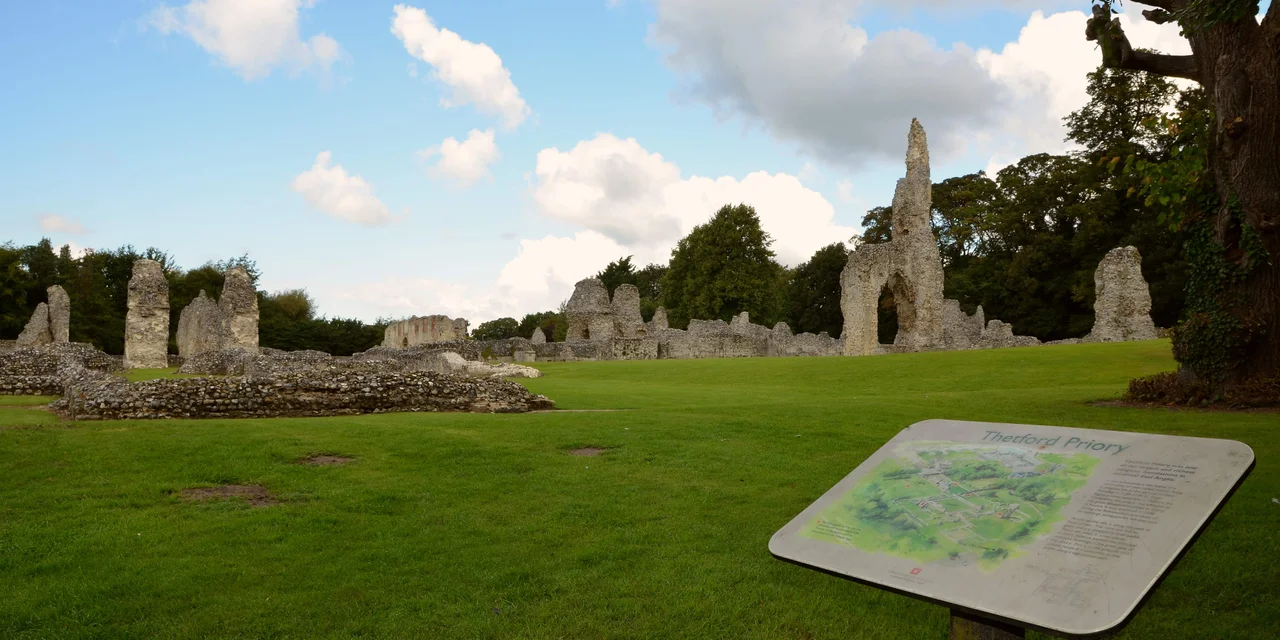

Thetford Priory
Roger Bigod, Earl of Norfolk, had made a vow of pilgrimage to the Holy Land and then, for reasons history does not record, decided he would not be going. To discharge the vow in a different way, he founded a priory. In 1103, that act of spiritual debt settlement became Thetford Priory, a Cluniac house that grew into one of the most significant monasteries in East Anglia — the burial place of dukes, the setting of royal luncheons, and eventually a ruin that people still visit today, some convinced it is haunted.
A Difficult Beginning
The first site was awkward. Bigod initially offered the abandoned cathedral church of the East Anglian bishops, on the Suffolk side of the River Little Ouse, as the priory's home. Benedictine monks arrived from the Priory of St Pancras in Lewes in 1104. The building was given over, woodwork cloisters were constructed, and the community tried to establish itself. But the site was hemmed in by the houses of the town's burghers, with no room for a guest-house and no space to grow.
Three years later, a new prior took stock and found the arrangement unworkable. Bigod responded by giving the monks a more open site on the Norfolk side of the river. On St. Martin's Day in 1114, the community relocated. On this second site — better-drained, more spacious, better-suited to the rhythms of monastic life — Thetford Priory found its permanent home. What they built there would stand, in some form, for more than four centuries.
Power, Politics, and the Bigod Dynasty
The priory became the spiritual heart of the Bigod family, who used it for their burials. Roger Bigod himself is buried there, as is Hugh Bigod, the first Earl of Norfolk, and Roger Bigod the second Earl. The church became a dynastic mausoleum, receiving the remains of some of the most powerful figures in medieval England.
The connection to royal circles ran deep. John Howard, the first Duke of Norfolk, was originally buried at Thetford Priory, as was Thomas Howard, the second Duke. Anne of York, a daughter of Edward IV, and Henry FitzRoy, the Duke of Richmond and Somerset — an illegitimate son of Henry VIII — were also interred here. When the priory was dissolved in the 1530s, some of these burials were moved. Others were not. The ground still holds what centuries chose to leave behind.
What Remains
Dissolution came during the English Reformation. The last prior was William Ixworth, appointed in 1518, who would have overseen the priory's end in the late 1530s. The buildings were stripped and the community disbanded. What survived was not much, and then time reduced it further.
Today the ruins are managed by English Heritage and open to the public. The lower walls of the church and cloister remain visible, tracing the scale of what was once here. The shell of the priors' lodging still stands, more substantial than the rest — its walls tall enough to suggest the grandeur of the building inside. Most striking is the gatehouse: a 14th-century structure that is almost completely intact, reached by a path from the main site, and still capable of evoking the moment of arrival that pilgrims and visitors would have experienced for four hundred years.
Both the priory and the gatehouse are Grade I listed buildings. The ruins carry a reputation for being haunted; a television ghost-hunting programme once devoted an episode to them. Whether or not that reputation is deserved, the place does hold its silences differently from most.
From the Air
Thetford Priory sits at 52.4164°N, 0.7426°E on the northwest edge of Thetford, just across the River Little Ouse from the town centre. The ruins and their surrounding managed grounds are visible from low altitude. Norwich Airport (EGSH) lies approximately 27 miles to the northeast. Flying at 1,500 feet in clear conditions, the rectangular outline of the priory grounds can be distinguished from the surrounding fields; the standing gatehouse is the most visible surviving structure. The town of Thetford is easily located along the Little Ouse and the A11 road.
Nearby Stories
- Ding Family Murders 1.5 km away
- Bungay Castle 2.6 km away
- Ely and Littleport Riots of 1816 4 km away
- Aldeburgh Festival 7.9 km away
- Bed Burial 12 km away
- Happisburgh Lighthouse 13 km away
- Walsingham Priory 18 km away
- Chain Bridge Forge, Spalding 34 km away