
Ely and Littleport Riots of 1816
On the evening of 22 May 1816, 56 residents of Littleport, Cambridgeshire, met at The Globe Inn to talk about the lack of work and the rising cost of grain. By the end of the night, there were hundreds of them in the streets. They had a horn, borrowed from a lighterman named Burgess, and someone was blowing it outside the inn, drawing villagers out into the darkness. The Napoleonic Wars had ended the previous year, throwing soldiers back onto a labour market that couldn't absorb them. Grain prices had spiked. The harvest had failed. People were hungry — genuinely, dangerously hungry. What began as a meeting became a riot, the riot became a march, and the march ended at the gallows at Parnell pits, where five men were hanged in front of a crowd.
The Night in Littleport
The rioters that night worked through the village with a logic born of grievance and alcohol. They smashed windows at Mingey's shop. They threw furniture into the street at Mr Clarke's property, at Josiah Dewey's place, at Robert Speechly's house. At the home of the Reverend John Vachell — the local vicar and magistrate, described as "an unpopular man" who "dealt harshly with even minor offences" — they tried to read the Riot Act at them; the crowd told him to go home. When Vachell threatened to shoot anyone who entered his house, three men rushed and disarmed him. He fled on foot with his wife and two daughters toward Ely. The rioters then stole a wagon and horses from Henry Tansley, armed it with fowling guns front and back, and named a man named John Dennis as their commander. Before dawn on 23 May, most of the mob was marching toward Ely, 4 miles to the south.
What the Rioters Wanted
At the gates of Ely, they were met by the Reverend Metcalfe, who read the Riot Act and asked what they required. The answer was simple. They wanted "the price of a stone of flour per day." They said that their children were starving and that they wanted a living wage. These were not abstract political demands. They were requests from people who could not feed their families in the year following the end of a long war, in a region where agricultural wages had not kept pace with the cost of bread. The magistrates negotiated with a committee of rioters in the White Hart public house. On the afternoon of 24 May, a detachment of the 1st Royal Dragoons, 18 men commanded by Captain Methuen, rode from Ely to Littleport. The rioters made a stand at The George and Dragon public house. Thomas Sindall attempted to take a musket from trooper William Porter and ran when he failed. Porter shot him through the back of the head. The rising was suppressed.
The Trial and Its Sentences
Eighty-two people stood before a Special Commission convened at Ely in June 1816. The special assizes lasted from Monday to Saturday. The Bishop of Ely had retained exclusive criminal jurisdiction in the area since 970 CE, and the trial took place under that authority, with two additional judges appointed by the Crown. Five men were sentenced to death and hanged. Five were transported to New South Wales for life and one for fourteen years, sailing on a convict ship that departed on 9 October 1816. Ten more received prison sentences, later commuted after community protest. One rioter, William Gotobed, a bricklayer, escaped, was eventually pardoned, returned to Littleport after seven years, and then went to America. The sermon preached at the judges' opening service set the tone for what followed: "that the law is not made for a righteous man, but for the lawless and disobedient."
Legacy of a Quiet Uprising
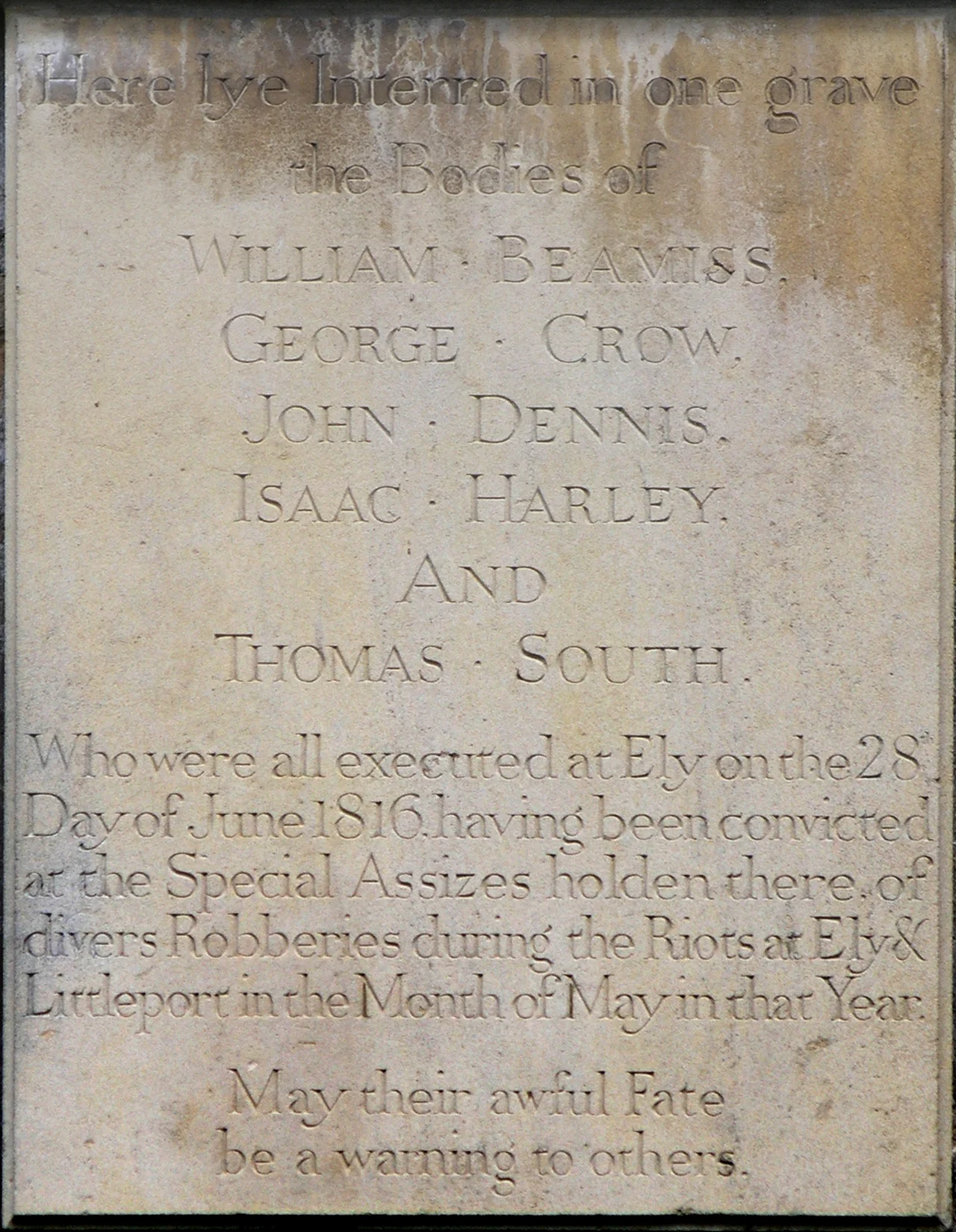
A monument in Littleport churchyard commemorates the five men who were hanged: Thomas South, John Dennis, George Crow, Isaac Harley, and William Beamiss. They were agricultural labourers and a licensed victualler, most of them in their twenties or thirties, rising against conditions they did not create and could not survive. The riots of 1816 were part of a broader wave of unrest across East Anglia and beyond — in West Suffolk, Norfolk, and Cambridgeshire that spring — driven by the same economic dislocations that the end of the Napoleonic Wars had produced. They were suppressed everywhere, as they were at Littleport. The men who led the troops were praised. The men who blew the horn outside The Globe Inn were hanged or sent to the far side of the world.
From the Air
The Ely and Littleport riots of 1816 took place across a landscape visible from altitude: the fenland between Littleport (52.452°N, 0.301°E) and Ely, approximately 4 miles to the south. The flat, drained fenland geography — with its straight drainage channels and wide skies — is immediately recognizable. Ely Cathedral's octagonal lantern tower is the dominant landmark. Nearest airport: Cambridge (EGSC), approximately 15 miles south of Ely.
Nearby Stories
- Bed Burial 2.5 km away
- Thetford Priory 6.6 km away
- Oundle School 8.1 km away
- RAF Lavenham 9 km away
- John Bunyan Museum 11 km away
- King's Lynn Minster 15 km away
- Woolsthorpe-by-Colsterworth 21 km away
- Walsingham Priory 21 km away