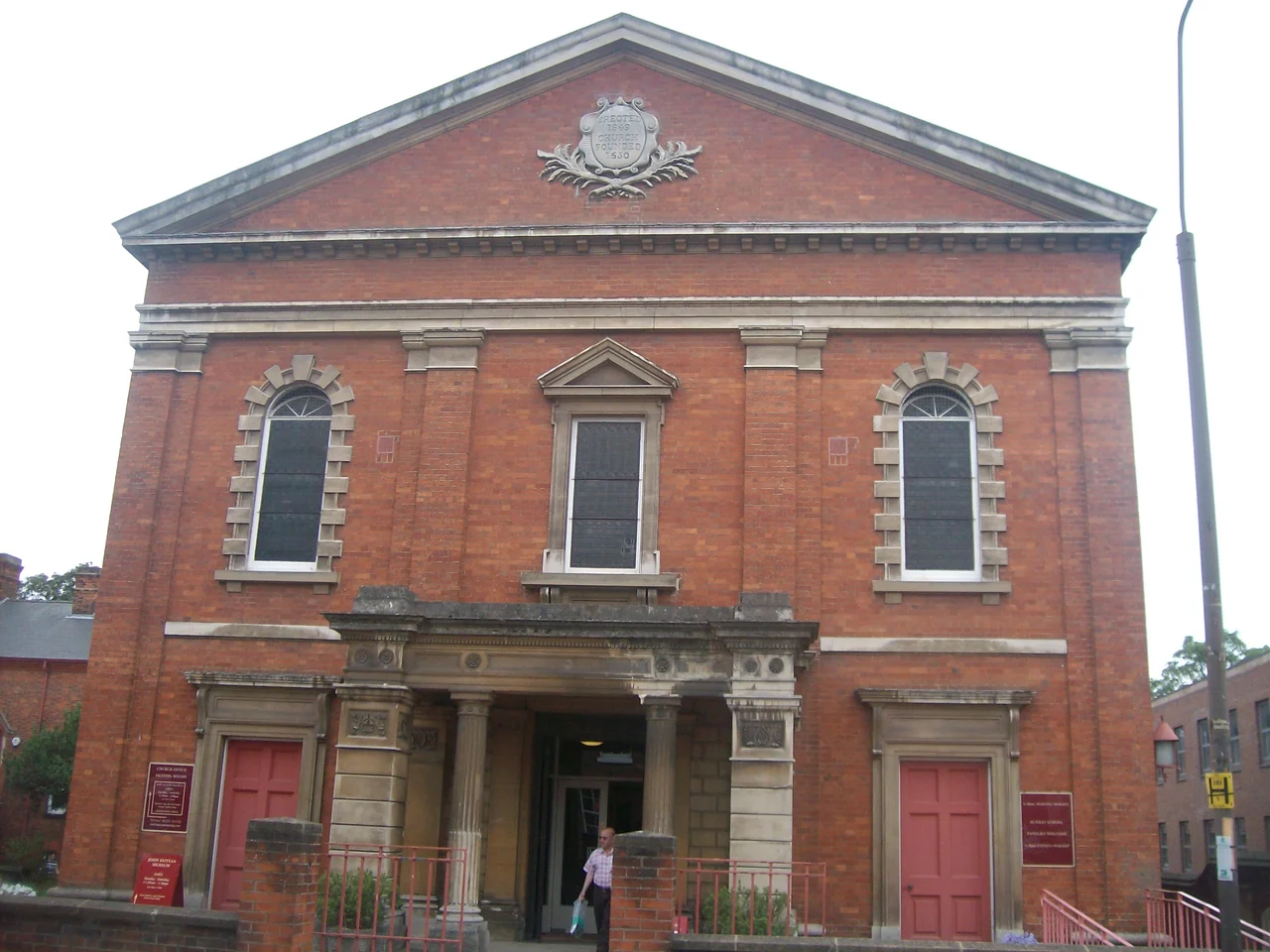

John Bunyan Museum
The iron violin is the thing that stops most visitors. It sits in a case in the John Bunyan Museum in Bedford, looking heavy and unmusical and slightly impossible - a violin-shaped object made out of metal, which on first inspection seems to defy the purpose of being a violin at all. But John Bunyan apparently played it. He made it himself, probably in prison, where wood was scarce and a man might have to improvise with whatever materials a 17th-century jail allowed. There is also a wooden flute he made and played, and a stoneware jug he used during his twelve years of imprisonment, and his last will and testament, and a third edition of The Pilgrim's Progress - the book that, more than any other piece of English prose except possibly the King James Bible, shaped how English-speaking Christians have imagined their faith for the past three and a half centuries. The museum is small. The objects are intimate. The cumulative effect is of standing close to a real person who has been pulled, against his own posthumous preferences, into being a religious monument.
A Barn, A Church, A Museum
The museum sits in the compound of the Bunyan Meeting Free Church on Mill Street in Bedford, in a building that opened in 1998 specifically to house the artefacts that had previously been crammed into a small room in the church itself. The story of the site goes back to 1672, the year of Charles II's Declaration of Indulgence, which briefly allowed nonconformist congregations to worship legally. Bunyan was released from Bedford County Jail that year - he had been arrested in November 1660 for preaching without a licence - and his congregation immediately bought a barn on this site to use as their meeting house. A purpose-built church replaced the barn over time. The current building, the second on the site, dates from 1849. It is a substantial brick church with bronze doors depicting scenes from The Pilgrim's Progress, given in 1876 by the Duke of Bedford. The doors have become a pilgrim destination in themselves. The museum building, opened in 1998, takes the artefacts out of the church proper and gives them the climate-controlled space they need. Among the displays are recreated tableaux of Bunyan's life and Bedford's social history in the 17th century.
The Stoneware Jug and the Prison Years
Bunyan's twelve years in Bedford County Jail - 1660 to 1672, with a brief release and rearrest along the way - were the formative ordeal of his life. He was held for refusing to stop preaching without the licence required under the Conventicle Act. The jail itself stood on the bridge over the River Great Ouse, less than half a mile from where his museum now is. Conditions in 17th-century English prisons were brutal: cramped, cold, infested, dependent on the prisoner's family for food and bedding. Bunyan's wife Elizabeth had to feed him by walking up from their home with whatever she could spare. His blind daughter Mary, from his first marriage, also visited - her presence was, by his own account, one of the things that made the imprisonment hardest to bear. The stoneware jug now in the museum is reckoned to be one of the vessels that came down to him from his family during those years - the most ordinary object imaginable, hand-thrown earthenware, glazed in salt, the kind of jug that would have held beer or thin soup. It survived. He used it. It is in the museum now because the people who came after him understood that the things he had touched in jail mattered more than any portrait or commemorative statue could.
The Book That Wouldn't Stop
The Pilgrim's Progress was published in 1678, six years after Bunyan's release from prison and ten years before his death. It was an immediate commercial success - selling so well that within a year there was a pirated edition, and within Bunyan's lifetime it went through eleven editions. By the end of the 19th century it had been translated into more than two hundred languages and dialects, including Inuktitut, Yoruba, Tahitian, Welsh and Manx, and was second only to the Bible in the libraries of British-speaking Protestant households across the world. The museum's third edition - one of the earliest still in private or institutional hands - is small, plain, badly printed and undecorated, looking nothing at all like the lavish illustrated editions that would later make Christian and Apollyon and Mr Worldly Wiseman household names. C. S. Lewis called it 'a book always more pungent and more refreshing than I had remembered.' George Bernard Shaw considered Bunyan a greater prose stylist than Shakespeare. The book is still in print. Bunyan died on 31 August 1688 of a fever caught while riding through rain from Reading to London, having successfully reconciled a father with his son. He is remembered in the Church of England with a Lesser Festival on 30 August. The museum opposite the Higgins Art Gallery is where his physical traces have come to rest.
From the Air
The John Bunyan Museum sits at 52.1366°N, 0.4636°W in central Bedford, in the Cultural Quarter on the north side of the River Great Ouse, opposite the Higgins Art Gallery & Museum. From the air the museum building reads as part of a tight cluster of historic and modern buildings on Mill Street, between Bedford Castle Mound and the River Embankment. Cranfield Airport (EGTC) lies 7nm south-west; Luton Airport (EGGW) about 18nm south. Best viewed at low altitudes in clear conditions; the wider Bedford riverfront, with its curve through the town centre and the spire of St Paul's, gives the area its visual character.
Nearby Stories
- Fowlmere Airfield 6 km away
- Canons Ashby House 7.9 km away
- Berkhamsted Castle 10 km away
- Boughton House 11 km away
- Pitt Rivers Museum 18 km away
- King's Ely 18 km away
- North Weald Airfield 18 km away
- Wigston 23 km away