.jpg)
Wigston
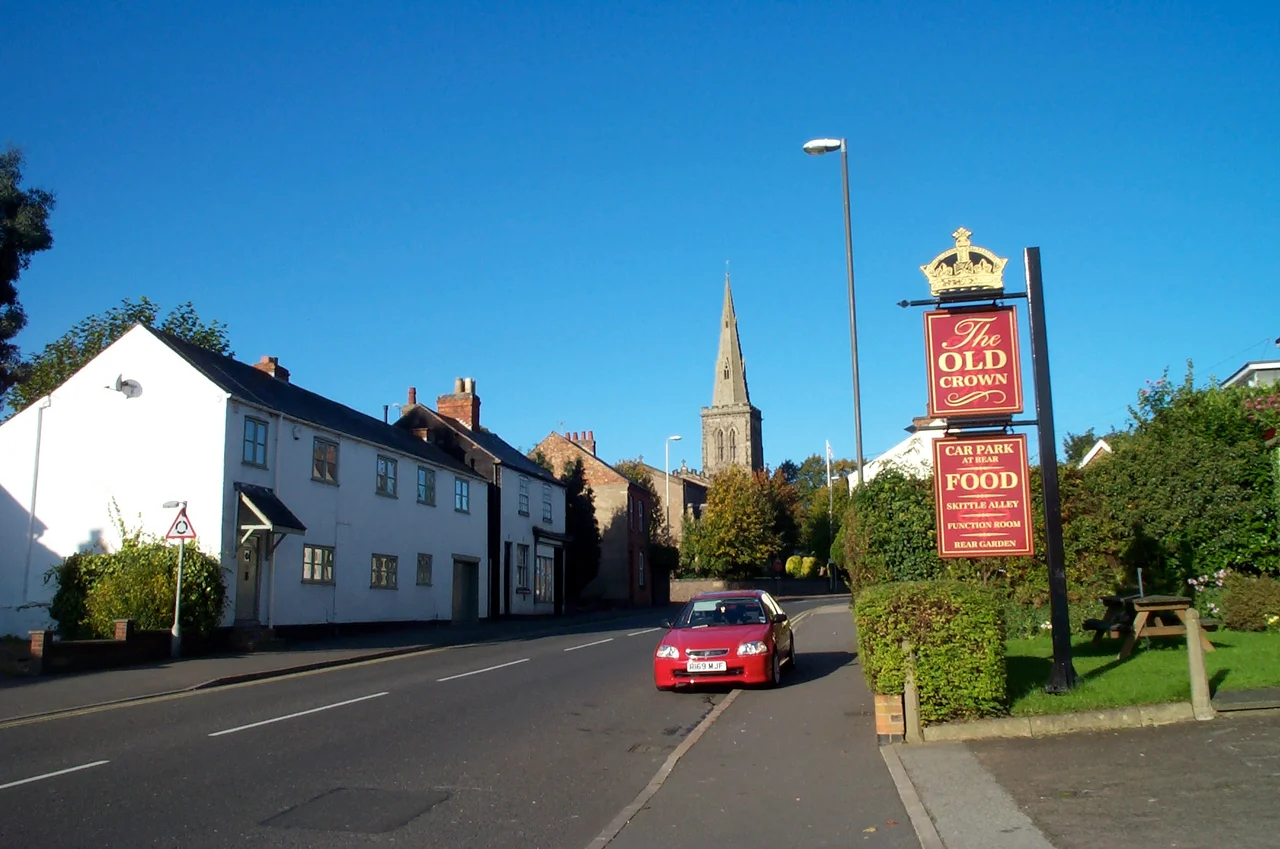
Wigstan was a Mercian prince, the grandson of two kings and the heir to a third, when he was assassinated in 849 by a relative who wanted his mother for a wife. The English saint who emerged from this murder, venerated as a martyr, made several posthumous journeys before settling in Evesham. One of the stops on that journey was a small Leicestershire village that took his name and kept it across eleven centuries. The town has since been called Wichingstone, Wigston Magna, and now mostly just Wigston. In the Middle Ages it was called Wigston Two Spires, because it had two medieval churches at a time when neighbouring villages were lucky to have one. Both still stand, four miles south of Leicester, and the older of them remembers a murdered prince whose name they share.
The Midland Peasant
In 1965 a historian named W. G. Hoskins published a book called The Midland Peasant, a meticulous study of Wigston's social history from the earliest records down to the nineteenth century. Hoskins, one of the founders of modern English local history, chose this particular town because its records were unusually complete and because nothing dramatic had ever happened here. That was the point. Wigston was an ordinary midland village, and Hoskins wanted to know what an ordinary midland village had actually been like for the people who lived in it. The book is still in print. It traces the slow shift from medieval open-field farming to nineteenth-century enclosures, the gradual emergence of a working population that no longer farmed but worked the framework knitting machines in their own cottages, and the eventual subsumption of the village into the suburbs of Leicester. It is a portrait of how an English place becomes itself.
The Highwayman, Jonathan Swift's Mother, and the Bass Player
George Davenport was a notorious local highwayman of the eighteenth century who robbed travellers on the road between Leicester and London. Abigail Herrick was born in Wigston in the 1640s and became the mother of Jonathan Swift, the author of Gulliver's Travels and one of the savagest satirists in the English language. Harry Ellis attended Bushloe High School here before becoming the England rugby team's scrum-half. Howard Riley grew up in Wigston and went on to play for Leicester City, scoring the decisive goal in the 1964 League Cup Final. Henry Davis Pochin was born here, made a fortune in manufacturing chemistry, and later bought the Bodnant estate in north Wales whose gardens are now one of the National Trust's most visited. Most strangely, Graham Chapman of Monty Python lived in Wigston police station around 1951 because his father was the police inspector there, and attended South Wigston Junior School before going on to medical training and the surreal comedy that gave the world the Spanish Inquisition sketch.
The Framework Knitters' Museum
Framework knitting was the industry that made Leicestershire what it was for two centuries. The frame itself was a complex mechanical apparatus, invented in Calverton in 1589 by William Lee, that could knit stockings far faster than any hand. By the seventeenth century the East Midlands was full of cottage workshops where knitters leased the frames from a hosier, paid weekly rent on them, and turned out stockings, gloves, and undergarments for whatever wages the hosier chose to pay. The system created independent skilled artisans and also made them desperately precarious. Wigston preserved one of these workshops, and it now operates as the Framework Knitting Museum, an institution that explains how stockings were once made by hand from yarn through finished sock, all on a machine designed in Elizabethan England. Hosiery manufacture continued in Wigston long after the hand frames disappeared, sustained by firms with names like Two Steeples, George Deacon and Sons, and the Wigston Co-Operative Hosiers, until the industry largely collapsed in the late twentieth century.
Bushloe House and a Designer's Mind
Until 2023 the offices of Oadby and Wigston Borough Council were in Bushloe House, a building started around 1850 and extended around 1880. The extension and most of the interior was designed by Christopher Dresser, one of the first industrial designers in the modern sense, who worked for Hiram Abiff Owston, the building's owner and a local solicitor. Dresser is now studied in design history courses worldwide; he designed silver, ceramics, glass, and furniture in a stripped-down geometric style that anticipated modernism by half a century. Most of his work is in museums. The Wigston house, with its Dresser interiors and furniture, was a quiet provincial example of an internationally significant designer's vocabulary, hiding behind a Victorian solicitor's front door. The council moved out in 2023. What happens to Bushloe House next is one of those choices that English towns make about which fragments of the past to keep.
A 134-Year Greengrocer Closes
Like a great many English market towns, Wigston's high street has slowly lost its independents to national chains and supermarkets. By the 2020s, supermarkets and chains accounted for around half the retail in the town centre. In January 2022, W. H. Cox greengrocers on Leicester Road, opposite Bell Street, announced it would close after 134 years of trading. Four generations of Coxes had sold fruit and vegetables in Wigston since 1888. That year, Queen Victoria was on the throne, Jack the Ripper was killing women in Whitechapel, and W. H. Cox first opened his shop. Closing it took the kind of family decision that always feels both inevitable and unbearable. The shop is now gone. The town's population of around 32,000 still buys its produce, mostly at the supermarkets, and the music hall star Gertie Gitana still rests in Wigston cemetery, a celebrity of the early twentieth century who married a local theatrical impresario named Don Ross and ended up here with him.
From the Air
Wigston Magna, Leicestershire (52.59 N, 1.11 W). The town sits four miles south of Leicester city centre, along the A5199, with Oadby a mile to the east and South Wigston a mile to the west along the B582. The Grand Union Canal runs along the southern edge, threading from Newton Harcourt through South Wigston towards Leicester. South Wigston railway station lies on the Birmingham to Peterborough Line. East Midlands Airport (EGNX) is 22 miles north-west. From low altitude, look for two church spires (All Saints' and St Wistan's) close together, the visual signature that gave the medieval town its name.
Nearby Stories
- National Shell Filling Factory, Chilwell 1 km away
- Staffordshire Regiment Museum 2 km away
- Rutland Water 3.3 km away
- Grantham 4.4 km away
- Wellingborough 9.9 km away
- Croxden Abbey 11 km away
- Bordesley Abbey 14 km away
- Electric Railway Museum 17 km away