
Staffordshire Regiment Museum
There is an oddly tender thing about a museum that puts a piece of an Iraqi armoured personnel carrier next to a 1760 grenadier's cap and expects you to follow the line between them. The Staffordshire Regiment Museum, on the A51 between Lichfield and Tamworth, has been doing exactly that since 1969, when the separate museums of the North Staffordshire Regiment and the South Staffordshire Regiment merged into one collection covering everything from 1705 to whatever the British Army's most recent deployment happens to be. Eleven thousand objects. Fourteen Victoria Crosses to remember. A trench reconstructed in the back garden. An adventure playground built around a life-size Warrior fighting vehicle and named after a sergeant who never came home from Afghanistan.
Whittington Barracks
The museum sits next to Whittington Barracks, which has been the regimental home since 1881 and is now headquarters to the Mercian Regiment, the modern formation that absorbed the Staffordshire Regiment in 2007. Whittington itself is a small Staffordshire village three miles east of Lichfield and four miles west of Tamworth, the barracks tucked discreetly behind a screen of trees on land the army has held for more than a century. The National Memorial Arboretum, the country's principal site of military remembrance, lies six miles to the east at Alrewas. The museum, in other words, is part of a geography of British military memory that quietly stretches across this corner of the Midlands.
Three Hundred Years of Service
The display moves chronologically through the regiments that became one regiment that became part of another. The 38th Regiment of Foot, raised in 1705 in Lichfield itself. The 64th, the 80th, the 98th. The amalgamations of 1881 that produced the North and South Staffords. The 1959 merger that produced the Staffordshire Regiment proper. Uniforms from India, Burma, the Crimea, Persia, South Africa, Egypt, the Sudan. Both World Wars. The Troubles in Northern Ireland. Cyprus. Kosovo. The first Gulf War as Operation Granby and the second as Telic. Afghanistan as Herrick. The oldest object in the museum is a Grenadier Company Officer's cap from around 1760, soft black wool and tarnished metal. The medals display contains those of eight of the fourteen regimental soldiers who won the Victoria Cross, Britain's highest award for valour in the face of the enemy.
The Trench in the Garden
Behind the building the museum has built things you cannot quite get inside an indoor case. There is a replica First World War trench, mud and duckboards and the smell of damp timber, where visitors can walk through what a thousand Staffordshire men spent four years in. There is the Smart Street Shelter, a reconstructed Second World War air-raid shelter, the kind that families crammed into when the sirens went. There are outdoor exhibits of armoured fighting vehicles, an FV432, an FV103 Spartan, a captured Iraqi MTLB, a Universal Carrier with a Bren gun, a Ferret armoured car the size of a small van. The remembrance garden holds the original Staffordshire Regiment memorial that used to stand at the National Memorial Arboretum until 2015, relocated here when veterans built a new one to replace it. The Duke of Gloucester opened the garden in April 2016.
Camp Fisher
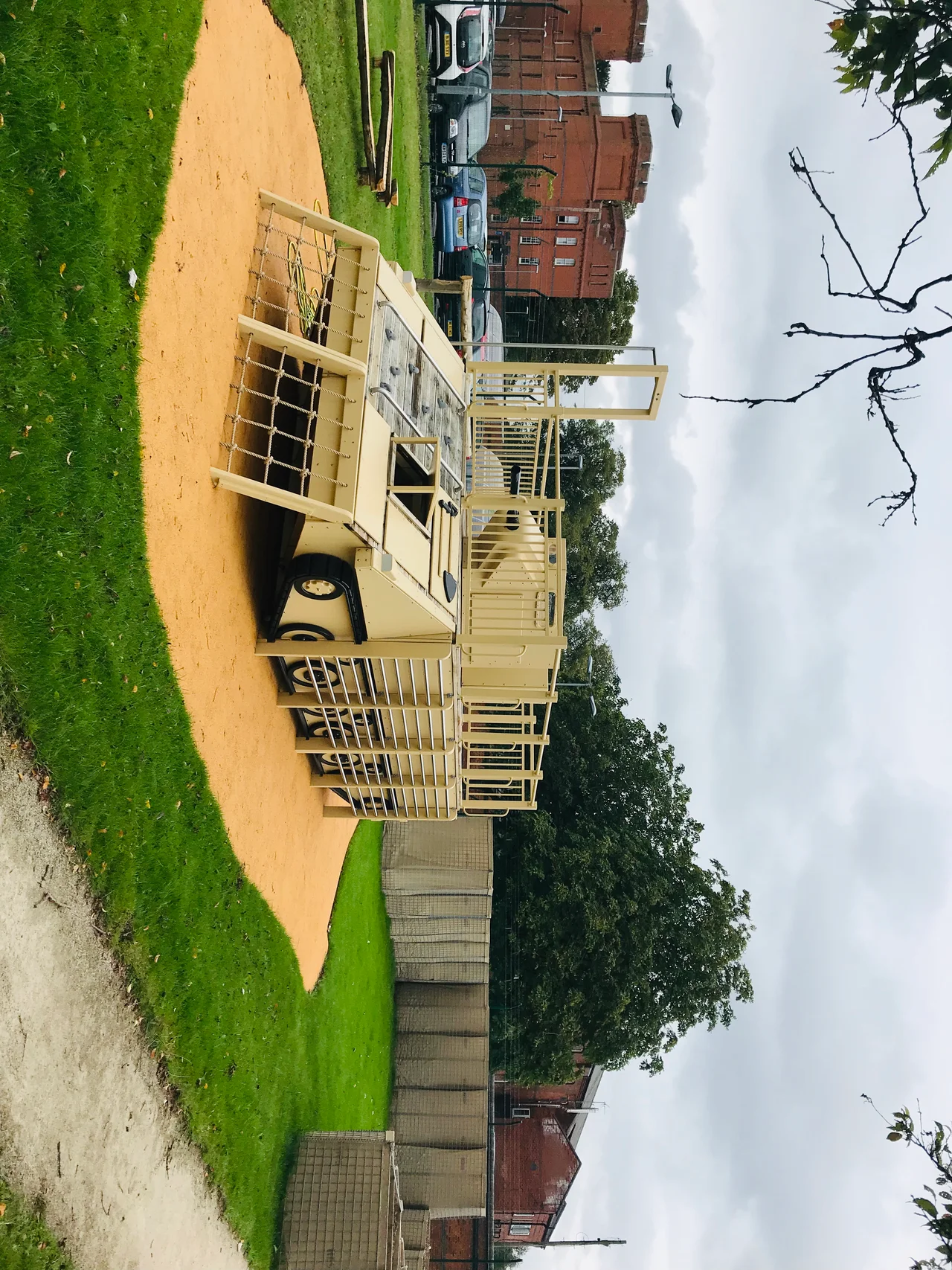
In 2019 the museum opened something that looks at first like a children's play area and is, on closer inspection, considerably more. Camp Fisher is a military-style adventure playground built around a life-size mock-up of a Warrior tracked armoured vehicle, the climbing frames arranged as a forward operating base of the kind the British Army used in Helmand Province. It is named for Warrant Officer Class 2 Ian Fisher of the 3rd Battalion the Mercian Regiment, killed in Afghanistan in 2013. Children climb on it. Their parents read the dedication. The museum runs trench-night events in December, carol services in the reconstructed trench, school visits keyed to the National Curriculum. The volunteers who run most of it are, in many cases, the children and grandchildren of the men whose uniforms hang upstairs.
From the Air
The Staffordshire Regiment Museum lies at 52.6596°N, 1.7778°W in Whittington, Staffordshire, on the A51 about 3 miles east of Lichfield and 4 miles west of Tamworth. Whittington Barracks sits immediately adjacent. From cruising altitude the three spires of Lichfield Cathedral are visible to the west and the long thin lake at the National Memorial Arboretum, Alrewas, can be seen 6 miles to the east. Birmingham Airport (EGBB) is 11 nm south-southwest and East Midlands (EGNX) 17 nm to the east-northeast. The barracks complex shows as a regular pattern of buildings and parade grounds surrounded by farmland. Recommended viewing altitude 3,000-5,000 ft AGL in clear visibility.
Nearby Stories
- Coalbrookdale 2.3 km away
- Market Bosworth 2.5 km away
- Croxden Abbey 5.3 km away
- Bordesley Abbey 7.4 km away
- Nottingham Canal 9.9 km away
- Combermere Abbey 14 km away
- Ludlow 18 km away
- Althorp 30 km away